
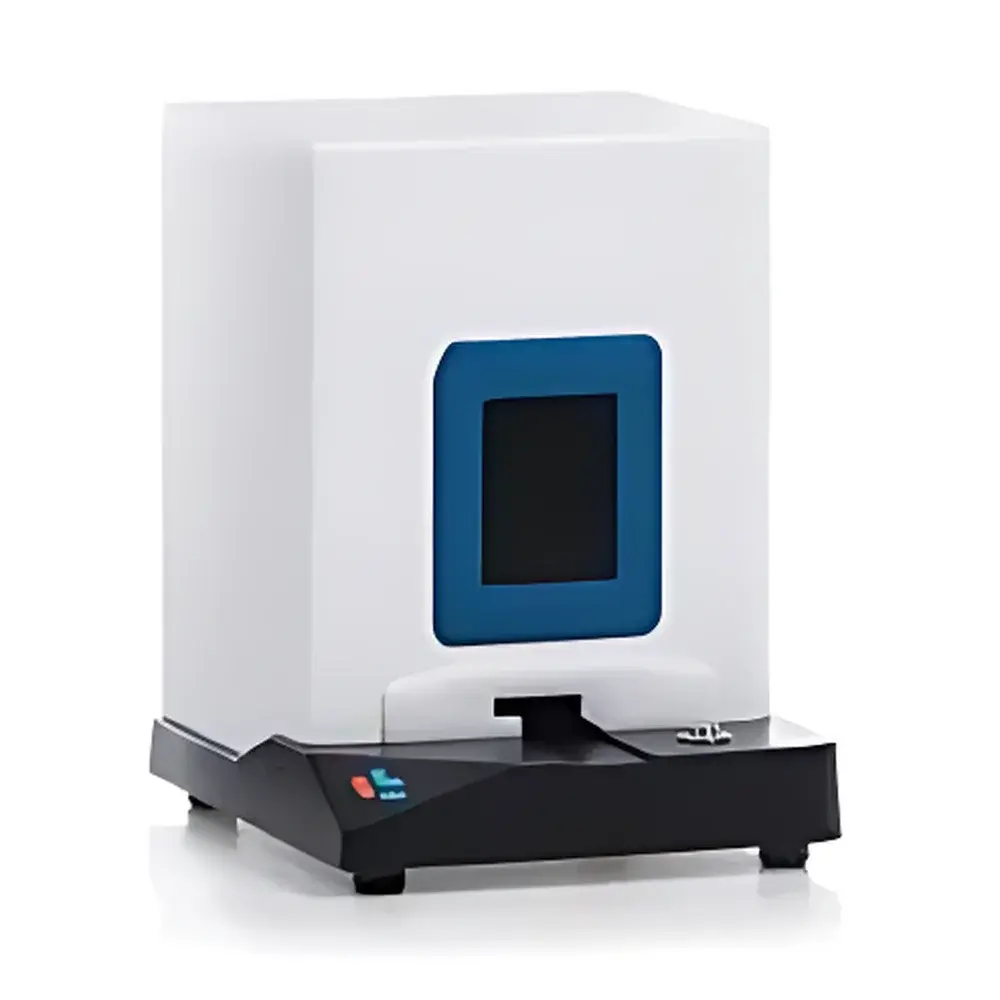
Precision NanoSystems NanoAssemblr Spark Nanoparticle Synthesis System
| Origin | Canada |
|---|---|
| Manufacturer Type | Authorized Distributor |
| Origin Category | Imported |
| Model | NanoAssemblr Spark |
| Pricing | Available Upon Request |
Overview
The Precision NanoSystems NanoAssemblr Spark Nanoparticle Synthesis System is an engineered microfluidic platform designed for rapid, reproducible, and scalable formulation of nanomedicines at the microliter scale. It operates on the principle of laminar-flow hydrodynamic focusing—a non-turbulent mixing mechanism that enables precise control over nanoparticle self-assembly kinetics. Unlike conventional bulk mixing methods (e.g., thin-film hydration, solvent injection, or sonication), which suffer from spatial and temporal heterogeneity, the Spark system achieves uniform mixing within defined fluidic geometries, ensuring consistent nucleation, growth, and stabilization conditions across all particles in a single batch. This deterministic assembly process directly translates into high batch-to-batch reproducibility, narrow polydispersity index (PDI < 0.15 typical), and exceptional encapsulation efficiency—particularly critical when working with scarce, high-value payloads such as modified siRNA, mRNA, CRISPR ribonucleoproteins, or proprietary small-molecule conjugates.
Key Features
- Single-step, push-button operation: Pre-loaded reagents are introduced into standardized microfluidic chips; insertion into the Spark instrument initiates fully automated mixing, dilution, and quenching—no manual syringe pumping or flow rate calibration required.
- Ultra-low volume processing: Generates 25–250 µL of nanoparticle suspension per run, minimizing consumption of expensive active pharmaceutical ingredients (APIs) and excipients during early-stage formulation screening.
- High-yield synthesis: Achieves >95% recovery of formed nanoparticles post-dilution, enabling direct downstream analysis without centrifugation or filtration losses.
- Scalable microfluidic architecture: Supports linear scale-up via increased total flow rate or parallel chip operation—maintaining identical physicochemical properties from discovery through preclinical development.
- Modular chip design: Interchangeable microfluidic cartridges accommodate varying formulation chemistries (e.g., lipid ratios, polymer MW, buffer pH) without hardware modification.
Sample Compatibility & Compliance
The NanoAssemblr Spark is validated for synthesis of diverse nanocarrier classes, including but not limited to: lipid nanoparticles (LNPs), liposomes, polymeric nanoparticles (e.g., PLGA, PEG-PLGA), dendrimers, polymer–drug conjugates, nanoemulsions, and hybrid organic–inorganic colloids. Its closed-system architecture complies with GLP-aligned laboratory practices and supports audit-ready documentation when integrated with compliant LIMS or ELN platforms. While the Spark itself does not carry FDA 510(k) or CE-IVD certification, its output formulations are routinely used in studies supporting IND-enabling toxicology, biodistribution, and PK/PD assessments conducted under ICH-GCP and ISO 14644-1 Class 7 cleanroom-compatible workflows.
Software & Data Management
The Spark Control Software provides real-time monitoring of pressure profiles, temperature stability, and chip insertion status. All synthesis parameters—including reagent volumes, flow ratios, mixing time, and dilution factor—are logged with timestamped metadata and exportable in CSV/JSON format. The software architecture supports integration with electronic lab notebooks (ELNs) and quality management systems (QMS) compliant with 21 CFR Part 11 requirements, including user authentication, electronic signatures, and immutable audit trails for method development records.
Applications
- Rapid screening of LNP formulations for mRNA/siRNA delivery optimization
- Development of targeted polymeric nanoparticles for intracellular small-molecule delivery
- Iterative design-of-experiments (DoE) for lipid molar ratio, PEG-lipid density, and ionizable amine pKa tuning
- Preparation of sterile-filterable nanosuspensions for in vitro transfection and primary cell culture studies
- Generation of reference standards for DLS, NTA, TEM, and HPLC-SEC characterization
- Process transfer support between academic labs and contract development and manufacturing organizations (CDMOs)
FAQ
What is the minimum recommended sample volume for reliable nanoparticle formation?
25 µL is the validated lower limit for robust self-assembly across most lipid and polymer systems; below this, interfacial effects may dominate and compromise size homogeneity.
Can the Spark system be used under sterile conditions?
Yes—pre-sterilized, single-use microfluidic chips (gamma-irradiated, ISO 11137 certified) enable aseptic nanoparticle synthesis when operated in laminar flow hoods or isolators.
Is method transfer to larger-scale NanoAssemblr instruments (e.g., Ignite or Benchtop) supported?
Yes—Spark-developed formulations demonstrate direct scalability to milliliter-scale production using identical mixing principles and chip-based geometry scaling rules.
Does the system support real-time particle sizing during synthesis?
No—the Spark is a synthesis-only platform; in-line DLS or FFF integration is not available. Post-synthesis characterization requires offline instrumentation.
Are custom chip geometries available for specialized applications?
Standard chips are fixed-design; however, Precision NanoSystems offers collaborative engineering pathways for application-specific microfluidic development under NDA.
Related Products




