
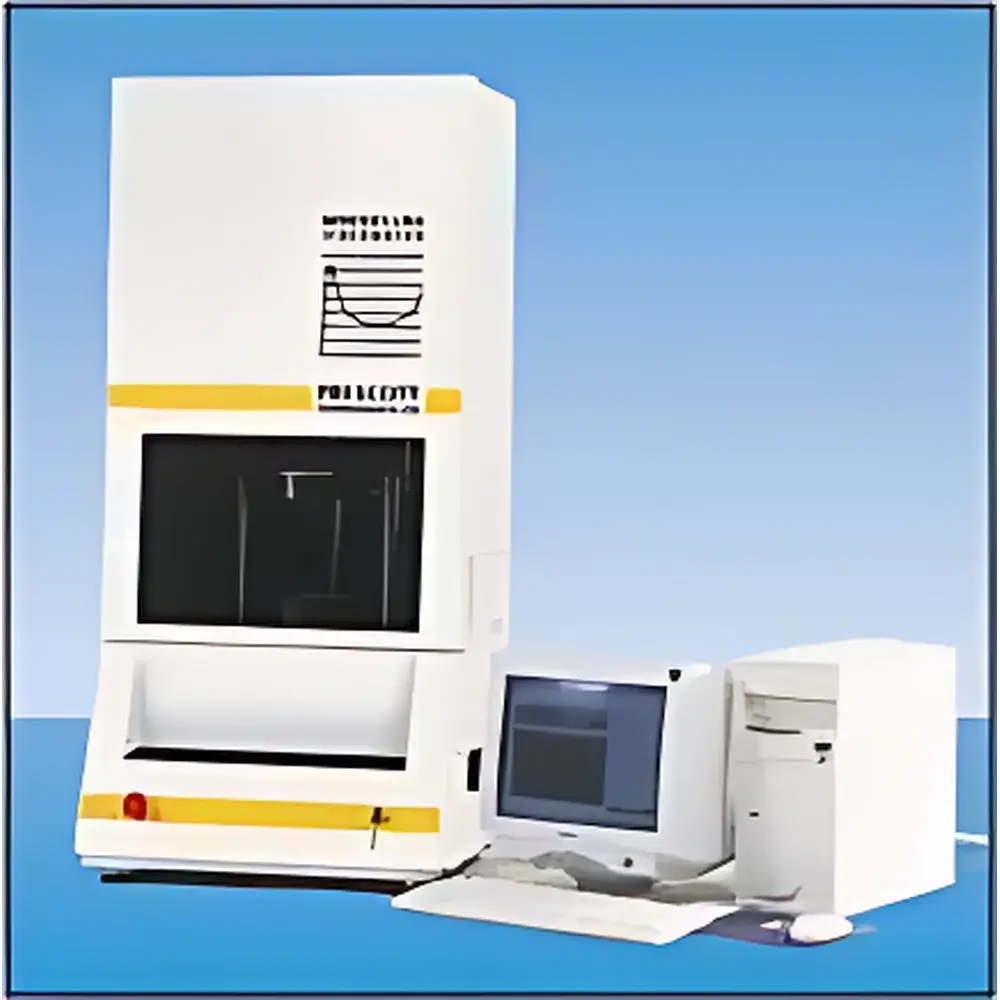
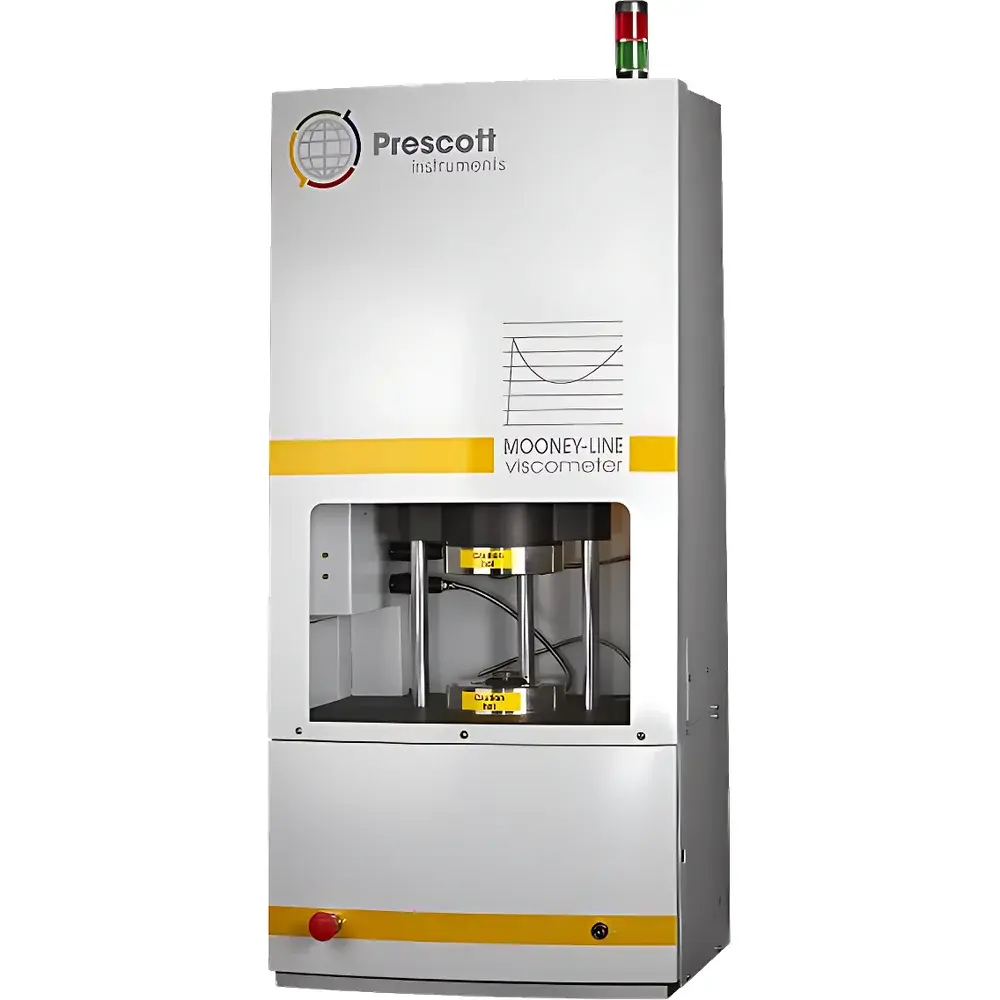
Prescott Mooney-Line Mooney Viscometer
| Brand | Prescott |
|---|---|
| Origin | United Kingdom |
| Manufacturer Type | Authorized Distributor |
| Origin Category | Imported |
| Model | Mooney-Line |
| Pricing | Upon Request |
| Standard Compliance | ISO 289 |
| Power Supply | Single-phase AC 220 V, 50 Hz |
| Compressed Air Requirement | 4.2 kg/cm² (60 psi) |
| Rotor Speed | 2 rpm |
| Temperature Control | Digital PID |
| Temperature Range | Ambient to 200 °C |
| Measuring Units | Mooney units (MU) for viscosity |
| Test Modes | Mooney viscosity [ML(1+X)], scorch time (ts1, ts2), compound scorch & viscosity profiling, stress relaxation, die release test |
| Preheat Option | Enabled / Disabled per test protocol |
| Data Storage | Microsoft Access or SQL Server database (exportable) |
| Host PC Requirements | Pentium-class CPU, Ethernet interface, Windows 2000 or XP |
| Optional Accessories | Small rotor, large rotor, volumetric sample cutter |
Overview
The Prescott Mooney-Line Mooney Viscometer is a precision-engineered instrument designed specifically for the rheological characterization of uncured rubber compounds and thermoplastic elastomers in quality control and R&D laboratories. It operates on the fundamental principle of rotational viscometry under standardized shear conditions, as defined by ISO 289:2018 — the internationally recognized specification for Mooney viscosity and scorch testing. Within a thermostatically controlled, sealed cavity, a calibrated rotor rotates at a fixed speed of 2 rpm against a pre-conditioned rubber specimen. The resulting torque resistance—expressed in Mooney units (MU)—is measured continuously and used to determine key processability parameters including minimum viscosity (ML), viscosity rise rate, scorch onset (ts1, ts2), and stress relaxation behavior. Its robust mechanical architecture, coupled with digital PID temperature regulation across a range from ambient to 200 °C, ensures high reproducibility and minimal thermal drift during extended test cycles.
Key Features
- Automated calibration routine triggered on demand—eliminates manual zeroing and enhances long-term measurement stability.
- Multi-mode test capability: ML(1+X) viscosity, scorch time determination (ts1/ts2), compound scorch profiling, stress relaxation analysis, and die release evaluation—all configurable within a single software environment.
- Modular rotor system supporting standard, small, and large rotor configurations to accommodate varying sample volumes and compound stiffness ranges.
- Digital PID temperature controller with ±0.3 °C accuracy over the full operating range (ambient to 200 °C), ensuring strict adherence to ISO 289 thermal ramp and dwell requirements.
- Integrated compressed air delivery interface (4.2 kg/cm² / 60 psi) for consistent cavity closure force and seal integrity during dynamic testing.
- Host computer compatibility with industry-standard Windows platforms (Windows 2000/XP), Ethernet connectivity, and Pentium-class processing for real-time data acquisition and visualization.
Sample Compatibility & Compliance
The Mooney-Line accommodates raw or compounded elastomeric materials—including natural rubber (NR), styrene-butadiene rubber (SBR), ethylene propylene diene monomer (EPDM), nitrile rubber (NBR), and thermoplastic vulcanizates (TPVs)—in slab or pre-cut disc form. Specimen geometry conforms to ISO 289 dimensional tolerances (typically Ø 45 mm × 2 mm thick). All test protocols are fully traceable and support audit-ready documentation required under GLP and GMP frameworks. The instrument meets essential electrical safety and electromagnetic compatibility (EMC) directives applicable to laboratory instrumentation in the EU and UK markets. While not inherently 21 CFR Part 11 compliant out-of-the-box, its SQL/Access database architecture enables integration with validated electronic lab notebook (ELN) systems supporting electronic signatures and audit trails.
Software & Data Management
The proprietary Mooney Analysis Software provides a unified interface for method setup, real-time curve monitoring, post-test parameter extraction, and comparative reporting. Raw torque vs. time and temperature vs. time datasets are stored in relational databases (Microsoft Access or SQL Server), allowing structured querying, batch export to CSV or Excel, and integration with LIMS environments. Each test record includes metadata such as operator ID, sample ID, test date/time, cavity temperature profile, rotor type, and calibration timestamp. Exported reports conform to internal QC templates and may be configured to include ISO 289-defined pass/fail criteria for ML and scorch thresholds. Database backups and user-access permissions can be administered via standard Windows domain policies.
Applications
This instrument serves critical functions across rubber formulation development, incoming raw material verification, batch release testing, and production process optimization. Typical use cases include: evaluating polymer molecular weight distribution via ML correlation; detecting early-stage scorch sensitivity in sulfur-cured compounds; assessing filler dispersion efficiency through stress relaxation decay profiles; qualifying reclaim rubber blends prior to extrusion; and generating comparative viscosity curves for halogen-free flame-retardant TPE formulations. Its ability to execute ML(1+4), ML(1+8), and custom time-based viscosity integrals makes it suitable for both routine QC labs and advanced polymer physics studies requiring kinetic modeling of vulcanization onset.
FAQ
Does the Mooney-Line comply with ASTM D1646?
Yes—the instrument satisfies all mechanical, thermal, and procedural requirements specified in ASTM D1646-22, which aligns closely with ISO 289 for Mooney viscosity and scorch testing.
Can test data be exported to third-party statistical analysis tools?
Yes—raw time-series data and summary parameters are exportable in CSV, TXT, and XLS formats, enabling direct import into JMP, Minitab, or Python-based analytics pipelines.
Is remote diagnostics or firmware update capability supported?
Firmware updates are performed locally via USB or network transfer using authenticated installer packages; remote desktop-assisted diagnostics are available through authorized Prescott service partners.
What maintenance intervals are recommended for the rotor and cavity assembly?
Daily visual inspection and cleaning with non-abrasive solvents are required; biannual calibration verification and annual precision wear inspection of rotor shaft bearings and cavity sealing surfaces are advised per Prescott’s Maintenance Protocol MP-MV-03.
Is the system compatible with modern Windows OS versions beyond Windows XP?
While originally certified for Windows 2000/XP, the software has been successfully deployed on Windows 7, 10, and 11 via compatibility mode and virtualized environments—contact Prescott Technical Support for validated configuration guidelines.







