
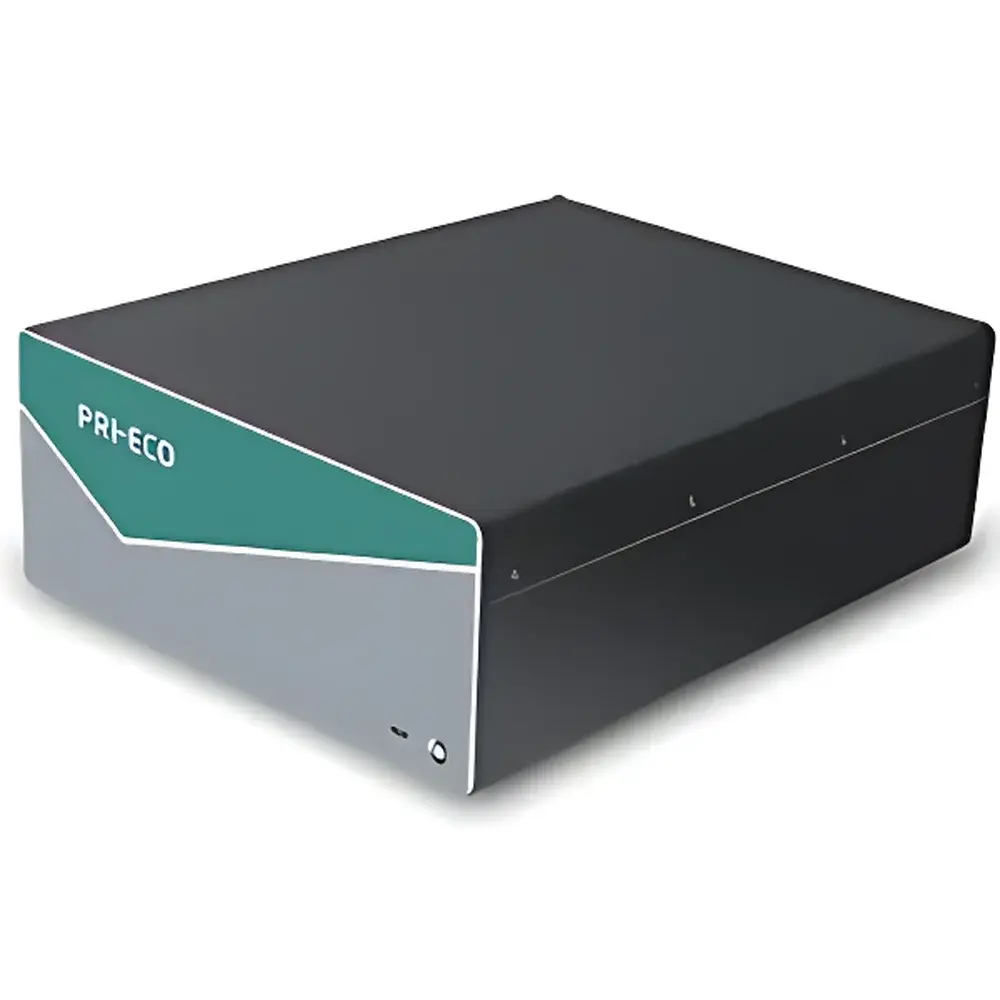
PRI-8300 Plus Soil Profile CO₂, CH₄, and N₂O Continuous Gradient Monitoring System
| Brand | Pri-eco |
|---|---|
| Model | PRI-8300 Plus |
| Origin | Beijing, China |
| Manufacturer | Pri-eco |
| Power Consumption | 100 W |
| Input Voltage | 110–220 VAC, 50–60 Hz |
| Dimensions (H×W×D) | 43.2 × 17.8 × 44.5 cm |
| Weight | 18 kg |
| Gas Analytes | CO₂, CH₄, N₂O, H₂O |
| Measurement Principle | Tunable Diode Laser Absorption Spectroscopy (TDLAS) coupled with hydrophobic gas-permeable membrane diffusion |
| Sampling Method | Multi-depth closed-loop diffusion profiling |
| Standard Depth Channels | 6 (configurable) |
| Membrane Material | Polypropylene |
| Membrane Wall Thickness | 1.55 mm |
| Inner Diameter | 5.5 mm |
| Burst Pressure | ≥116 psi |
| Intraluminal Burst Pressure | ≥36 psi |
| Permeation Rate | 1.4 mL/(min·cm²·bar) @ 23°C (isopropanol) |
| Saturation Pressure | 15.5 psi @ 23°C (isopropanol) |
| Sampling Temperature Range | −10 to +45 °C (extendable to −30 °C) |
| Sample Flow Rate | 0.050 L/min at 760 Torr |
| Operating Pressure Range | 700–1000 Torr (40–133 kPa) |
| CO₂ Range | 0–10% vol |
| CH₄ Range | 0–1% vol |
| N₂O Range | 0–500 ppmv |
| H₂O Range | 0–7% vol |
| CO₂ Precision (1 s) | ±0.2 ppmv |
| CH₄ Precision (1 s) | ±1 ppbv |
| N₂O Precision (1 s) | ±0.2 ppbv |
| H₂O Precision (1 s) | ±50 ppmv |
| CO₂ Precision (5 min) | ±0.04 ppmv |
| CH₄ Precision (5 min) | ±0.2 ppbv |
| N₂O Precision (5 min) | ±0.03 ppbv |
| H₂O Precision (5 min) | ±10 ppmv |
| Calibration Options | 3-channel automated calibration module (optional, customizable) |
Overview
The PRI-8300 Plus Soil Profile CO₂, CH₄, and N₂O Continuous Gradient Monitoring System is an engineered solution for high-resolution, in situ quantification of greenhouse gas (GHG) concentration gradients across soil depth profiles. Designed specifically for long-term, unattended operation in field and controlled-environment settings, the system integrates tunable diode laser absorption spectroscopy (TDLAS) with a robust hydrophobic polypropylene membrane-based diffusion architecture. Unlike conventional point-sampling or chamber-based approaches, the PRI-8300 Plus enables continuous, multi-depth (up to six standard channels, expandable) profiling without mechanical disturbance to soil structure or biogeochemical equilibria. Its closed-loop, pressure-stabilized sampling manifold ensures consistent mass transfer kinetics across variable soil textures and moisture regimes—critical for reproducible flux inversion modeling. The system addresses a persistent methodological gap in soil biogeochemistry: the need for spatially resolved, real-time data on subsurface gas dynamics that reflect both microbial production zones and diffusive transport limitations.
Key Features
- Multi-depth gradient profiling: Six standard depth-specific sampling ports (customizable up to 12), each equipped with independently calibrated TDLAS detection modules for simultaneous CO₂, CH₄, N₂O, and H₂O quantification.
- Hydrophobic membrane interface: Proprietary polypropylene membranes (1.55 mm wall thickness, 5.5 mm ID) provide selective gas permeation while excluding liquid water and particulates—eliminating the need for inline filters or condensate traps.
- Dynamic range optimization: Dual-range detection logic enables high sensitivity at trace levels (e.g., sub-ppbv N₂O) and linearity up to 10% CO₂—suitable for both aerobic surface horizons and anaerobic, methanogenic deeper layers.
- Minimal soil perturbation: Diffusion-driven sampling operates at near-ambient pressure differentials; no active pumping or vacuum induction preserves natural gas-phase continuity and avoids artificial advective artifacts.
- Environmental resilience: Rated for operation from −10 to +45 °C (with optional extended low-temperature package down to −30 °C); sealed electronics and conformal-coated circuitry ensure reliability in high-humidity, variable-pressure field deployments.
- Modular calibration architecture: Optional 3-channel automated calibration system supports zero-span-gas delivery with traceable NIST-traceable standards, compliant with ISO/IEC 17025 verification workflows.
Sample Compatibility & Compliance
The PRI-8300 Plus is validated for use across mineral soils, organic peats, permafrost-affected cryosols, rhizosphere zones, and managed agroecosystems—including fertilized croplands and biochar-amended plots. Its membrane-based interface tolerates moderate root penetration and soil particle abrasion without performance degradation. All gas measurement protocols align with ASTM D6348–21 (standard test method for determination of gaseous compounds by gas chromatography) and ISO 14067:2018 (carbon footprint quantification). Data acquisition firmware supports audit-trail logging meeting FDA 21 CFR Part 11 requirements when configured with user authentication and electronic signature modules. System metadata (temperature, pressure, flow, calibration timestamps) are embedded in raw data streams to support GLP-compliant reporting and third-party model integration (e.g., DNDC, CENTURY).
Software & Data Management
The PRI-8300 Plus ships with PriView™ v4.2—a cross-platform (Windows/macOS/Linux) desktop application supporting real-time visualization, spectral diagnostics, and automated baseline correction. Raw absorbance spectra are archived in HDF5 format with embedded CF-1.8 metadata conventions for interoperability with Python (xarray, netCDF4), R (ncdf4), and MATLAB environments. Remote monitoring is enabled via secure TLS 1.3 MQTT or RESTful API endpoints, allowing integration into centralized environmental observatory networks (e.g., NEON, ICOS). All configuration changes, calibration events, and alarm triggers generate timestamped, immutable logs with SHA-256 checksums—facilitating full traceability during regulatory audits or peer-reviewed data submission.
Applications
- Soil carbon cycling studies: Resolving vertical CO₂ production maxima relative to root density, microbial hotspots, and redox boundaries.
- Methanogenesis mapping: Identifying anaerobic microsites in rice paddies, wetlands, and thawing permafrost using CH₄/N₂O ratio stratification.
- Nitrogen transformation dynamics: Quantifying nitrification-denitrification coupling through co-located N₂O and O₂ gradient analysis.
- Fertilizer efficacy trials: Assessing spatial-temporal response of GHG emissions to urea, nitrification inhibitors, or slow-release formulations.
- Root-soil-microbe interactions: Capturing diel-scale CH₄ pulses linked to photosynthetic carbon allocation in mycorrhizal systems.
- Climate feedback modeling: Providing boundary-condition inputs for process-based models simulating soil-atmosphere exchange under warming or drought scenarios.
FAQ
How does the semi-permeable membrane prevent water vapor interference while maintaining gas diffusion fidelity?
The polypropylene membrane exhibits high selectivity for non-polar gases (CO₂, CH₄, N₂O) over polar H₂O due to its low surface energy and controlled crystallinity. At soil-relevant temperatures (−10 to +45 °C), water activity remains below saturation pressure—ensuring vapor-phase transport dominates and condensation is thermodynamically inhibited.
Can the system operate autonomously for extended field deployments?
Yes. With external 12 V DC power or solar-charged battery backup, the PRI-8300 Plus supports >6 months of unattended operation. Internal non-volatile memory retains 30 days of high-frequency (1 Hz) data, and scheduled FTP/SFTP upload minimizes on-site maintenance.
Is the depth resolution adjustable, and what is the minimum inter-port spacing?
Standard configurations allow ≥10 cm vertical spacing between ports. Custom manifolds support 5 cm minimum spacing; all ports maintain independent thermal stabilization and pressure regulation to ensure comparability across depths.
Does the system comply with international calibration traceability standards?
All factory calibrations are performed using NIST-traceable gas standards (Scott-Marrin, Air Liquide). Optional on-site verification kits include certified reference materials (CRMs) with uncertainty budgets documented per ISO Guide 35 and EURACHEM/CITAC guidelines.
How is data integrity maintained during network outages or power interruptions?
Local storage uses industrial-grade eMMC with wear-leveling and journaling. Power-fail-safe write buffering ensures no sample loss during brownouts. Upon recovery, the system auto-resynchronizes timestamps using GPS-disciplined oscillators (optional add-on).







