
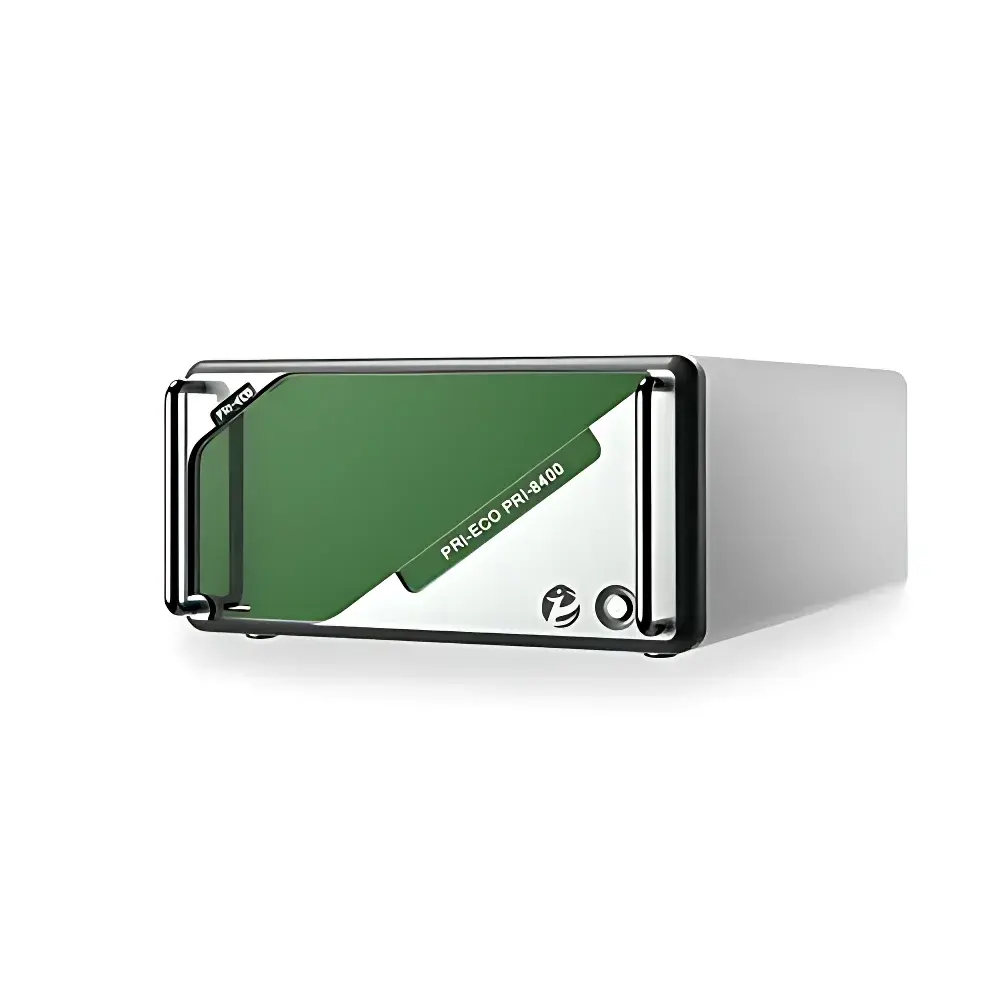
PRI-8400 Subsurface Closed-Loop Online Dilution Profile Continuous Monitoring System
| Brand | Pri-eco |
|---|---|
| Origin | Beijing, China |
| Manufacturer | Pri-eco |
| Country of Origin | Domestic (China) |
| Model | PRI-8400 |
| Price | Upon Request |
Overview
The PRI-8400 Subsurface Closed-Loop Online Dilution Profile Continuous Monitoring System is an engineered solution for in situ, real-time profiling of soil gas composition—including CO₂, CH₄, N₂O, NH₃, and stable isotopic ratios (e.g., δ¹³C-CO₂, δ¹⁵N-N₂O)—within the unsaturated and saturated zones of terrestrial ecosystems. Unlike conventional point-sampling or grab-based approaches, the PRI-8400 implements a fully closed-loop, membrane-mediated gas extraction architecture grounded in Fickian diffusion principles and dynamic dilution kinetics. It integrates semi-permeable polytetrafluoroethylene (PTFE) membranes with programmable mass-flow-controlled dilution to maintain thermodynamic equilibrium at the soil–membrane interface while preventing condensation, adsorption artifacts, or pressure-induced soil disturbance. Designed in collaboration with the Institute of Geographic Sciences and Natural Resources Research (IGSNRR), Chinese Academy of Sciences, the system enables high-temporal-resolution (1–10 s intervals), low-intrusion (<0.2 L/min total flow), and quantitatively traceable measurements across heterogeneous soil profiles—addressing longstanding limitations in subsurface biogeochemical flux quantification.
Key Features
- Subsurface closed-loop architecture with integrated PTFE semi-permeable membranes for passive, pressure-neutral gas equilibration
- Onboard dynamic dilution module enabling linear response across 0–100% v/v concentration ranges for multiple target analytes
- Modular multi-channel configuration: standard 6 subsurface sampling ports (depth-customizable); optional 3-point calibration manifold
- Wide operational envelope: -20 to +45 °C ambient; extended range available (-30 to +45 °C); compatible with frozen, waterlogged, and compacted soils
- Minimal soil perturbation: diffusion-based sampling eliminates suction-induced advective transport artifacts and maintains natural pore-gas dynamics
- Robust mechanical design: 15 kg chassis (43.2 × 17.8 × 44.5 cm); 100 W power consumption; AC 110–220 V, 50–60 Hz
- Gas handling specifications: operating pressure 40–133 kPa (400–1000 Torr); sample flow rate 0.001–0.2 L/min (unfiltered, 760 Torr reference)
Sample Compatibility & Compliance
The PRI-8400 is compatible with a broad spectrum of downstream analyzers—including cavity ring-down spectrometers (CRDS), tunable diode laser absorption spectrometers (TDLAS), quadrupole mass spectrometers (QMS), and gas chromatographs (GC)—enabling flexible deployment across isotopic and molecular detection modalities. Its gas pathway materials (electropolished stainless steel, PTFE, and perfluoroelastomer seals) meet ASTM D6196-20 and ISO 16000-22 requirements for low-outgassing, inert sampling systems. The system supports GLP-compliant operation through configurable metadata tagging (depth, timestamp, temperature, pressure), audit-trail-enabled configuration logs, and hardware-level synchronization with external data acquisition platforms. While not certified under FDA 21 CFR Part 11 by default, its software interface supports third-party validation packages for regulated environmental monitoring applications.
Software & Data Management
The PRI-8400 operates via a Linux-based embedded controller with a web-accessible GUI supporting remote configuration, real-time channel monitoring, and automated calibration sequencing. Raw sensor outputs (analog/digital) and derived concentration time series are exported in CF-compliant NetCDF format, ensuring interoperability with MATLAB, Python (xarray, netCDF4), and R-based ecological modeling workflows. Time-stamped data streams include synchronized thermocouple readings (soil temperature at each port), manifold pressure differentials, dilution ratio setpoints, and analyzer-specific diagnostic flags. Optional integration with PRI-Link™ middleware enables direct ingestion into cloud-based observatory networks (e.g., NEON, ICOS) and FAIR-aligned data repositories.
Applications
- Rhizosphere respiration dynamics and root exudation studies under controlled drought or nutrient stress
- Denitrification and nitrification hotspots mapping in agricultural and wetland soils
- Permafrost thaw monitoring via CH₄/N₂O depth-profile coupling with thermal gradient sensors
- Carbon sequestration verification in afforested or biochar-amended soils
- In situ fermentation gas profiling in buried bioreactors or silage monitoring systems
- Isotopic tracer experiments (e.g., ¹³C-bicarbonate, ¹⁵N-ammonium) requiring continuous, depth-resolved efflux tracking
FAQ
Can the PRI-8400 be used with isotope-ratio infrared spectrometers (IRIS)?
Yes—the system’s low-dead-volume, moisture-tolerant (0–100% H₂O) gas path and precise dilution control make it compatible with commercial IRIS analyzers for δ¹³C-CO₂ and δ¹⁵N-N₂O measurements.
How is depth resolution achieved without physical probes?
Each of the six independent sampling channels connects to a dedicated membrane diffusion probe installed at discrete depths; spatial resolution is determined by probe spacing and soil diffusivity—not instrument electronics.
Does the system require external vacuum or pump support?
No—it operates as a self-contained closed loop using internal mass flow controllers; no external vacuum source or sample pump is needed.
What maintenance is required for long-term field deployment?
Annual recalibration against certified gas standards and membrane integrity checks (via He leak test) are recommended; PTFE membranes typically exceed 18 months of continuous operation in non-acidic soils.
Is remote diagnostics supported?
Yes—SSH access, live telemetry dashboards, and firmware-over-the-air (FOTA) updates are enabled via Ethernet or LTE module (optional).






