
Pri-eco δ13C Continuous Soil Microbial Respiration Analyzer with Automated Temperature Control
| Brand | Pri-eco |
|---|---|
| Origin | Beijing, China |
| Manufacturer Type | OEM Manufacturer |
| Country of Origin | China |
| Model | δ13C Continuous Measurement System |
| CO₂ Detection Limit | ≤1 ppm |
| δ¹³C Precision | ≤0.3 ‰ |
| Temperature Range | –5 to 35 °C |
| Temp. Control Accuracy | ±0.15 °C |
| Channel Capacity | 16 parallel incubation vessels |
| Max. Uninterrupted Operation | 30 days |
| Vessel Volume | 50 mL |
Overview
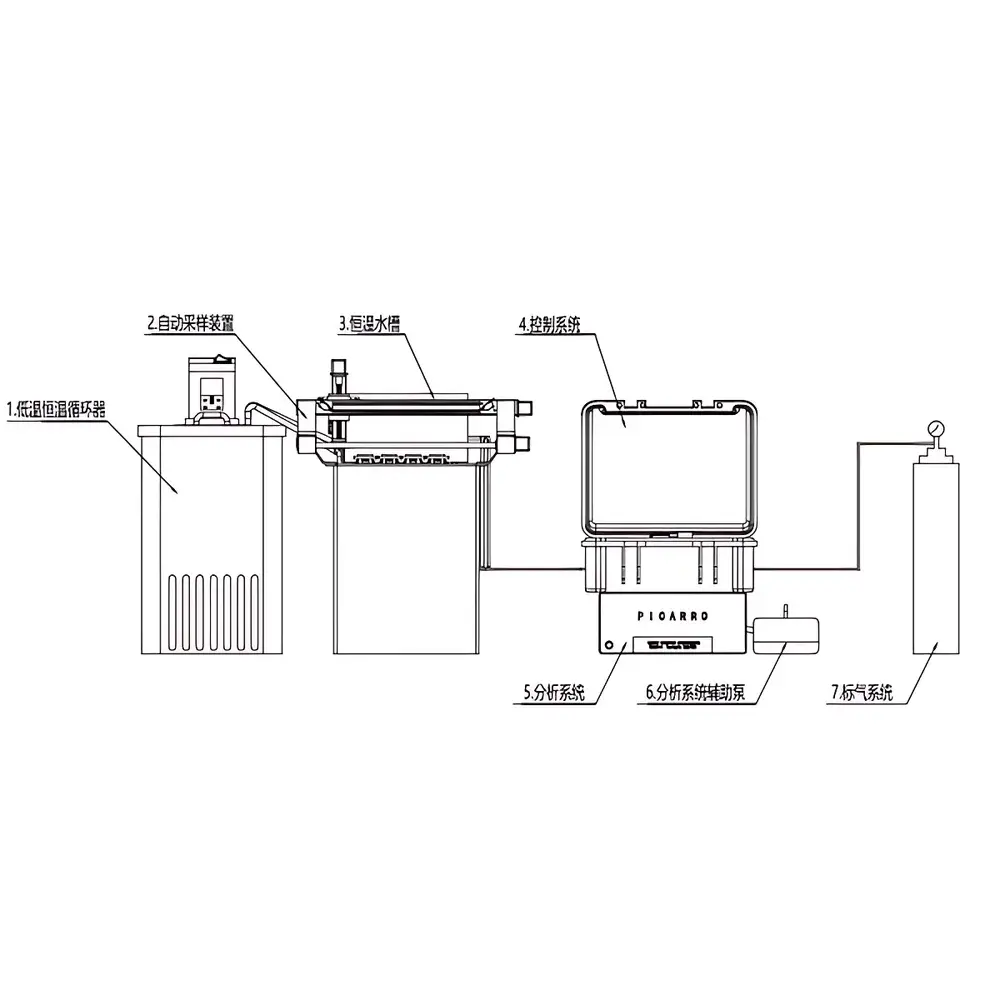
The Pri-eco δ13C Continuous Soil Microbial Respiration Analyzer with Automated Temperature Control is a purpose-built isotopic gas flux measurement platform engineered for high-temporal-resolution tracking of microbial CO₂ production and its stable carbon isotope signature (δ¹³C) during controlled soil incubation experiments. It operates on the principle of cavity-enhanced laser absorption spectroscopy (CE-LAS) coupled with real-time gas-phase isotopic ratio analysis—enabling simultaneous, non-destructive quantification of CO₂ concentration and δ¹³C in exhaled respiratory gas from soil microcosms. Unlike discrete sampling or offline IRMS-based workflows, this system eliminates manual intervention, sample transfer artifacts, and temporal undersampling—delivering time-series data at sub-hour resolution across multi-week experiments. Its design addresses critical methodological gaps in soil biogeochemistry: the decoupling of respiration rate from isotopic source partitioning, temperature-dependent microbial functional shifts, and dynamic substrate-use efficiency under varying thermal regimes.
Key Features
- Simultaneous dual-parameter acquisition: CO₂ mixing ratio (≤1 ppm detection limit) and δ¹³C value (≤0.3 ‰ precision, 1σ) per channel, synchronized at user-defined intervals (e.g., every 15–60 min).
- 16-channel parallel incubation architecture supporting independent environmental control per vessel, enabling factorial experimental designs (e.g., temperature × moisture × substrate addition).
- Automated temperature regulation across –5 to 35 °C with ±0.15 °C stability (verified via NIST-traceable Pt100 sensors embedded in each vessel base), facilitating Arrhenius-based Q₁₀ modeling and cryo-soil process studies.
- Modular, tool-free soil vessel mounting system allows rapid online replacement without interrupting ongoing measurements—critical for long-term turnover experiments or multi-phase substrate additions.
- Dual-loop gas circulation: primary loop maintains laminar flow through soil headspace; secondary loop enables optional CO₂ scrubbing (e.g., Ascarite™/Drierite™) or dilution prior to analysis—mitigating feedback inhibition from elevated CO₂ partial pressure.
- Integrated soil temperature probing: motorized stainless-steel probe inserts automatically into each 50 mL vessel at scheduled intervals, recording in-situ thermal gradients with <0.1 °C repeatability.
- On-board calibration sequence: periodic introduction of certified reference gases (e.g., NIST SRM 1610, CO₂-in-air standards) corrects for instrumental drift and ensures metrological traceability per ISO/IEC 17025 guidelines.
Sample Compatibility & Compliance
The system accommodates standard 50 mL glass serum vials with butyl rubber septa—compatible with common soil incubation protocols (e.g., ASTM D5988-22 for aerobic biodegradation). Vessels are sealed under ambient or controlled O₂/N₂ atmospheres prior to placement. All wetted materials (Teflon™ tubing, electropolished 316L stainless steel fittings, fused silica optical cells) comply with USP Class VI and FDA 21 CFR Part 11 requirements for material compatibility and extractables profiling. Data integrity safeguards include electronic audit trails, user role-based access control, and encrypted local storage—supporting GLP/GMP-aligned validation documentation packages.
Software & Data Management
Control and acquisition are managed via Pri-eco’s proprietary LabView-based software suite, deployable on Windows OS or Android tablets. The interface supports script-driven experiment sequencing: automated temperature ramping, gas loop switching, probe insertion timing, and calibration injection scheduling. Raw spectral data, calibrated CO₂/δ¹³C values, soil temperature logs, and system diagnostics are stored in HDF5 format with embedded metadata (CF-1.8 compliant). Export options include CSV, NetCDF, and direct SQL database push. Optional cloud synchronization enables remote monitoring and cross-site data harmonization—facilitating multi-laboratory meta-analyses under FAIR (Findable, Accessible, Interoperable, Reusable) principles.
Applications
- Temperature sensitivity of soil organic matter mineralization (Q₁₀ estimation) across climate-relevant gradients.
- Isotopic tracing of C-source partitioning between labile vs. recalcitrant SOM pools using ¹³C-labeled substrates (e.g., glucose, cellulose, lignin).
- Evaluation of priming effects under warming scenarios—quantifying native SOM decomposition acceleration upon fresh C input.
- Validation of microbial carbon use efficiency (CUE) models using concurrent CO₂ efflux and δ¹³C mass balance constraints.
- Soil microbiome functional response assessment in permafrost-thaw or alpine soil studies where sub-zero incubations are required.
- Method development for standardized soil respiration assays aligned with ISO 16072 (soil microbiological properties) and ISO 21249 (stable isotope analysis in environmental samples).
FAQ
What analytical technique does the system employ for δ¹³C measurement?
It utilizes off-axis integrated cavity output spectroscopy (OA-ICOS) at 2004 nm, optimized for CO₂ isotopologue discrimination (¹²C¹⁶O² vs. ¹³C¹⁶O²), with wavelength-scanned referencing to eliminate pressure- and temperature-induced spectral interference.
Can the system operate unattended for full 30-day cycles?
Yes—hardware redundancy (dual mass flow controllers, backup power conditioning), automated fault recovery, and 128 GB onboard storage ensure uninterrupted operation; remote health monitoring alerts notify users of anomalies via email/SMS.
Is third-party software integration supported?
The system exposes RESTful API endpoints for programmatic control and data ingestion, enabling interoperability with MATLAB, Python (via requests library), or laboratory information management systems (LIMS) using standard JSON payloads.
How is system calibration traceability documented?
Each calibration event logs timestamp, reference gas lot number, certified δ¹³C value, deviation from target, and operator ID—exportable as PDF reports compliant with ISO/IEC 17025 Clause 7.7 requirements.
Does the dual-loop gas architecture support reactive gas treatments (e.g., O₃, NO)?
No—the secondary loop is configured exclusively for CO₂ conditioning (scrubbing/dilution); reactive species would degrade Teflon™ components and compromise optical path stability.







