
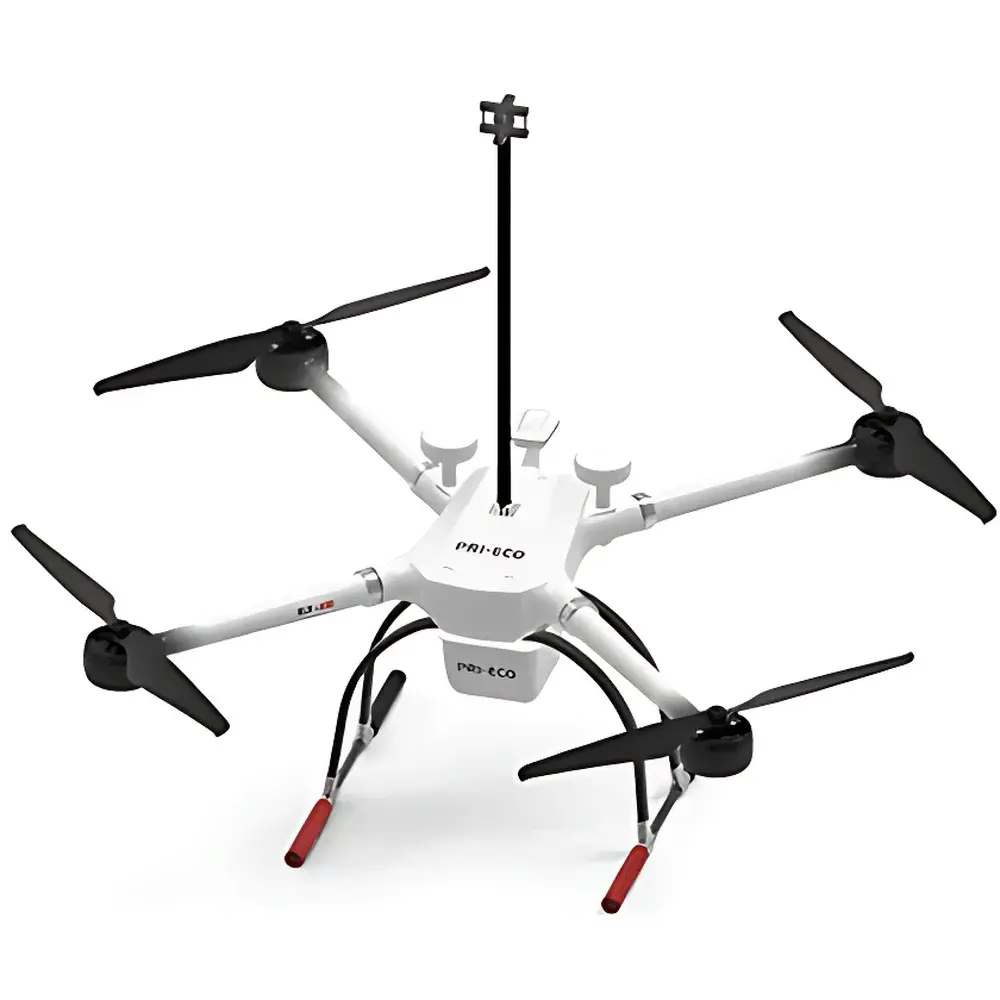
ZERO Pri-eco ZERO Aerial-Grade Natural Gas Leak Detection System
| Brand | Pri-eco |
|---|---|
| Origin | Beijing, China |
| Manufacturer Type | OEM Manufacturer |
| Country of Origin | China |
| Model | ZERO Aerial Edition |
| Detection Principle | Mid-Infrared Laser Direct Absorption Spectroscopy (MIRLAS) |
| Target Gases & Ranges | CH₄ (0–10,000 ppm), C₂H₆ (0–1,000 ppm), H₂O (0–3 %v/v) |
| Sensitivity (1-s) | CH₄: 1 ppb, C₂H₆: 0.5 ppb, H₂O: 50 ppm |
| Measurement Update Rate | 1–5 Hz |
| Sample Flow Rate | ~330 mL/min |
| Operating Temperature | −10 to +45 °C |
| Relative Humidity Limit | <99% RH (non-condensing) |
| Power Supply | 12–15 V DC |
| Analyzer Power Consumption | 20–40 W |
| UAV Integration Power Draw | Up to 500 W |
| Positioning | High-Accuracy BeiDou GNSS + Wind Compensation Algorithm |
| Leak Localization Accuracy | <1 m (typical) |
| Data Output | RS-232, Ethernet |
| Onboard Storage | 32 GB |
| Battery Autonomy | ≥1.5 h (standalone operation) |
Overview
The ZERO Pri-eco ZERO Aerial-Grade Natural Gas Leak Detection System is a field-deployable, factory-precalibrated trace gas analyzer engineered for high-precision, real-time detection and quantification of methane (CH₄), ethane (C₂H₆), and water vapor (H₂O) in ambient air. It employs Mid-Infrared Laser Direct Absorption Spectroscopy (MIRLAS), leveraging the fundamental vibrational absorption bands of target gases in the 2.5–12 µm spectral region—where molecular absorption cross-sections are orders of magnitude stronger than in the near-infrared. This intrinsic spectroscopic advantage enables exceptional selectivity, minimal cross-sensitivity, and robust baseline stability without requiring high-finesse optical cavities or complex multipass configurations. The system’s compact, low-volume measurement cell ensures rapid gas exchange and tight thermal–pressure control—critical for maintaining calibration integrity during dynamic mobile operations. Designed from the outset for aerial, vehicular, and portable deployment, it meets mechanical and environmental requirements for sustained operation on unmanned aerial vehicles (UAVs), ground vehicles (including EVs and two-wheelers), and human-carried platforms.
Key Features
- True aerial-grade architecture: mass-optimized (<4.2 kg analyzer unit) and power-efficient (20–40 W nominal), compatible with Class II/III commercial UAVs and battery-electric ground platforms.
- MIRLAS-based detection with inherent immunity to optical misalignment and zero moving parts—eliminating cavity-length drift and reducing long-term calibration drift to <±2% per year (CH₄).
- Integrated BeiDou GNSS receiver with sub-meter horizontal accuracy and real-time wind vector compensation—enabling georeferenced plume mapping and source attribution under variable meteorological conditions.
- Ruggedized mechanical design validated per MIL-STD-810G for shock, vibration, and thermal cycling—certified for continuous operation across −10 °C to +45 °C ambient range and up to 99% RH (non-condensing).
- Onboard data logging (32 GB embedded storage), dual-output interface (RS-232 + 10/100BASE-T Ethernet), and optional encrypted TLS 1.2 telemetry for secure cloud upload.
Sample Compatibility & Compliance
The ZERO Aerial Edition is optimized for unmodified ambient air sampling at flow rates of ~330 mL/min. No chemical scrubbers, dryers, or pre-concentrators are required for standard operation; H₂O interference is actively compensated via co-measured water vapor signal and thermodynamic modeling. The system complies with ISO 17025-aligned calibration traceability protocols, and its measurement uncertainty budget has been independently verified per EPA Method 21 Annex A and ISO 13864:2022 for fugitive emission surveys. All firmware and data handling routines support audit-ready metadata tagging—including timestamp, GNSS coordinates, temperature, pressure, humidity, and instrument status flags—to satisfy GLP/GMP and regulatory reporting requirements (e.g., U.S. EPA OOOOa, EU MRV, and China’s GB 31570–2015).
Software & Data Management
Data acquisition and post-processing are supported by Vista Smart Cloud Platform—a four-tier architecture comprising edge firmware, local synchronization agent, centralized ingestion engine, and web-based analytics dashboard. The platform supports time-synchronized trajectory replay, plume dispersion modeling (using Gaussian puff and Lagrangian particle dispersion algorithms), and automated leak classification (size, persistence, recurrence). All data transfers employ AES-256 encryption; stored datasets reside on ISO 27001-certified domestic servers compliant with China’s PIPL and Cybersecurity Law. Offline analysis tools include Python SDK, MATLAB toolbox, and CSV/NetCDF export for third-party integration with GIS (ArcGIS, QGIS) and enterprise EAM systems.
Applications
- Mobile methane surveying along natural gas transmission and distribution pipelines (ground vehicle and UAV-based).
- Urban fugitive emission monitoring for municipal utilities and regulatory agencies conducting LDAR programs.
- Well pad and compressor station screening in upstream oil & gas operations—especially where rapid spatial coverage and low false-positive rate are critical.
- Academic and governmental atmospheric research requiring high-temporal-resolution CH₄:C₂H₆ ratio profiling to distinguish biogenic vs. thermogenic sources.
- Emergency response and post-event leak verification following seismic activity or infrastructure damage.
FAQ
What certification standards does the ZERO Aerial Edition meet for field deployment?
It conforms to CE marking requirements for electromagnetic compatibility (EN 61326-1) and environmental robustness (IEC 60068-2 series), and its measurement methodology aligns with ASTM D6522–22 for open-path hydrocarbon detection.
Can the system operate autonomously on a drone without ground station telemetry?
Yes—the analyzer supports fully standalone operation with internal GNSS logging, buffered storage, and scheduled wake-up cycles; full dataset sync occurs upon landing or Wi-Fi reconnection.
Is H₂O measurement used only for compensation, or is it a reportable output?
H₂O is both a correction variable and a primary measured parameter; its concentration (0–3 %v/v, ±50 ppm @ 1 s) is included in all raw data packets and supports humidity-dependent sensitivity recalibration.
How frequently does the system require factory recalibration?
Under typical field use, annual recalibration is recommended; drift monitoring is enabled via built-in reference gas check routines and zero-air validation sequences executed automatically every 24 hours.
Does the Vista Cloud Platform support multi-user role-based access control?
Yes—administrators can define granular permissions (view-only, edit, QA/QC approval, export rights) aligned with ISO 27001 access governance policies.







