
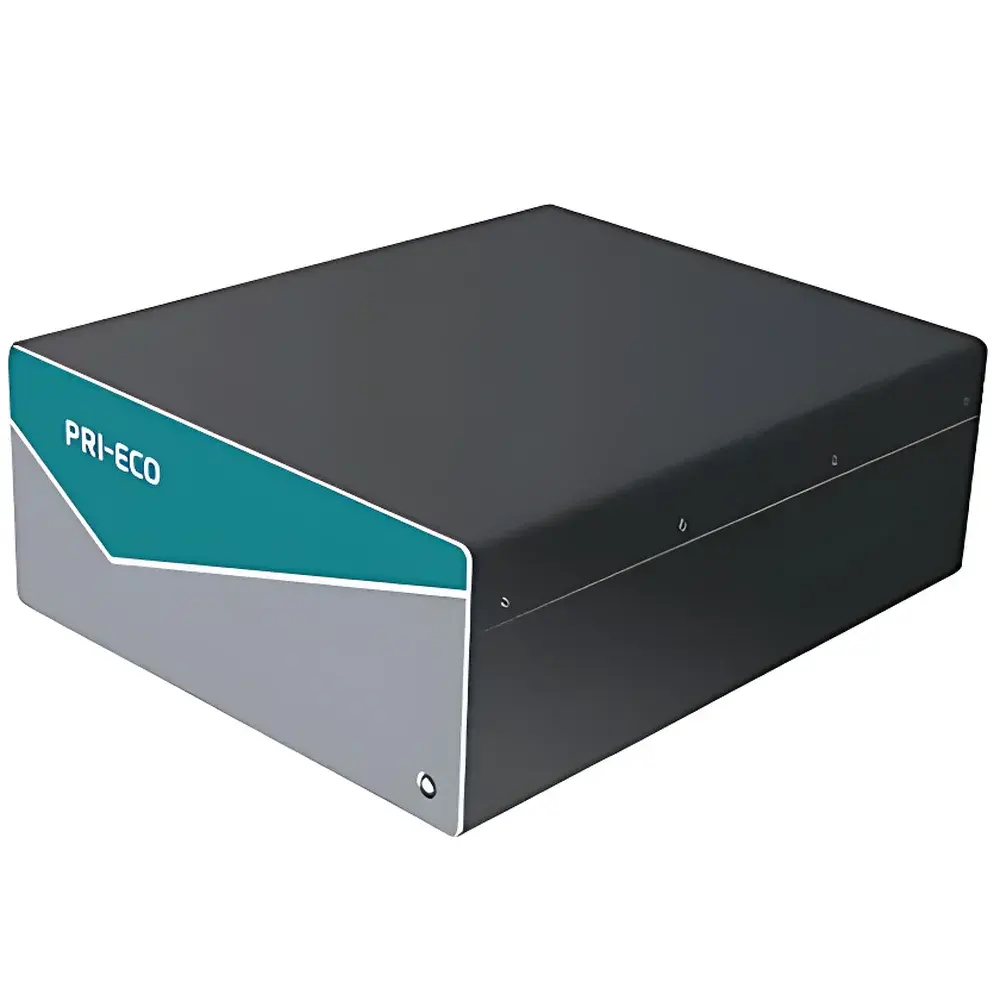
Pri-eco ZERO CH4 C2H6 H2O Portable Multicomponent Gas Analyzer
| Brand | Pri-eco |
|---|---|
| Origin | Beijing, China |
| Manufacturer Type | OEM Manufacturer |
| Product Type | Portable |
| Measurement Principle | Mid-Infrared Laser Absorption Spectroscopy (MIRLAS) |
| Repeatability | CH₄ ≤ 0.3 ppb (1 min), C₂H₆ ≤ 0.10 ppb (1 min), H₂O ≤ 40 ppm (1 min) |
| Accuracy (1 s) | CH₄ 1 ppb, C₂H₆ 0.5 ppb, H₂O 50 ppm |
| Accuracy Range | CH₄ 0–500 ppm, C₂H₆ 0–500 ppm, H₂O 0–3 %v/v |
| Sampling Flow Rate | ~180 mL/min |
| Operating Temperature | −10 to +45 °C |
| Relative Humidity | <99% RH, non-condensing |
| Data Output | USB, RS-232 |
| Power Supply | 110–230 V AC |
| Power Consumption | 50 W (steady-state), 90 W (warm-up) |
| Weight | 10.5 kg |
Overview
The Pri-eco ZERO CH4 C2H6 H2O Portable Multicomponent Gas Analyzer is an engineered solution for high-fidelity, real-time quantification of methane (CH₄), ethane (C₂H₆), and water vapor (H₂O) in ambient and process gas streams. It employs mid-infrared laser absorption spectroscopy (MIRLAS), a physics-based measurement principle that leverages the fundamental vibrational-rotational absorption bands of target molecules in the 2.5–12 µm spectral region. Unlike near-infrared (NIR) or electrochemical methods, MIRLAS delivers superior selectivity and immunity to cross-interference—particularly critical when distinguishing CH₄ from C₂H₆ in complex hydrocarbon matrices or correcting for H₂O-induced spectral broadening. The analyzer features a compact, temperature- and pressure-stabilized multi-pass optical cavity optimized for low-flow operation (~180 mL/min), enabling rapid gas exchange while maintaining thermodynamic equilibrium essential for trace-level accuracy. Its fully pre-calibrated factory configuration eliminates field calibration drift and reduces time-to-data, supporting compliance with EPA Method 21–adjacent workflows and ISO 13864:2022 recommendations for mobile emission monitoring systems.
Key Features
- Mid-infrared direct absorption spectroscopy (MIRLAS) with no requirement for high-reflectivity mirrors or external reference cells—minimizing optical complexity and long-term alignment drift.
- Integrated thermal and pressure stabilization within the measurement cell, ensuring <±0.1 °C and <±0.5 hPa control—critical for sub-ppb CH₄ precision under variable environmental conditions.
- Ruggedized mechanical architecture validated per MIL-STD-810G for shock, vibration, and thermal cycling—enabling reliable deployment in vehicle-mounted, airborne, and marine platforms without performance degradation.
- Low-maintenance design with annual service intervals; no consumables, no moving parts in the optical path, and no frequent recalibration requirements.
- Real-time dual-channel synchronized acquisition at 1 Hz native sampling rate for all three analytes, with on-board averaging algorithms supporting configurable integration times (1 s to 1 min).
- Modular hardware interface supporting optional plume mapping modules—including GPS-synchronized spatial tagging and differential concentration gradient calculation for CH₄/C₂H₆ ratio profiling.
Sample Compatibility & Compliance
The ZERO analyzer accepts undiluted, unfiltered sample gas across a wide dynamic range: CH₄ (0–500 ppm), C₂H₆ (0–500 ppm), and H₂O (0–3 %v/v). It operates continuously within −10 to +45 °C ambient temperature and up to 99% RH (non-condensing), with internal condensation management preventing liquid ingress into the optical path. The system meets electromagnetic compatibility (EMC) requirements per IEC 61326-1:2022 and safety standards per IEC 61010-1:2010. While not certified as intrinsically safe, it is routinely deployed in Class I, Division 2 environments when installed with appropriate barrier systems. Data integrity aligns with ALCOA+ principles (Attributable, Legible, Contemporaneous, Original, Accurate, Complete, Consistent, Enduring, Available) and supports audit-ready logging compatible with GLP/GMP-aligned QA/QC protocols.
Software & Data Management
The analyzer ships with Pri-eco’s proprietary ZERO Control Suite—a Windows-based application supporting instrument initialization, real-time visualization, spectral diagnostics, and raw absorbance data export (CSV, HDF5). All measurements are timestamped with microsecond resolution and include embedded metadata (T, P, flow rate, laser current, detector voltage). The software enables user-defined alarm thresholds, automated report generation (PDF/Excel), and seamless integration with third-party GIS platforms via standardized TCP/IP or Modbus RTU interfaces. Audit trails record all parameter changes, user logins, and firmware updates—supporting 21 CFR Part 11-compliant electronic signatures when deployed in regulated environments.
Applications
- Mobile methane leak detection and quantification along natural gas transmission corridors, distribution networks, and LNG terminals.
- Source attribution using CH₄/C₂H₆ ratio fingerprinting to distinguish biogenic vs. thermogenic emissions across landfills, oil wells, and agricultural sites.
- Plume dispersion modeling and thermal mapping via synchronized GPS-tagged concentration profiles during aerial or ground-based surveys.
- Process monitoring in biogas upgrading units, where real-time H₂O correction ensures accurate CH₄ purity assessment prior to injection.
- Field validation of satellite- and aircraft-based remote sensing data (e.g., TROPOMI, GHGSat) through ground-truth reference measurements.
FAQ
What is the fundamental measurement principle used in the ZERO analyzer?
Mid-infrared laser absorption spectroscopy (MIRLAS), operating on rovibrational transitions of CH₄, C₂H₆, and H₂O in their strongest fundamental absorption bands.
Does the instrument require periodic calibration with certified gas standards?
No—factory pre-calibration is traceable to NIST-certified reference materials; only annual verification is recommended per ISO/IEC 17025 guidelines.
Can the ZERO analyzer operate unattended for extended deployments?
Yes—its low power consumption (50 W steady-state), passive thermal management, and robust enclosure support continuous operation for >30 days with external battery or solar backup.
Is H₂O measurement used solely for compensation, or is it reported as a primary output?
H₂O is a fully quantified primary output with independent accuracy specifications; its data is used both for reporting and for real-time spectroscopic interference correction of CH₄ and C₂H₆ signals.
What level of data traceability does the system provide for regulatory reporting?
Full digital chain-of-custody: each data point includes instrument ID, firmware version, environmental metadata, and cryptographic hash—enabling reproducibility and audit readiness per EPA OOOOa and EU MRV requirements.







