
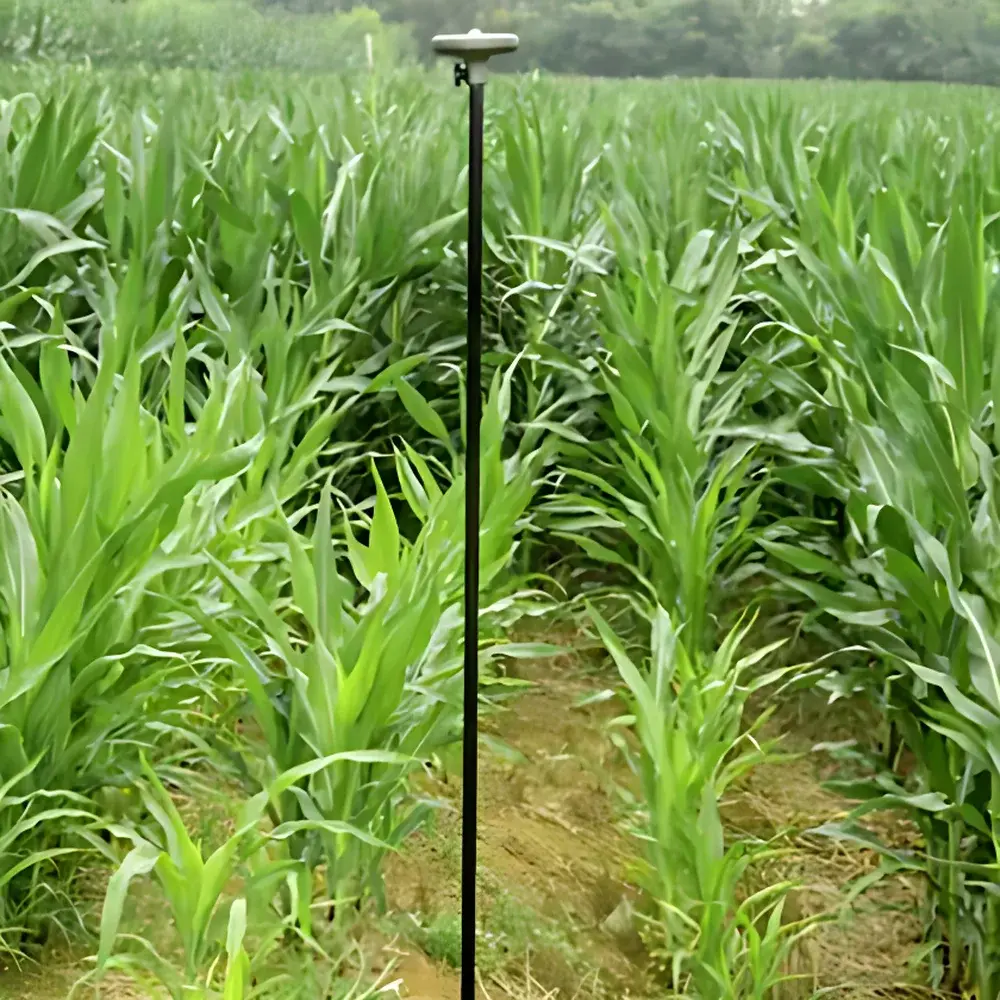
Pri-eco DMS-600 Distributed Multispectral Monitoring System
| Brand | Pri-eco |
|---|---|
| Origin | Beijing, China |
| Manufacturer Type | Original Equipment Manufacturer (OEM) |
| Country of Origin | China |
| Model | DMS-600 |
| Temperature Accuracy | ±0.3 °C |
| Relative Humidity Accuracy | ±3 % RH |
| Operating Temperature Range | −40 °C to +80 °C |
| Spectral Channels | 18 |
| Center Wavelengths (nm) | 410, 435, 460, 485, 510, 535, 560, 585, 610, 645, 680, 705, 730, 760, 810, 860, 900, 940 |
| Bandwidth | 20 nm per channel |
| Field of View | 41° |
| Optical Sensor Type | Diffuse irradiance (cosine-corrected) |
| Number of Spectral Sensor Units | 3 |
| Power Supply | Rechargeable Li-polymer battery (5000 mAh) |
| Operating Current | 80 mA |
| Sleep Current | 180 μA |
| Weight | 600 g |
| Data Transmission | NB-IoT |
| Remote Access | Web-based cloud platform and dedicated mobile application |
Overview
The Pri-eco DMS-600 Distributed Multispectral Monitoring System is an engineered field-deployable sensor platform designed for continuous, non-destructive assessment of vegetation biophysical and biochemical parameters across agroecological landscapes. It operates on the principle of passive reflectance spectroscopy—measuring diffuse solar irradiance in 18 discrete spectral bands spanning the visible (410–680 nm) and near-infrared (705–940 nm) regions. By capturing normalized spectral response patterns from plant canopies, the DMS-600 enables quantitative estimation of key agronomic indicators including leaf area index (LAI), aboveground biomass, chlorophyll content (SPAD-equivalent), nitrogen concentration, and canopy water status. Its distributed architecture supports scalable deployment across heterogeneous terrain—fields, pastures, rangelands, and forest edges—without requiring line-of-sight infrastructure or centralized power sources. The system integrates three synchronized multispectral sensor units with cosine-corrected optical heads, ensuring angular response compliance with ISO 9060:2018 Class C specifications for diffuse irradiance measurement.
Key Features
- Distributed wireless topology: Supports seamless mesh expansion via NB-IoT connectivity; no gateway hardware required for basic telemetry.
- Multi-parameter fusion: Simultaneously acquires spectral reflectance, ambient temperature (−40 °C to +80 °C), and relative humidity (0–100 % RH) with traceable calibration records.
- Low-power autonomous operation: 5000 mAh Li-polymer battery sustains >6 months of typical duty-cycle logging (15-min intervals) with 180 μA deep-sleep current draw.
- Ruggedized field design: IP67-rated enclosure; operating temperature range certified per IEC 60068-2-1 and IEC 60068-2-2 standards.
- Calibration traceability: Factory spectral responsivity characterization provided per channel; optional NIST-traceable recalibration service available.
- Compact form factor: 600 g total mass with integrated mounting bracket; optimized for pole, tripod, or UAV-mounted deployment.
Sample Compatibility & Compliance
The DMS-600 is validated for use over herbaceous and shrubby vegetation canopies with LAI ≥ 0.5 and canopy height ≥ 15 cm. It complies with ISO 11727:2021 (optical sensors for plant phenotyping) and meets electromagnetic compatibility requirements per EN 61326-1:2013. All firmware and data handling protocols conform to ISO/IEC 17025:2017 documentation practices for environmental monitoring instrumentation. While not a medical or diagnostic device, its spectral output aligns with USDA ARS-developed vegetation index algorithms (e.g., NDVI, PRI, MCARI) used in USDA-NRCS conservation planning workflows and FAO CropWatch reporting frameworks.
Software & Data Management
Data acquisition, visualization, and export are managed through a secure cloud-based platform compliant with GDPR and ISO/IEC 27001:2022 information security standards. Raw spectral time series are stored with embedded metadata (GPS coordinates, UTC timestamps, sensor health flags). The web interface supports batch download in NetCDF-4 format, compatible with Python (xarray), R (raster), and MATLAB environments. The companion mobile application provides real-time alerting for threshold breaches (e.g., canopy water deficit >15 %), configurable sampling schedules, and over-the-air firmware updates. Audit trails—including user access logs, parameter modification history, and calibration event records—are retained for ≥24 months to support GLP-aligned field trials.
Applications
- High-resolution precision agriculture: Zone-specific irrigation scheduling based on canopy water index (CWI) and chlorophyll dynamics.
- Rangeland health monitoring: Temporal tracking of green fractional cover and senescence rates across seasonal grazing cycles.
- Ecological research: Long-term validation of satellite-derived vegetation indices (e.g., Sentinel-2 MSI, Landsat OLI) at plot scale.
- Climate resilience studies: Correlating spectral response shifts with microclimatic variables under controlled drought or heat-stress experiments.
- Carbon flux modeling: Supporting eddy covariance tower networks by providing ground-truth LAI and fPAR inputs.
FAQ
What spectral indices can be derived directly from DMS-600 raw data?
NDVI, GNDVI, PRI, MCARI, TCARI, OSAVI, and WI (Water Index) are preconfigured in the cloud platform; custom index definitions can be uploaded via JSON schema.
Is the system suitable for use under dense forest canopy?
No—it is optimized for open or semi-open canopies where direct sky view fraction exceeds 30 %; under closed canopy, signal-to-noise ratio degrades below usable thresholds for quantitative retrieval.
How frequently is factory recalibration recommended?
Annual recalibration is advised for projects requiring metrological traceability; field drift monitoring is supported via onboard reference panel logging routines.
Can spectral data be exported without using the cloud platform?
Yes—local SD card logging (optional accessory) enables offline storage in CSV or binary formats; USB-C direct readout is supported for edge computing integration.
Does the system meet FDA 21 CFR Part 11 requirements for electronic records?
While not intended for regulated pharmaceutical or clinical use, the audit trail, electronic signature, and data integrity controls satisfy baseline Part 11 criteria for environmental field data in GLP-compliant agricultural research.





