
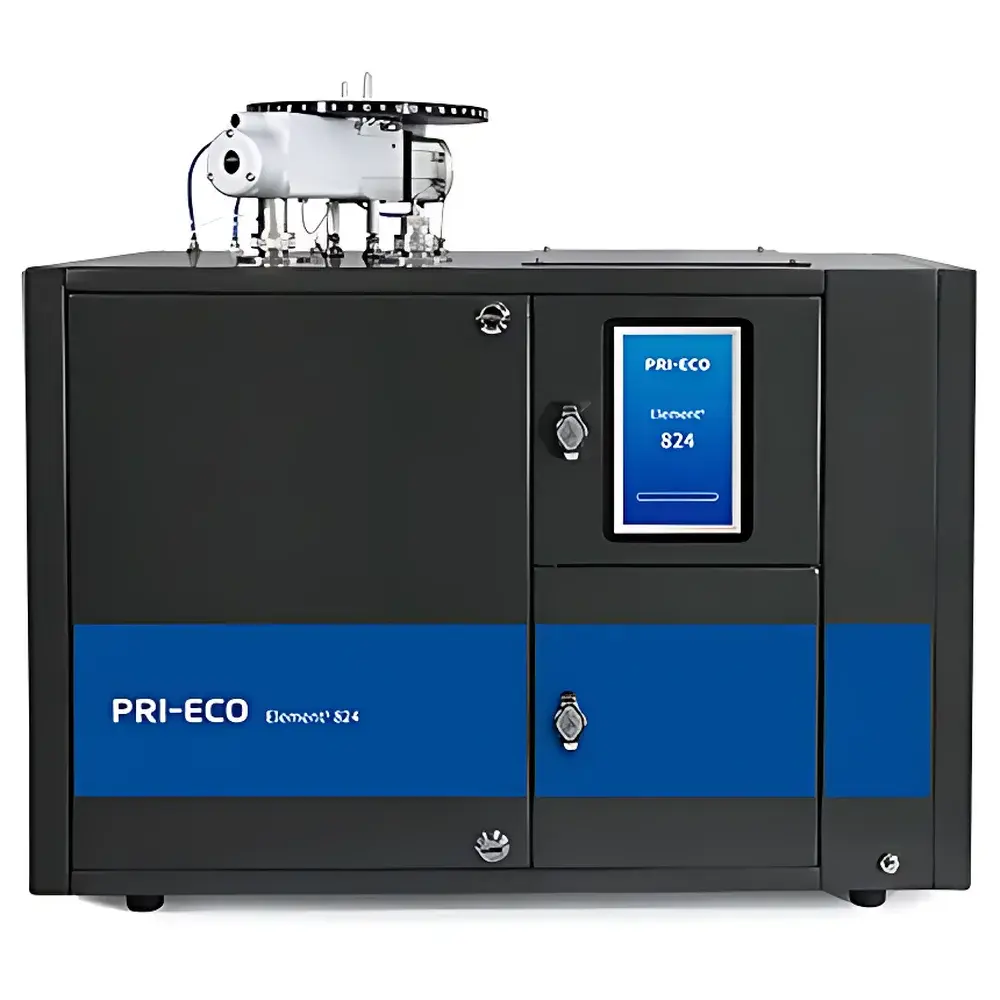
Pri-eco Element5 824 CN Soil-Specific Organic Elemental Analyzer
| Brand | Pri-eco |
|---|---|
| Origin | Beijing, China |
| Manufacturer Type | Direct Manufacturer |
| Model | Element5 824 |
| Detection Elements | C, N |
| Sample Form | Solid (soil), liquid |
| Combustion System | Dual-furnace Dumas flash combustion |
| Separation Method | GC column (3 m) |
| Detection | High-sensitivity TCD (reference-gas-free self-calibration) |
| Autosampler Options | Pneumatic (147-position), electric (32/50/100-position), manual |
| Analysis Time (C/N) | ≤5 min |
| Measurement Range | C/N: 0.002–20 mg |
| Accuracy | <0.2% (certified reference materials, purity >99.9%) |
| Precision | <0.1% RSD (certified reference materials, purity >99.9%) |
| Furnace Temp | Up to 1100 °C (left & right), separation oven up to 110 °C |
| Carrier Gas | Ultra-high-purity He (99.999%, 3–5 bar) |
| Oxidant | Ultra-high-purity O₂ (99.999%, 3–5 bar) |
| Auxiliary Gas | Oil-free compressed air |
| Power Supply | 230 V, 50/60 Hz, 5 A, 1100 W |
| Dimensions | 810 × 500 × 370 mm |
| Weight | 68 kg |
| Software | EAS Clarity (linear, quadratic, cubic calibration |
| Compliance | Designed for GLP/GMP environments |
Overview
The Pri-eco Element5 824 CN is a soil-optimized organic elemental analyzer engineered for high-precision, routine quantification of total carbon (C) and total nitrogen (N) in heterogeneous environmental matrices. It implements the Dumas combustion principle—rapid, high-temperature flash oxidation in an oxygen-rich environment—followed by gas chromatographic separation and thermal conductivity detection (TCD). Unlike Kjeldahl or wet-chemical methods, this instrument delivers complete elemental recovery without digestion bias, acid interference, or incomplete mineralization—critical for soils containing recalcitrant organic matter, carbonates, or iron oxides. The dual-furnace architecture physically isolates the oxidation and reduction zones, enabling independent temperature control (up to 1100 °C per furnace) and precise stoichiometric oxygen dosing. This configuration minimizes cross-contamination, enhances baseline stability, and extends catalyst lifetime—particularly important for high-volume soil testing where sample heterogeneity and matrix effects dominate analytical uncertainty.
Key Features
- Dual independent high-temperature furnaces (max. 1100 °C each) for optimized oxidative decomposition and post-combustion reduction, eliminating carryover between C and N measurement cycles
- Intelligent oxygen delivery system: real-time calculation and electronic regulation of O₂ flow based on sample mass and expected C/N content, reducing consumable usage by up to 35% versus fixed-flow systems
- Automated leak detection protocol integrated into startup and standby sequences—performs pressure decay analysis across all gas lines and valves without operator intervention
- Reference-gas-free TCD detector with built-in self-calibration algorithm; eliminates dependency on certified calibration gases while maintaining long-term signal drift <0.05% per 24 h
- Modular autosampler support: pneumatic 147-position carousel for unattended batch processing, or electric options (32/50/100 positions) with gravimetric feedback for critical mass-dependent applications
- 3-meter fused-silica GC column for robust separation of CO₂ and N₂ peaks under helium carrier gas, ensuring resolution >2.5 even at trace-level injections (≤0.002 mg C)
- Touchscreen HMI with embedded EAS Clarity software—supports multi-point linear, quadratic, and cubic calibration models, with automatic outlier rejection and residual error mapping
Sample Compatibility & Compliance
The Element5 824 CN accepts solid soil samples up to 1000 mg in high-purity tin or silver capsules—compatible with standard EPA Method 9060A (total organic carbon in soils) and ISO 10694:1995 (soil quality—determination of organic and total carbon after dry combustion). Liquid samples (e.g., soil extracts, digestates) may be introduced via microvial adapters. The system meets mechanical and electrical safety requirements per IEC 61010-1 and electromagnetic compatibility per EN 61326-1. When deployed with role-based user accounts, electronic signatures, and audit-trail logging enabled, the instrument satisfies data integrity prerequisites for GLP-compliant laboratories and FDA 21 CFR Part 11–regulated environments. All calibration standards, blank corrections, and system suitability tests are timestamped, user-attributed, and exportable in CSV or PDF/A format.
Software & Data Management
EAS Clarity provides full lifecycle data handling—from method definition and sequence programming to raw signal visualization, peak integration, and report generation. Calibration curves are stored with metadata including date, analyst ID, standard lot number, and uncertainty budget. Each analysis generates a structured result file containing integrated peak areas, retention times, baseline noise metrics, and furnace temperature logs. Data export supports LIMS integration via ASTM E1384-compliant XML schema or direct ODBC connectivity. Optional software modules include trend monitoring (Shewhart X-bar/R charts), inter-laboratory comparison reporting (ISO/IEC 17043), and automated QC flagging based on user-defined control limits (e.g., CRM recovery ±2%, duplicate RSD <1.5%). All raw chromatograms and processed results are archived with SHA-256 hash verification to ensure forensic traceability.
Applications
- Soil carbon sequestration monitoring in agricultural and reforestation projects (IPCC Tier 2/Tier 3 reporting)
- Quality assurance of compost, biosolids, and biochar amendments per USCC STA and EU EN 13039
- Nitrogen use efficiency studies in crop nutrition trials—quantifying total N prior to isotopic ratio analysis (δ¹⁵N) on connected IRMS systems
- Regulatory compliance testing for landfill leachate, dredged sediments, and contaminated site remediation endpoints
- Marine sediment characterization in benthic biogeochemical cycling research (e.g., C:N:P stoichiometry)
- Pharmaceutical excipient screening where residual organic solvents or carbonaceous impurities must be excluded per ICH Q5C
FAQ
What sample preparation is required for soil analysis?
Air-dried, homogenized soil samples should be ground to ≤250 µm and stored desiccated. No acid fumigation or pretreatment is needed—carbonates are fully oxidized during flash combustion.
Can the Element5 824 CN measure sulfur or chlorine?
No—this model is configured exclusively for C and N. For S/Cl analysis, the Element5 832 variant with high-temperature quartz reactor and halogen trap is recommended.
How often must the GC column be replaced?
Under typical soil testing conditions (50–100 samples/week), the 3 m column maintains resolution for ≥12 months; performance is monitored automatically via peak symmetry and retention time stability.
Is helium the only acceptable carrier gas?
Yes—helium is mandatory for optimal TCD sensitivity and CO₂/N₂ separation kinetics. Hydrogen or argon are incompatible due to thermal conductivity mismatch and column degradation risk.
Does the system support remote diagnostics?
Yes—via secure TLS-encrypted web interface; service engineers can initiate firmware updates, view real-time sensor diagnostics, and validate calibration status with customer authorization.




