
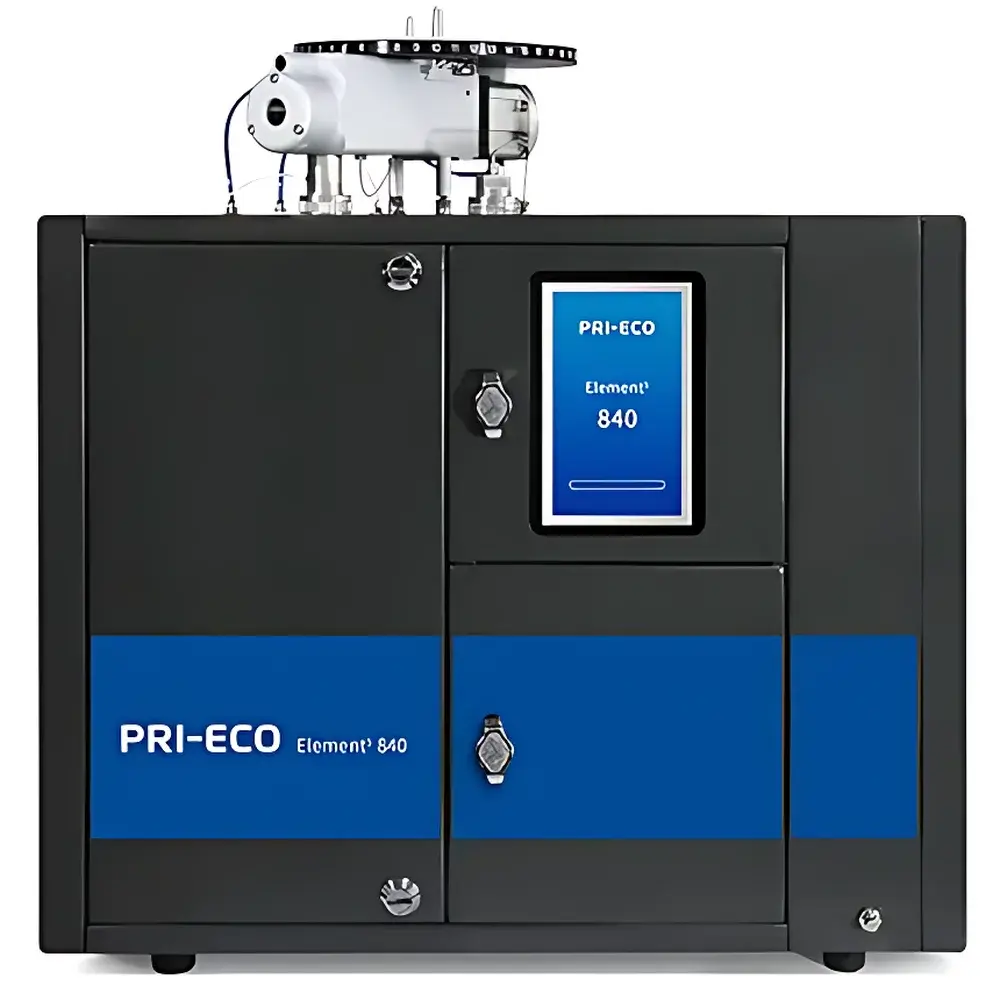
Pri-eco Element5 840 CHNSO Organic Elemental Analyzer
| Brand | Pri-eco |
|---|---|
| Origin | Beijing, China |
| Manufacturer Type | Manufacturer |
| Model | Element5 840 |
| Detection Elements | C, H, N, S, O |
| Sample Introduction | Single-furnace Dumas combustion with catalytic reduction for oxygen |
| Measurement Principle | High-temperature flash combustion (Dumas method) coupled with gas chromatographic separation and thermal conductivity detection (TCD) |
| Automation Features | Auto leak detection, electronic flow control, intelligent O₂ dosing, self-calibrating TCD |
| Sample Capacity | 0.1–500 mg (up to 1000 mg for soil), solid/liquid |
| Analysis Time | C/N: 5 min |
| C/H/N | 8 min |
| C/H/N/S | 10–25 min |
| O | 4 min |
| Detection Range | C: 0.002–20 mg |
| H | 0.002–5 mg |
| N | 0.002–20 mg |
| S | 0.002–6 mg |
| O | 0.002–2 mg |
| Accuracy | <0.2% (certified reference materials, purity >99.9%) |
| Precision | <0.1% RSD (same reference materials) |
| Furnace Temp | up to 1100 °C |
| Separation Oven | ≤110 °C |
| Carrier Gas | Ultra-high-purity He (99.999%, 3–5 bar) |
| GC Column | 0.8–4 m packed capillary column |
| Detector | High-sensitivity, reference-gas-free TCD |
| Software | EAS Clarity (supports linear, quadratic, cubic calibration |
| Dimensions | 510 × 500 × 370 mm |
| Weight | 53 kg |
| Power | 230 V, 50/60 Hz, 4 A, 900 W |
| Optional Accessories | Analytical balance, consumables (Sn/Ag capsules), isotope interface kit for IRMS coupling |
Overview
The Pri-eco Element5 840 CHNSO Organic Elemental Analyzer is a single-furnace, high-precision combustion-based instrument engineered for quantitative determination of carbon (C), hydrogen (H), nitrogen (N), sulfur (S), and oxygen (O) in organic and organometallic samples. It implements the Dumas flash combustion principle—rapid, controlled oxidation at up to 1100 °C in an oxygen-rich environment—followed by chromatographic separation of gaseous reaction products (CO₂, H₂O, N₂, SO₂, CO) and selective detection via a high-stability thermal conductivity detector (TCD). Oxygen quantification is achieved through high-temperature pyrolytic reduction using tungsten carbide catalysts, generating CO for downstream separation and detection. This dual-mode (oxidation/reduction) capability within one furnace enables full CHNSO analysis without manual hardware reconfiguration, reducing operator intervention and cross-contamination risk. The system is built upon legacy NCT (formerly Costech) combustion architecture, refined by Pri-eco for enhanced thermal stability, gas-flow reproducibility, and long-term baseline integrity—critical for laboratories operating under ISO/IEC 17025, USP , or EPA Method 520 compliance frameworks.
Key Features
- Single-furnace design integrating both combustion and reduction zones—eliminates inter-furnace transfer variability and simplifies maintenance
- Intelligent oxygen dosing algorithm dynamically adjusts O₂ volume based on sample mass and elemental composition, minimizing gas consumption and extending catalyst life
- Self-calibrating TCD detector requiring no reference gas or periodic zero/span adjustments—ensures continuous baseline stability across multi-day sequences
- Automated leak detection routine executed prior to each analysis cycle, verifying integrity of the entire gas path (furnace, traps, columns, detector)
- Electronic mass-flow controllers for He carrier gas and O₂ oxidant—enabling precise, repeatable flow regulation (±0.1 mL/min resolution) independent of ambient pressure fluctuations
- Modular inlet options: pneumatic autosampler (147-position), motorized autosamplers (32/50/100 positions), or manual quartz boat loading—supporting throughput scalability from R&D to routine QC labs
- Touchscreen HMI with embedded diagnostics, real-time gas pressure monitoring, and furnace temperature profiling—no external PC required for basic operation
Sample Compatibility & Compliance
The Element5 840 accommodates heterogeneous matrices including soils, sediments, plant tissues, pharmaceutical intermediates, polymers, fuels, and foodstuffs. Sample mass ranges from 0.1 mg (high-concentration standards) to 1000 mg (low-carbon soils), with capsule selection (Sn for CHNS, Ag for O) optimized for complete combustion and minimal blank contribution. All consumables—including high-purity tin/silver capsules, quartz wool, and CuO/Pt catalysts—meet ASTM D5291 and ISO 14852 traceability requirements. The instrument’s firmware and EAS Clarity software support 21 CFR Part 11-compliant user authentication, electronic signatures, and immutable audit trails—enabling deployment in GMP-regulated environments such as pharmaceutical quality control or contract research organizations (CROs). Calibration curves are validated per ICH Q2(R2) guidelines using certified reference materials (e.g., sulfanilamide, EDTA, benzoic acid) with documented uncertainty budgets.
Software & Data Management
EAS Clarity is a dedicated, Windows-based acquisition and evaluation platform designed specifically for elemental combustion analyzers. It supports multi-point calibration (linear, quadratic, or cubic regression), automatic peak integration with retention time locking, and real-time interference correction (e.g., H₂O co-elution compensation during N analysis). Raw chromatograms, calibration reports, and sample logs are stored in encrypted SQLite databases with configurable backup intervals. Export modules generate ASTM-compliant .csv files, PDF analytical reports with metadata (operator ID, instrument ID, calibration date), and structured XML for LIMS integration. Audit trail functionality records all critical events—including method edits, calibration updates, and result overrides—with timestamp, user ID, and pre-/post-change values—fully satisfying GLP documentation mandates.
Applications
- Environmental science: Total organic carbon (TOC) and total nitrogen (TN) in soils, sediments, and wastewater sludge per ISO 10694 and EPA 445.1
- Agricultural research: Protein content estimation (N × 6.25) in feedstuffs and fertilizers; sulfur speciation in biochar-amended soils
- Pharmaceutical development: Elemental impurity screening (ICH Q3D) for residual catalysts (Pd, Pt) and excipient stoichiometry verification
- Food safety: Authenticity testing of honey (C-4 plant signature via δ¹³C-IRMS coupling), protein labeling accuracy, and adulteration detection
- Petroleum geochemistry: Van Krevelen diagrams via H/C vs. O/C atomic ratios for kerogen typing and maturity assessment
- Materials science: Stoichiometric validation of MOFs, conductive polymers, and battery electrode precursors
FAQ
What sample preparation is required prior to analysis?
Solid samples must be homogenized and weighed into high-purity Sn or Ag capsules (0.1–500 mg typical; up to 1000 mg for soil). Liquids are absorbed onto cellulose or quartz wool before encapsulation. No acid digestion or derivatization is needed.
Can the Element5 840 interface with an isotope-ratio mass spectrometer (IRMS)?
Yes—optional IRMS coupling kit provides standardized 6-mm outer diameter effluent tubing, pressure-regulated split flow, and synchronization signals for simultaneous elemental and isotopic analysis (δ¹³C, δ¹⁵N, δ³⁴S, δ¹⁸O).
How often does the TCD require maintenance or recalibration?
The self-calibrating TCD requires no reference gas or manual recalibration. Routine maintenance includes quarterly replacement of CO₂ and H₂O traps and annual catalyst regeneration—documented in the built-in service log.
Is method validation support available for regulatory submissions?
Pri-eco provides IQ/OQ/PQ protocols aligned with ASTM D5291, ISO 14852, and USP , including precision studies, LOD/LOQ determination, and robustness testing templates compatible with FDA eCTD structure.
What gases are mandatory, and what purity specifications apply?
Ultra-high-purity helium (99.999%, 3–5 bar) as carrier gas; oxygen (99.999%, 3–5 bar) for combustion; oil-free compressed air (≤0.01 ppm hydrocarbons) for pneumatic actuators. Gas purity directly impacts baseline noise and detection limit stability.
Related Products





