
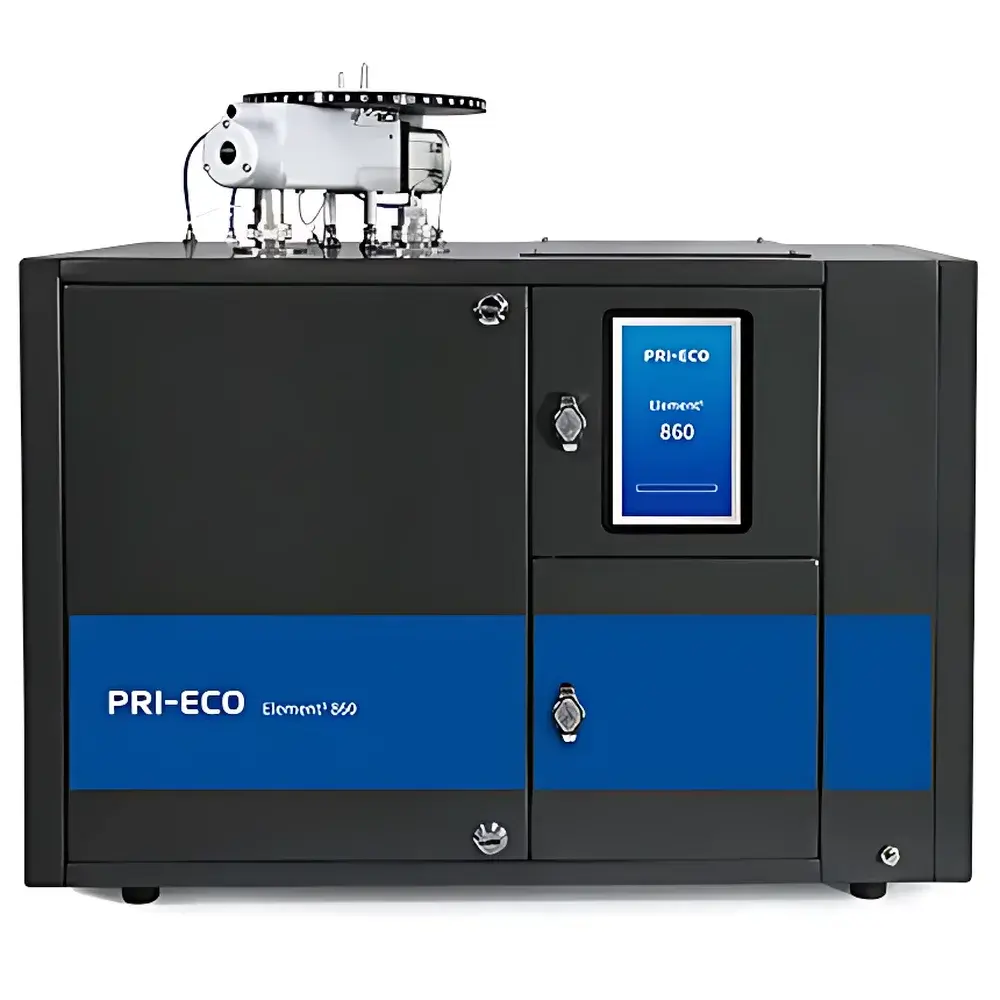
Pri-eco Element5 860 Dumas Nitrogen and Protein Analyzer
| Brand | Pri-eco |
|---|---|
| Origin | Beijing, China |
| Manufacturer Type | Direct Manufacturer |
| Model | Element5 860 |
| Detection Principle | High-Temperature Catalytic Combustion (Dumas Method) with Gas Chromatographic Separation |
| Measured Elements | Total Nitrogen, Crude Protein (calculated) |
| Sample Forms | Solid and Liquid |
| Furnace Configuration | Dual-Furnace System (Oxidation + Reduction) |
| Carrier Gas | Ultra-High-Purity Helium (99.999%, 3–5 bar) |
| Reactant Gas | Ultra-High-Purity Oxygen (99.999%, 3–5 bar) |
| Detector | Self-Calibrating Thermal Conductivity Detector (TCD) |
| Automation Features | Auto-Leak Detection, Intelligent Oxygen Dosage Control, Electronic Flow Regulation, Auto-Flow Setup |
| Sample Capacity | Up to 147 positions (Pneumatic Autosampler) |
| Analysis Time per Sample | 4–8 min (N) |
| Nitrogen Measurement Range | 0.002–20 mg |
| Accuracy | <0.2% RSD (Certified Reference Materials, >99.9% purity) |
| Precision | <0.1% RSD (Same reference materials) |
| Furnace Temperature | Up to 1100 °C (each furnace) |
| Sample Mass Range | 0.1–400 mg |
| Power Supply | 230 V, 50/60 Hz, 5 A, 1100 W |
| Dimensions | 980 × 500 × 370 mm |
| Weight | 78 kg |
| Software | EAS Clarity (Compliant with FDA 21 CFR Part 11 Audit Trail & User Access Control) |
Overview
The Pri-eco Element5 860 Dumas Nitrogen and Protein Analyzer is a high-performance, dual-furnace organic elemental analyzer engineered for precise quantification of total nitrogen in diverse organic matrices—enabling direct calculation of crude protein content via the standard Kjeldahl conversion factor (N × 6.25). It implements the internationally recognized Dumas combustion method (ISO 13878:1998, AOAC 992.15, ASTM D5158, EN ISO 16634-1), combining flash combustion at up to 1100 °C in a controlled oxygen environment with high-resolution gas chromatographic separation and thermal conductivity detection. Unlike classical Kjeldahl digestion, the Element5 860 eliminates hazardous acid reagents, reduces analysis time by >80%, and delivers trace-level sensitivity (0.002 mg N) without manual catalyst regeneration or post-combustion scrubbing. Its dual-furnace architecture physically isolates oxidation and reduction zones—ensuring stoichiometric completeness, minimizing cross-contamination, and extending catalyst lifetime. The system is purpose-built for laboratories requiring routine, high-throughput nitrogen analysis under GLP/GMP-aligned operational rigor.
Key Features
- Dual independent high-temperature furnaces (each up to 1100 °C), enabling strict thermal segregation of oxidative combustion and catalytic reduction steps
- Self-calibrating Thermal Conductivity Detector (TCD) with no requirement for reference gas—reducing consumable dependency and calibration drift
- Intelligent oxygen dosage control: real-time calculation and dynamic delivery of optimal O₂ volume based on sample mass and expected nitrogen load
- Automated leak detection protocol executed prior to each analysis cycle—verifying integrity of the entire gas path (He/O₂ lines, valves, reactor seals)
- Electronic mass-flow controllers for carrier (He) and reactant (O₂) gases, ensuring reproducible retention times and peak resolution across 1000+ consecutive runs
- Modular autosampler options: pneumatic 147-position carousel or motorized trays (32/50/100 positions), compatible with standard tin or silver microcrucibles
- Touchscreen HMI with embedded diagnostics, real-time pressure/temperature monitoring, and guided maintenance alerts
Sample Compatibility & Compliance
The Element5 860 accommodates solid and liquid samples ranging from 0.1 to 400 mg—including soils, feedstuffs, pharmaceutical excipients, marine sediments, dairy powders, and petrochemical catalysts. Optional oxidation/reduction tube diameters (3.5 mm, 5.0 mm, 7.5 mm) allow optimization for low-carbon biomass (e.g., algae) or high-carbon polymers (e.g., rubber, plastics), while maintaining consistent combustion efficiency and CO₂ removal. All hardware and software components comply with ISO/IEC 17025:2017 requirements for testing laboratories. The EAS Clarity software supports full 21 CFR Part 11 compliance—including electronic signatures, role-based access control, immutable audit trails, and data integrity validation—and is validated for use in regulated environments including USP , EP 2.2.46, and FDA-reviewed QC workflows.
Software & Data Management
EAS Clarity is a dedicated, Windows-based acquisition and evaluation platform featuring multi-curve calibration (linear, quadratic, cubic), automatic baseline correction, peak integration with retention time locking, and batch reporting with customizable templates (PDF/CSV/XLSX). It integrates seamlessly with LIMS via ASTM E1384-compliant export protocols and supports instrument remote monitoring through secure HTTPS endpoints. Raw chromatograms, calibration logs, system suitability reports, and daily performance verification records are stored with SHA-256 hashing for forensic traceability. User-defined SOPs can be embedded directly into method files, enforcing procedural consistency across shifts and operators.
Applications
- Agricultural science: Total nitrogen and crude protein quantification in cereals, forages, fertilizers, and compost
- Food & beverage QA/QC: Verification of protein labeling compliance (EU Regulation 1169/2011, FDA 21 CFR 101.9), allergen matrix screening
- Pharmaceutical R&D: Nitrogen content verification in APIs, excipients, and lyophilized formulations per ICH Q5C
- Environmental monitoring: TN determination in wastewater sludge, sediment cores, and atmospheric particulate filters (PM₂.₅/PM₁₀)
- Petroleum industry: Nitrogen speciation in crude oils and refinery streams per ASTM D4294 and D5762
- Academic research: Coupling with IRMS (Isotope Ratio Mass Spectrometry) for δ¹⁵N stable isotope analysis in biogeochemical cycling studies
FAQ
What standards does the Element5 860 validate against?
It meets ISO 13878, AOAC 992.15, ASTM D5158, EN ISO 16634-1, and USP for nitrogen determination.
Can the system analyze volatile or halogenated samples?
Yes—optional quartz-lined reaction tubes and sulfur-trapping modules enable robust analysis of chlorinated organics and nitrated explosives.
Is helium the only acceptable carrier gas?
Helium is mandatory for optimal TCD sensitivity and chromatographic resolution; hydrogen or argon are not supported.
How is calibration verified daily?
A certified urea standard (NIST SRM 84g) is run as a system suitability test; %RSD ≤0.1% and recovery 99.5–100.5% confirm readiness.
Does the instrument support unattended overnight operation?
Yes—autosampler capacity, thermal stability, and automated gas management allow fully autonomous 24-hour sequences with email alerting on anomalies.
Related Products





