
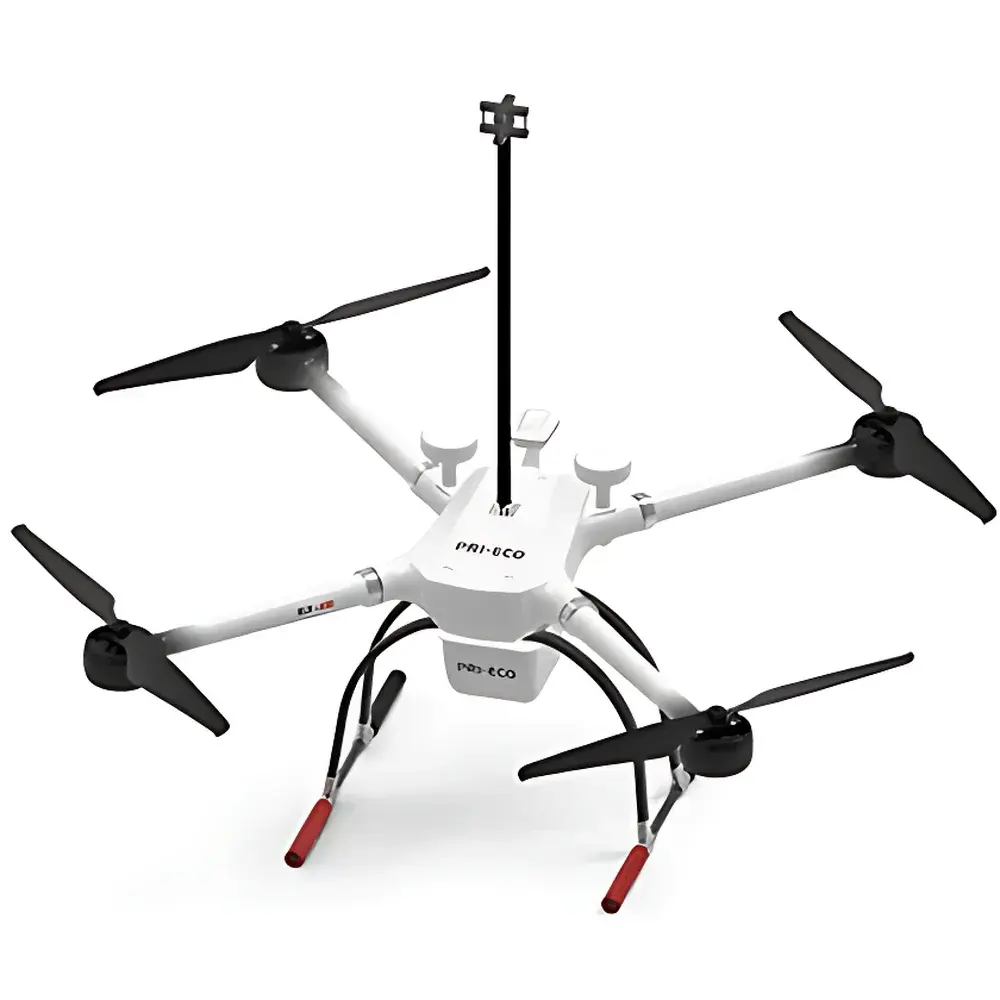
Pri-eco ZERO Flight CH4/C2H6/H2O Analyzer
| Brand | Pri-eco |
|---|---|
| Model | ZERO Flight |
| Type | Portable Multicomponent Gas Analyzer |
| Measurement Principle | Mid-Infrared Laser Absorption Spectroscopy (MIRLAS) |
| Detection Targets | CH₄, C₂H₆, H₂O |
| Sensitivity | 0.5 ppb (CH₄, 5 s), 0.1 ppb (C₂H₆, 5 s), 40 ppm (H₂O, 5 s) |
| Accuracy Range | 0–500 ppm (CH₄, C₂H₆), 0–3 %v/v (H₂O) |
| Sampling Flow Rate | ~180 mL/min (standard), optional 1000 mL/min pump |
| Response Time | 1 or 2 Hz |
| Operating Temperature | −10 to +45 °C |
| Relative Humidity Limit | <99% RH, non-condensing |
| Power Consumption | 15 W (steady-state), 20 W (peak) |
| Battery Life | 6 h (integrated Li-ion) |
| Weight | 2 kg |
| Data Interfaces | WiFi, USB, RS-232 |
| Sample Volume | 60 mL |
| Compliance | Designed for field-deployable environmental monitoring per ISO 14064-1, ASTM D6522, and EPA Method 25A principles |
Overview
The Pri-eco ZERO Flight CH4/C2H6/H2O Analyzer is a field-deployable, battery-powered multicomponent gas analyzer engineered for high-fidelity, real-time quantification of methane (CH₄), ethane (C₂H₆), and water vapor (H₂O) in ambient air. It employs mid-infrared laser absorption spectroscopy (MIRLAS) — a physics-based, calibration-stable technique leveraging fundamental vibrational absorption bands near 3.3 µm (CH₄), 3.4 µm (C₂H₆), and 2.7 µm (H₂O). Unlike near-infrared (NIR) or electrochemical sensors, MIRLAS delivers inherent selectivity, minimal cross-sensitivity, and immunity to optical fouling due to the absence of high-reflectivity cavity optics. The instrument’s compact architecture (2 kg, 15 W steady-state power) enables integration onto unmanned aerial systems (UAS), mobile ground platforms, and handheld survey rigs — fulfilling a critical need for spatially resolved, trace-level hydrocarbon mapping in emissions verification, landfill monitoring, oil & gas infrastructure assessment, and atmospheric research.
Key Features
- True ppb-level detection limits: 0.5 ppb CH₄ and 0.1 ppb C₂H₆ (5-second averaging), validated against NIST-traceable standards
- Dual-channel differential sampling path with automated zero/reference cycle — eliminating baseline drift without external calibration gases
- Integrated thermoelectric temperature stabilization (< ±0.05 °C) ensuring spectral line-narrowing and long-term measurement reproducibility
- Minimal sample demand: only 60 mL total volume required for full spectral acquisition, compatible with low-flow sampling manifolds
- Configurable data output: native WiFi streaming (TCP/IP), RS-232 serial, USB-C, and optional 4–20 mA analog output for SCADA integration
- Optional integrated GPS module with time-synchronized geotagging for plume visualization and flux modeling (e.g., Gaussian dispersion or inverse Lagrangian methods)
- Ruggedized enclosure rated IP54; operational across −10 to +45 °C and up to 99% RH (non-condensing)
Sample Compatibility & Compliance
The ZERO Flight analyzer accepts ambient air, stack effluent (diluted), and soil gas samples without chemical scrubbing or pre-concentration. Its MIRLAS core exhibits negligible interference from CO₂, CO, NOₓ, or common VOCs within the targeted spectral windows. For regulatory alignment, the system supports audit-ready data logging compliant with GLP and ISO/IEC 17025 documentation requirements. While not certified as a Class I, Division 1 device, its low-power design and absence of ignition sources permit safe operation in non-hazardous zones per IEC 60079-0. Instrument validation follows ASTM D6522 (for CH₄ in ambient air) and EPA Method 25A principles for extractive hydrocarbon analysis. All firmware and data handling modules are structured to support future 21 CFR Part 11 readiness via timestamped, user-authenticated audit trails.
Software & Data Management
The analyzer ships with Pri-eco’s FlightView™ desktop application (Windows/macOS/Linux), enabling real-time spectral visualization, multi-gas overlay plots, and automatic plume boundary detection. Raw absorbance spectra (12-bit resolution, 1024 points per scan) are stored in HDF5 format with embedded metadata (GPS, temperature, pressure, flow rate). Data export supports CSV, NetCDF, and MAT formats for interoperability with Python (SciPy, Pandas), MATLAB, and QGIS workflows. Firmware updates are delivered over-the-air via secure HTTPS, and configuration profiles (e.g., UAV flight mode vs. stationary survey) can be saved and deployed across fleets. Optional cloud ingestion via MQTT or REST API enables centralized dashboarding in AWS IoT Core or Azure IoT Hub environments.
Applications
- UAS-based fugitive emission surveys at natural gas compressor stations, well pads, and LNG terminals
- Mobile ground-based leak detection and repair (LDAR) programs meeting OOOOa/OOOOb compliance timelines
- Landfill perimeter monitoring and surface emission flux estimation using inverse dispersion modeling
- Atmospheric boundary layer studies requiring simultaneous CH₄/C₂H₆ ratio profiling for source apportionment (biogenic vs. thermogenic)
- Calibration transfer validation for open-path FTIR and DOAS systems
- Soil gas screening in contaminated site characterization and bioremediation tracking
FAQ
What spectral technique does the ZERO Flight use, and why is MIR superior to NIR for CH₄/C₂H₆?
It uses tunable mid-infrared laser absorption spectroscopy (MIRLAS) targeting fundamental rovibrational transitions. MIR offers 10–100× stronger absorption cross-sections than NIR overtones, yielding higher signal-to-noise ratios, reduced susceptibility to water vapor interference, and intrinsic specificity without chemometric correction.
Can the instrument operate unattended for extended periods?
Yes — with an external 12 V DC power supply and optional external battery pack, continuous operation exceeds 24 hours. Internal Li-ion supports 6 h at full duty cycle (2 Hz, GPS/WiFi active).
Is H₂O measurement used for compensation only, or is it a quantitative output?
H₂O is a fully calibrated, traceable output (0–3 %v/v, ±40 ppm @ 5 s), enabling real-time humidity correction of CH₄/C₂H₆ signals and direct use in eddy covariance or isotopic correction workflows.
Does the system require daily span calibration?
No — the dual-beam differential design with internal reference cell and thermal stabilization ensures <0.5% drift over 72 h. Field zeroing (using ambient air or N₂) is recommended before each deployment, but span calibration is only required quarterly or after maintenance.
How is data synchronized with GPS position during UAV flights?
The onboard GPS module timestamps each gas reading with PPS-locked microsecond precision. FlightView™ fuses inertial measurement unit (IMU) data and GNSS epochs to assign geospatial coordinates to every spectral acquisition, enabling sub-meter plume mapping at 2 Hz.







