
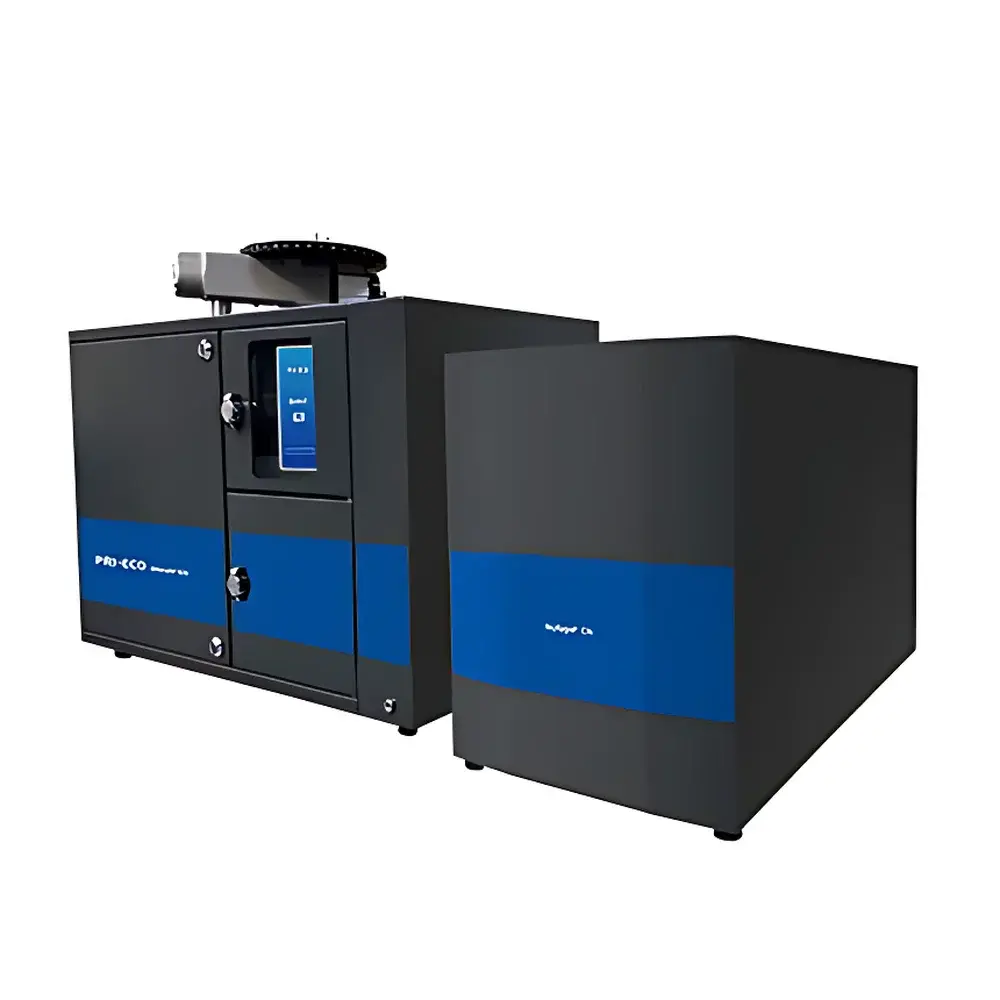
Pri-eco Isotope5 CN Isotope Ratio Mass Spectrometer
| Brand | Pri-eco |
|---|---|
| Origin | Beijing, China |
| Manufacturer Type | Original Equipment Manufacturer (OEM) |
| Country of Origin | China |
| Model | Isotope5 CN |
| Measurement Range | δ¹³C, δ¹⁵N |
| Resolution | >75 at m/z 29 |
| Detection System | Triple Faraday Collector for C/N/H/S/O |
| Mass Analyzer | 14 cm radius, 90° magnetic sector with permanent high-stability magnet |
| Vacuum System | Integrated low-power turbomolecular pump |
| Power Consumption | 240 W (typical) |
| Dimensions | 70 cm (L) × 30 cm (W) × 47 cm (H) |
| Weight | 45 kg |
Overview
The Pri-eco Isotope5 CN Isotope Ratio Mass Spectrometer is a compact, benchtop-scale magnetic sector IRMS engineered for high-precision stable isotope ratio analysis of carbon and nitrogen. Based on licensed technology from Compact Science Systems (UK), the instrument employs conventional double-focusing magnetic sector mass spectrometry with a 14 cm radius, 90° geometry and a permanently stabilized high-field magnet. It operates on the principle of ion beam separation by mass-to-charge ratio (m/z) in a static magnetic field, followed by simultaneous detection of isotopic ions (e.g., 44CO2, 45CO2, 28N2, 29N2) using a triple Faraday cup collector array. Designed for routine laboratory deployment—not dedicated clean-room facilities—the Isotope5 CN delivers robust performance in δ¹³C and δ¹⁵N measurements with sub-permil precision under standard operating conditions, supporting applications requiring trace-level isotopic fidelity without infrastructure-intensive installation.
Key Features
- Benchtop footprint (70 × 30 × 47 cm) enabling flexible integration into QC labs, field-deployable research stations, or teaching laboratories.
- Triple Faraday collector configuration optimized for simultaneous measurement of m/z 44, 45 (for CO2-based δ¹³C) and m/z 28, 29 (for N2-based δ¹⁵N), minimizing peak-jumping artifacts and improving long-term reproducibility.
- Integrated vacuum system featuring a low-power turbomolecular pump—no external roughing pump required—reducing maintenance overhead and operational noise.
- High-resolution capability (>75 at m/z 29) ensuring baseline separation of interfering isobaric species (e.g., 29N2 vs. 14N15N) critical for accurate δ¹⁵N determination in complex matrices.
- Low gas consumption architecture: helium carrier gas usage ≤3–5 bar; standby mode reduces continuous flow during idle periods, lowering annual helium demand by ~40% versus conventional IRMS platforms.
- Self-diagnostic firmware and automated leak-check routines embedded in control software, supporting GLP-compliant instrument qualification without third-party service intervention.
Sample Compatibility & Compliance
The Isotope5 CN is designed for interfacing with multiple front-end sample introduction systems: Element5 EA (Elemental Analyzer) for solid/liquid CN analysis, GC for volatile organic compounds, and LC for thermally labile or polar analytes. When coupled to Element5 EA (with dual combustion furnaces up to 1100 °C and automatic O2 flow regulation), the system achieves full CHNS/O elemental quantification alongside isotopic analysis. All configurations comply with ASTM D7618 (δ¹³C in biofuels), ISO 11290-1 (microbial source tracing), and USP isotopic authenticity protocols. Data acquisition meets FDA 21 CFR Part 11 requirements for electronic records and signatures when deployed with audit-trail-enabled software versions. Instrument validation documentation—including IQ/OQ/PQ templates—is provided to support GMP/GLP audits in food authenticity, clinical diagnostics (e.g., H. pylori urea breath test validation), and environmental forensics workflows.
Software & Data Management
The Isotope5 CN is controlled via a unified software suite supporting real-time instrument diagnostics, method setup, data acquisition, and offline isotope ratio calculation. The package includes automatic peak centering, intensity normalization, and multi-point internal standard calibration (e.g., CO2 and N2 reference gases). Raw ion beam intensities are logged with timestamped metadata (pressure, temperature, filament emission current) for full traceability. Data export formats include CSV, ASCII, and .raw for compatibility with third-party statistical tools (e.g., R, MATLAB, IRMS-specific packages like Isodat Legacy or IonOS). Batch processing supports up to 147 samples via pneumatic autosampler integration; all sequence files retain user-defined annotations for chain-of-custody compliance. Software updates are delivered via secure HTTPS portal with version-controlled release notes and impact assessments for regulated environments.
Applications
- Biogeochemical cycling: Quantifying soil organic matter turnover, nitrogen fixation rates, and carbon sequestration efficiency via δ¹³C and δ¹⁵N signatures in plant-soil-atmosphere systems.
- Food authenticity & traceability: Detecting honey adulteration (C4 sugar syrup addition), origin verification of dairy products, and botanical origin assessment of essential oils.
- Clinical & microbiological diagnostics: Urea breath testing for Helicobacter pylori infection using 13C-labeled urea; metabolic phenotyping in oncology and nutrition studies.
- Petroleum geochemistry: Source rock characterization and oil-oil correlation through compound-specific δ¹³C analysis of n-alkanes (GC-IRMS mode).
- Forensic science: Human remains identification via δ¹³C/δ¹⁵N collagen profiling; illicit drug precursor sourcing using isotopic fingerprinting.
FAQ
What sample types can be analyzed directly on the Isotope5 CN?
Solid and liquid samples require prior conversion to CO2 and N2 gases via elemental analyzer (EA) or chromatographic separation (GC/LC); no direct solid probe inlet is supported.
Does the system meet ISO/IEC 17025 accreditation requirements?
Yes—when operated with documented SOPs, calibrated reference materials (IAEA-600, USGS40), and full audit trail enabled, the Isotope5 CN + Element5 EA configuration satisfies ISO/IEC 17025:2017 clause 7.7 for measurement uncertainty estimation.
Is helium the only carrier gas option?
Helium is mandatory for optimal resolution and sensitivity; hydrogen or nitrogen are not supported due to ion optics constraints and collision-induced fragmentation risks.
Can the instrument operate unattended overnight?
Yes—integrated thermal management, auto-shutdown on vacuum loss, and scheduled run sequences enable 24/7 operation with minimal supervision.
What is the typical turnaround time per sample in EA-IRMS mode?
4–5 minutes per sample, including EA combustion, gas purification, and IRMS acquisition—excluding sample preparation and calibration cycles.






