
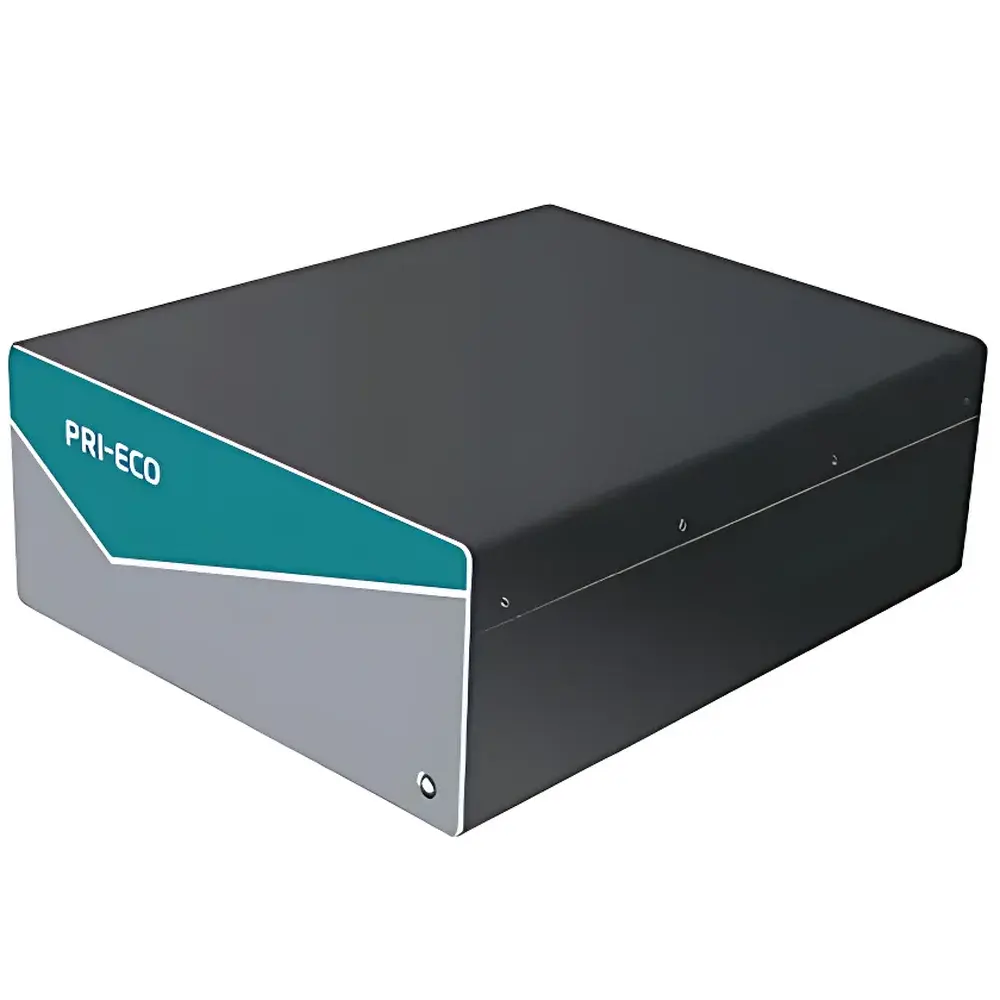
Pri-eco ZERO Mobile-Mounted High-Precision Natural Gas Leak Detection System
| Brand | Pri-eco |
|---|---|
| Origin | Beijing, China |
| Manufacturer Type | Direct Manufacturer |
| Country of Origin | China |
| Model | ZERO Mobile-Mounted |
| Detection Principle | Mid-Infrared Laser Direct Absorption Spectroscopy (MIRLAS) |
| Detectable Gases & Ranges | CH₄ (0–10,000 ppm), C₂H₆ (0–1,000 ppm), H₂O (0–3 %) |
| Accuracy (1 s) | CH₄: 1 ppb, C₂H₆: 0.5 ppb, H₂O: 50 ppm |
| Data Update Rate | 1–5 Hz |
| Sample Flow Rate | ~330 mL/min |
| Operating Temperature | −10 to +45 °C |
| Relative Humidity Limit | <99 % RH (non-condensing) |
| Positioning | High-Accuracy BeiDou GNSS + Wind Correction |
| Power Consumption | Analyzer: 20–40 W |
| Full System (incl. pump) | ≤80 W |
| Weight | 8.3 kg |
| Dimensions | 450 × 350 × 150 mm |
| Data Storage | 256 GB–2 TB onboard + unlimited cloud archive |
| Communication Interfaces | Wi-Fi, 5G, RS-232, Ethernet |
| Leak Localization Accuracy | <1 m |
Overview
The Pri-eco ZERO Mobile-Mounted High-Precision Natural Gas Leak Detection System is an engineered field-deployable gas analyzer designed for real-time, quantitative detection and geolocated mapping of methane (CH₄), ethane (C₂H₆), and water vapor (H₂O) emissions from natural gas infrastructure. It employs mid-infrared laser direct absorption spectroscopy (MIRLAS), a physically grounded optical technique that exploits the fundamental vibrational-rotational absorption bands of target molecules in the 2.5–12 µm spectral region. Unlike near-infrared (NIR) or electrochemical methods, MIRLAS delivers superior selectivity, reduced cross-sensitivity, and intrinsic calibration stability—enabling trace-level quantification without chemical reagents or consumables. The system’s compact, pressure- and temperature-controlled multipass sample cell ensures high signal-to-noise ratio at low flow rates (~330 mL/min), minimizing residence time variability and thermal drift. Its robust mechanical architecture—including shock-isolated optical mounts, vibration-damped electronics chassis, and conformal thermal management—is validated per MIL-STD-810G for mobile deployment across automotive, UAV, marine, and pedestrian platforms.
Key Features
- Field-ready MIRLAS core: Single-beam, mirror-free optical path eliminates alignment sensitivity and long-term drift associated with high-finesse cavity systems.
- Sub-ppb detection limits: 1 ppb/s (CH₄) and 0.5 ppb/s (C₂H₆) noise-equivalent concentration enable reliable identification of fugitive emissions during high-speed mobile surveys (up to 80 km/h).
- Integrated environmental metrology: Co-located 3D ultrasonic anemometer, digital magnetic compass, and BeiDou GNSS provide synchronized wind vector, heading, and sub-meter positional metadata for plume dispersion modeling and source attribution.
- Low-SWaP-C design: 8.3 kg mass, ≤80 W total power draw, and 450 × 350 × 150 mm footprint support mounting on SUVs, electric motorcycles, drones (Class II/III), and handheld carriers.
- Real-time edge processing: Onboard CPU performs second-by-second concentration calculation, leak flagging, georeferenced data tagging, and adaptive alarm triggering based on configurable concentration gradients and dwell thresholds.
- Environmental resilience: Rated for continuous operation between −10 °C and +45 °C, <99 % RH (non-condensing), and functional under light rain/snow conditions per IP54 enclosure certification.
Sample Compatibility & Compliance
The ZERO system is optimized for ambient air sampling in outdoor and semi-confined environments—including transmission corridors, distribution networks, compressor stations, and urban utility right-of-ways. It complies with EPA Method 21 principles for leak detection and supports reporting frameworks aligned with OGMP 2.0, ISO 14064-1, and GHG Protocol Corporate Standard. Its MIRLAS methodology avoids interference from common atmospheric constituents (CO₂, CO, NOₓ, VOCs) due to spectral isolation in the fingerprint region. All firmware and data handling modules adhere to IEC 62443-3-3 security requirements for industrial control systems. Raw spectral data and processed concentration time series are timestamped, signed, and archived with immutable audit trails—meeting GLP documentation integrity expectations for regulatory submissions.
Software & Data Management
Data acquisition, visualization, and post-processing are managed via the Vista Smart Cloud Platform—a four-tier architecture comprising edge firmware, secure 5G/Wi-Fi telemetry, centralized time-series database (TimescaleDB), and web-based analytics dashboard. Each measurement packet includes synchronized CH₄/C₂H₆/H₂O concentrations, BeiDou position (lat/lon/alt), wind speed/direction, temperature, pressure, and instrument health flags. Offline analysis tools support trajectory replay, plume contouring (CH₄:C₂H₆ ratio mapping), leak rate estimation using inverse Gaussian models, and automated report generation (PDF/CSV). All data transfers employ TLS 1.3 encryption; on-premise server options are available for sovereign data hosting. Audit logs record user access, configuration changes, and calibration events in compliance with FDA 21 CFR Part 11 electronic record requirements.
Applications
- Transmission & distribution pipeline integrity monitoring: Rapid screening of linear infrastructure at highway speeds with <1 m leak localization accuracy.
- Urban natural gas leak response: Integration with municipal GIS for prioritized dispatch and root-cause correlation (e.g., aging cast iron vs. valve packing failure).
- Compressor station fugitive emission quantification: Simultaneous CH₄ and C₂H₆ measurement enables distinction between biogenic and thermogenic sources.
- Regulatory compliance auditing: Generation of auditable datasets for EPA LDAR programs, state air agency reporting, and voluntary ESG disclosures.
- Academic and atmospheric research: High-temporal-resolution mobile flux studies supporting inverse modeling of regional methane budgets.
FAQ
What is the minimum detectable leak rate under typical driving conditions?
Detection sensitivity depends on vehicle speed, wind conditions, and background concentration. At 60 km/h with crosswind >1.5 m/s, the system reliably identifies leaks ≥0.5 g/hr CH₄ equivalent within 150 m lateral range.
Does the system require daily calibration or zero/span gas cylinders?
No. The MIRLAS platform uses physically stable laser wavelength references and in-situ water vapor correction; factory calibration remains valid for ≥12 months under normal operating conditions. Optional automated zero checks can be scheduled weekly using internal purge valves.
Can the system operate autonomously on a drone?
Yes. The analyzer meets DO-160G Section 21 crash safety standards and has been flight-tested on VTOL UAVs with payload capacity ≥10 kg. Power and data interfaces comply with MAVLink 2.0 protocols.
How is data integrity ensured during intermittent 5G connectivity?
All measurements are buffered locally on encrypted NVMe storage (256 GB minimum). Upon reconnection, time-stamped packets are transmitted in sequence with SHA-256 hash verification to prevent duplication or omission.
Is third-party software integration supported?
Yes. RESTful API endpoints provide real-time access to live streams and historical archives. Pre-built connectors exist for ArcGIS Enterprise, QGIS, and custom SCADA systems via MQTT or OPC UA gateways.
Related Products







