
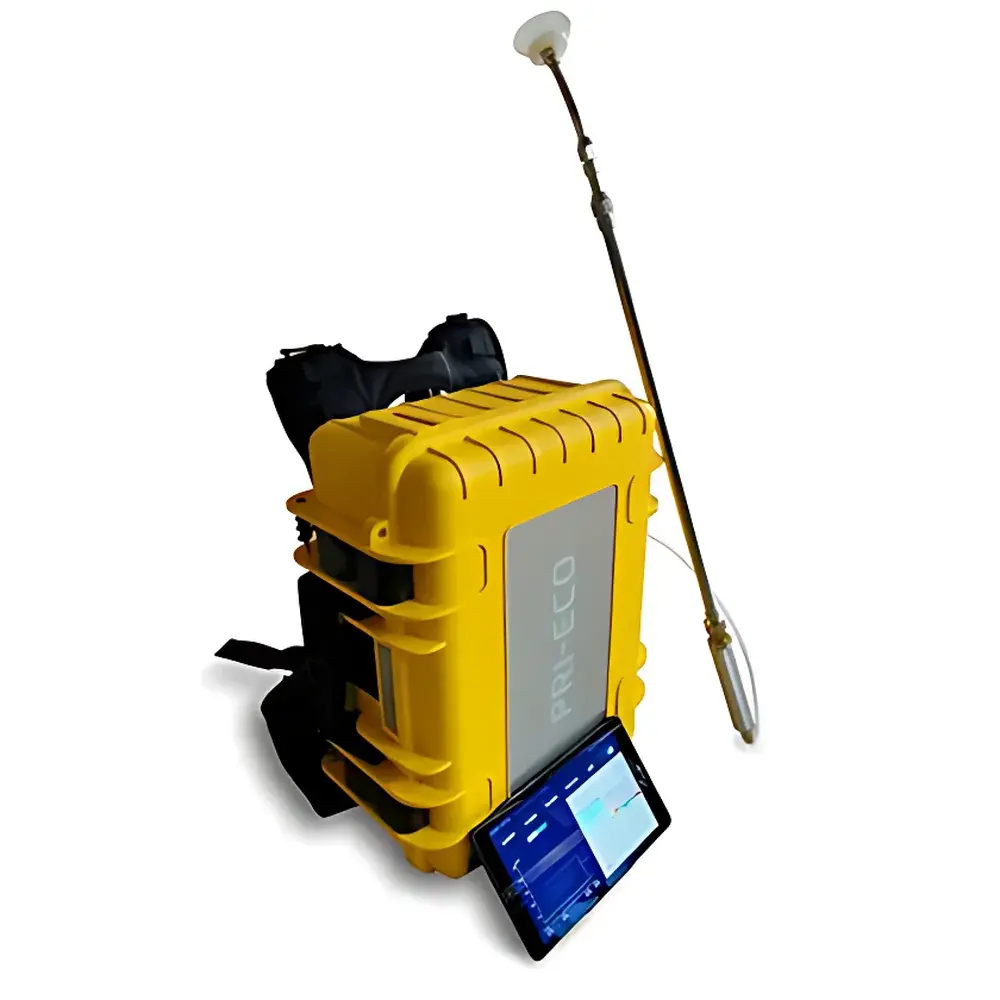
Pri-eco ZERO Portable High-Precision Natural Gas Leak Detection System
| Brand | Pri-eco |
|---|---|
| Origin | Beijing, China |
| Manufacturer Type | Manufacturer |
| Country of Origin | Domestic (China) |
| Model | ZERO Portable |
| Detection Principle | Mid-Infrared Laser Direct Absorption Spectroscopy (MIRLAS) |
| Target Gases & Ranges | CH₄ (0–10,000 ppm), C₂H₆ (0–1,000 ppm), H₂O (0–3 %) |
| Accuracy (1 s) | CH₄: 1 ppb, C₂H₆: 0.5 ppb, H₂O: 50 ppm |
| Data Update Rate | 1–5 Hz |
| Sample Temperature Range | −10 to +45 °C |
| Sample Flow Rate | 330 mL/min |
| Power Supply | 9–36 V DC, 2–4 A, 20–40 W |
| Weight | 4.1 kg |
| Dimensions | 365 × 295 × 170 mm |
| Battery Runtime | >7 h |
| Onboard Storage | 32 GB |
| Cloud Integration | Unlimited |
| Data Output | Wi-Fi, 5G |
| Data Security | End-to-end encryption, local server option |
| Environmental Rating | Tested for shock, vibration, and thermal cycling per IEC 60068-2 standards |
Overview
The Pri-eco ZERO Portable High-Precision Natural Gas Leak Detection System is an engineered field-deployable analyzer designed for quantitative, real-time detection and localization of methane (CH₄), ethane (C₂H₆), and water vapor (H₂O) in ambient air. It employs mid-infrared laser direct absorption spectroscopy (MIRLAS), a physics-based optical technique that exploits the fundamental vibrational-rotational absorption bands of target gases in the 2.5–12 µm spectral region. Unlike near-infrared or electrochemical methods, MIRLAS delivers inherently higher molecular specificity, reduced cross-sensitivity, and long-term baseline stability—critical for distinguishing thermogenic methane (e.g., from pipeline leaks) from biogenic sources via C₂H₆/CH₄ ratio analysis. The system features a compact, temperature- and pressure-stabilized multipass optical cell with optimized pathlength and flow dynamics, enabling high signal-to-noise ratio measurements at sub-ppb precision without cavity enhancement or high-finesse mirrors. Its architecture is purpose-built for mobile deployment: validated for operation across automotive, UAV-mounted, marine, and pedestrian survey platforms under ISO 14064-3 and EPA OOOOa-compliant monitoring protocols.
Key Features
- True field-portable design: 4.1 kg mass, integrated battery support (>7 h runtime), and low power consumption (20–40 W) enable seamless integration on drones, electric bicycles, SUVs, and handheld operations.
- MIRLAS core engine: Single-beam, mirror-free optical path minimizes alignment drift and mechanical hysteresis—ensuring <0.5 % system drift over 12 months without recalibration.
- High-speed, high-fidelity data acquisition: 1–5 Hz configurable output synchronized with GNSS position and IMU orientation for georeferenced plume mapping.
- Ruggedized mechanical construction: Shock- and vibration-tested per IEC 60068-2-64 (random vibration) and IEC 60068-2-27 (shock), with IP54-rated enclosure for dust and moisture resistance.
- Thermally regulated sample handling: Integrated Peltier-cooled inlet and pressure-controlled flow system maintain stable cavity conditions across −10 to +45 °C ambient range.
- Comprehensive onboard analytics: Real-time C₂H₆/CH₄ ratio calculation, leak localization algorithms (<1 m typical positional accuracy), and automated alarm tagging with GPS timestamping.
Sample Compatibility & Compliance
The ZERO system is validated for continuous sampling of ambient air containing up to 99 % RH (non-condensing) and particulate concentrations typical of urban, industrial, and rural environments. It complies with ASTM D6522–22 (Standard Test Method for Determination of Nitrogen Oxides, Carbon Monoxide, and Oxygen in Emissions from Stationary Sources by Continuous Sampling Methods) for gas measurement traceability principles, and supports audit-ready data logging aligned with EPA Method 21 and ISO 14067 requirements for GHG quantification. All firmware and calibration records adhere to ALCOA+ (Attributable, Legible, Contemporaneous, Original, Accurate, Complete, Consistent, Enduring, Available) principles. Optional NIST-traceable calibration gas certificates are available for regulatory reporting.
Software & Data Management
Data acquisition and post-processing are managed through Pri-eco’s proprietary ZERO Control Suite—a Windows/Linux-compatible application supporting real-time telemetry visualization, trajectory replay, and plume contour generation (CH₄/C₂H₆ spatial mapping). Raw spectra, concentration time-series, and GNSS metadata are stored locally (32 GB eMMC) with optional encrypted cloud synchronization. Export formats include CSV, NetCDF, and GeoJSON for GIS integration. The software implements role-based access control, full audit trail (per FDA 21 CFR Part 11 Annex 11), and cryptographic hash verification of all stored datasets. Firmware updates are digitally signed and delivered via secure OTA channel.
Applications
- Regulatory compliance surveys: EPA LDAR programs, state-level methane mitigation initiatives, and O&G facility emissions verification.
- Infrastructure integrity assessment: Pipeline corridor screening, compressor station perimeter monitoring, and LNG terminal fugitive emission audits.
- Scientific research: Urban methane flux studies, landfill gas migration tracking, and atmospheric chemistry campaigns requiring simultaneous CH₄/C₂H₆ isotopic proxy inference.
- Emergency response: Rapid leak source identification during blowdown events or post-seismic infrastructure damage assessments.
- Renewable natural gas (RNG) certification: Quantitative verification of biogas upgrading efficiency and pipeline injection purity.
FAQ
What detection principle does the ZERO system use, and why is it superior for methane leak detection?
It uses mid-infrared laser direct absorption spectroscopy (MIRLAS), which targets fundamental rovibrational transitions—offering orders-of-magnitude higher specificity and lower detection limits than NIR or catalytic bead sensors.
Can the ZERO system operate on unmanned aerial vehicles (UAVs)?
Yes. Its weight, power profile, and shock tolerance meet Class III UAV payload specifications per ASTM F3322-21; inertial navigation fusion enables accurate leak geo-localization during dynamic flight.
Is factory calibration traceable to international standards?
All factory calibrations are performed using NIST-traceable permeation tubes and certified gas standards; calibration certificates include uncertainty budgets per ISO/IEC 17025.
How is data security ensured during transmission and storage?
End-to-end AES-256 encryption is applied to all wireless (Wi-Fi/5G) transmissions and local storage; optional air-gapped deployment supports sovereign data hosting on customer-managed servers.
What maintenance schedule is recommended for field operation?
Annual verification of optical alignment and flow calibration is recommended; no routine consumables or sensor replacements are required within the first 36 months of operation.
Related Products







