
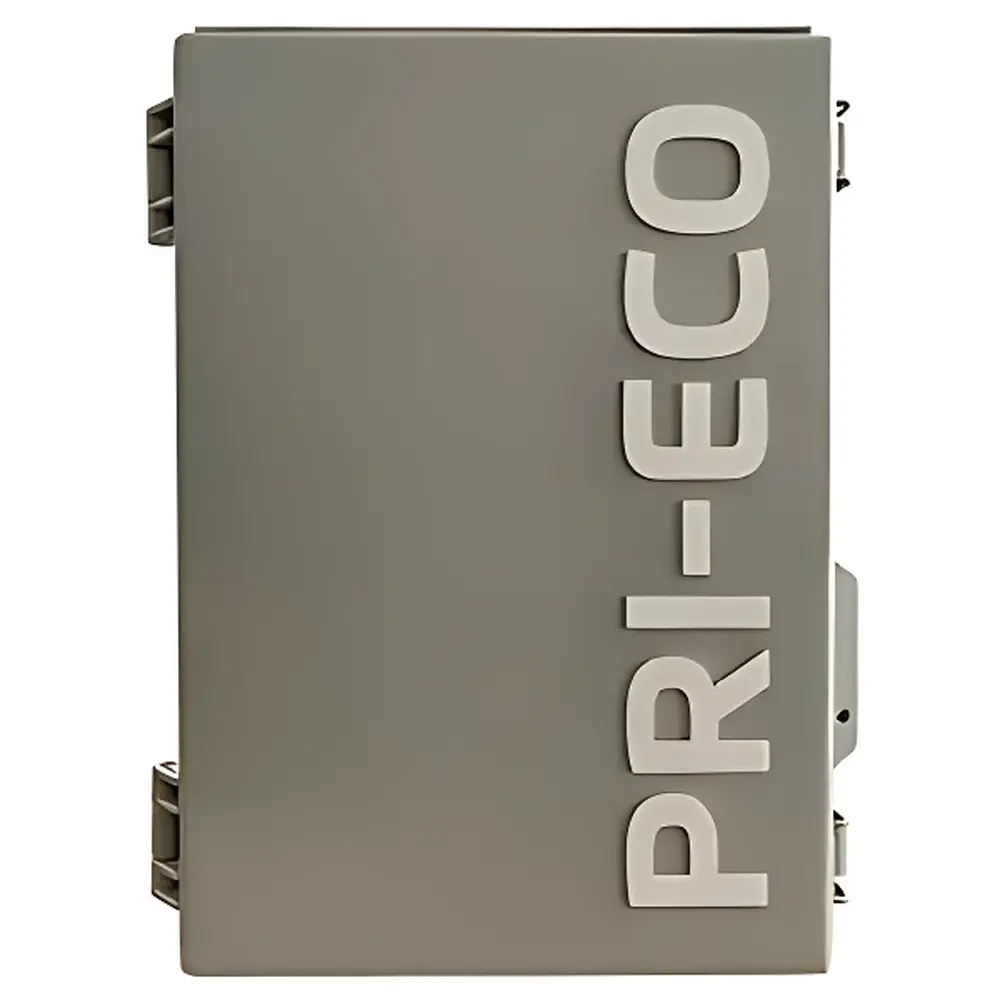
PRI-eco PRI-501w CO₂ and H₂O Analyzer
| Brand | PRI-eco |
|---|---|
| Origin | Beijing, China |
| Manufacturer Type | Original Equipment Manufacturer (OEM) |
| Model | PRI-501w |
| Measurement Principle | Dual-Wavelength Non-Dispersive Infrared (Dual-NDIR) |
| CO₂ Range | 0–2000 ppm |
| CO₂ Accuracy | ±2% of reading (±1.5% after calibration) |
| CO₂ Zero Stability | ±2% over >12 months |
| CO₂ Repeatability (Zero) | ±0.3% |
| CO₂ Repeatability (Span) | ±1.5% |
| CO₂ Zero Drift (Constant Temp.) | ±2% per year |
| CO₂ Zero Drift (Ambient Temp.) | ±0.03% per °C |
| H₂O Range | 0–6% vol |
| H₂O Accuracy | ±2% of reading |
| Operating Temperature | −20 to +45 °C |
| Operating Pressure | 800–1150 mbar |
| Sample Flow Rate | 1 L/min (adjustable) |
| T₉₀ Response Time | 10 s (adjustable) |
| Warm-up Time | 1 min |
| Calibration Interval | Recommended annually |
| Max. Humidity | <99% RH (non-condensing) |
| Outputs | RS-232, Analog (0–5 V / 4–20 mA) |
| Dimensions | 250 × 160 × 90 mm |
| Weight | 3 kg |
| Power Supply | 7–28 V DC |
Overview
The PRI-eco PRI-501w CO₂ and H₂O Analyzer is a field-deployable, dual-channel gas concentration analyzer engineered for high-precision, long-term environmental monitoring in urban ecosystem studies, eddy covariance flux networks, and atmospheric boundary layer research. It employs dual-wavelength non-dispersive infrared (Dual-NDIR) spectroscopy — a physically robust and interference-resistant optical method that leverages two discrete infrared absorption bands: one centered at the primary CO₂ absorption peak near 4.26 µm, and another at a nearby reference wavelength where CO₂ absorption is negligible. A monolithic silicon wafer-based broadband IR source provides stable, spectrally consistent emission across both channels, minimizing drift due to thermal aging or mechanical misalignment. Simultaneous measurement of sample gas temperature and internal optical path temperature enables real-time thermodynamic compensation, while integrated absolute pressure and ambient temperature sensors support full atmospheric state correction per the ideal gas law. This architecture ensures traceable, pressure- and temperature-compensated concentration outputs compliant with ISO 12039 and ASTM D6216 standards for ambient gas analysis.
Key Features
- Dual-wavelength NDIR optical engine with monolithic silicon IR source — replaceable in-field without recalibration
- Onboard microprocessor with adaptive signal normalization algorithms to correct for source intensity decay and optical window contamination
- Integrated temperature, pressure, and flow monitoring — all used in real-time compensation of raw absorbance signals
- Simultaneous CO₂ (0–2000 ppm) and H₂O (0–6% vol) quantification with independent calibration matrices
- Low-power design optimized for solar-battery operation (7–28 V DC input); typical power draw <2.5 W in continuous mode
- Compact, ruggedized housing (IP54-rated enclosure) suitable for unattended outdoor deployment in diverse climatic zones
- Configurable analog output (0–5 V or 4–20 mA) and RS-232 serial interface supporting Modbus RTU and ASCII protocols
Sample Compatibility & Compliance
The PRI-501w is designed for continuous sampling of ambient air, stack effluent, and soil respiration gases. Its inlet path accommodates particulate-laden streams when paired with standard hydrophobic membrane filters (e.g., PTFE, 0.2 µm pore size). The analyzer meets electromagnetic compatibility requirements per IEC 61326-1 (industrial environment), and its analog output circuits comply with IEC 61000-4-5 surge immunity (2 kV line-to-earth). For regulatory reporting, measurement uncertainty budgets are traceable to NIST-certified gas standards (e.g., CO₂ in N₂, certified to ±0.5% k=2), and instrument validation follows ISO/IEC 17025 principles. While not FDA 21 CFR Part 11–certified by default, audit-ready data logging (with timestamped metadata) supports GLP/GMP-aligned field deployments when used with validated external data acquisition systems.
Software & Data Management
The PRI-501w operates autonomously but interfaces seamlessly with third-party SCADA, CR1000X, or Raspberry Pi–based edge controllers via ASCII command set or Modbus registers. Firmware supports user-defined averaging intervals (1 s to 60 min), configurable alarm thresholds, and cyclic self-diagnostic logs (optical gain, detector offset, temperature gradients). Optional 4G LTE cellular module enables remote firmware updates, diagnostic telemetry, and secure MQTT-based data streaming to cloud platforms (e.g., AWS IoT Core or Azure IoT Hub). All output data include embedded metadata: UTC timestamp, internal sensor readings (T, P, flow), and instrument status flags — ensuring full chain-of-custody for time-series analysis.
Applications
- Urban carbon flux monitoring in smart city infrastructure projects
- Soil-atmosphere exchange studies using closed-chamber or gradient methods
- Indoor air quality (IAQ) assessment in green buildings and transit hubs
- Calibration verification and cross-sensitivity characterization of low-cost CO₂ sensors
- Integration into multi-parameter environmental stations (wind speed/direction, PAR, rain gauge, PM₂.₅)
- Mobile platform deployments on UAVs, vehicles, or backpack-mounted sensor arrays
FAQ
Does the PRI-501w require periodic zero/span gas injections?
No — it features automatic baseline stabilization via dual-wavelength referencing and does not rely on external zero gas. Span calibration is recommended annually using certified standard gases.
Can the unit operate continuously at −20 °C?
Yes — the internal thermoelectric heater maintains optical block temperature within operational range; battery-heated inlet lines are advised for sub-zero condensation-prone environments.
Is analog output linear across the full CO₂ range?
Yes — factory-calibrated 4–20 mA output maps linearly to 0–2000 ppm CO₂ with NIST-traceable linearity verification (R² > 0.9999).
What maintenance is required beyond annual calibration?
Routine inspection of inlet filter integrity and optical window cleanliness; no consumables or moving parts are present in the optical path.
How is data synchronization handled across distributed PRI-501w nodes?
All units support PPS (pulse-per-second) input for hardware-level time alignment and NTP client mode when connected to Ethernet-enabled gateways.
Related Products




