
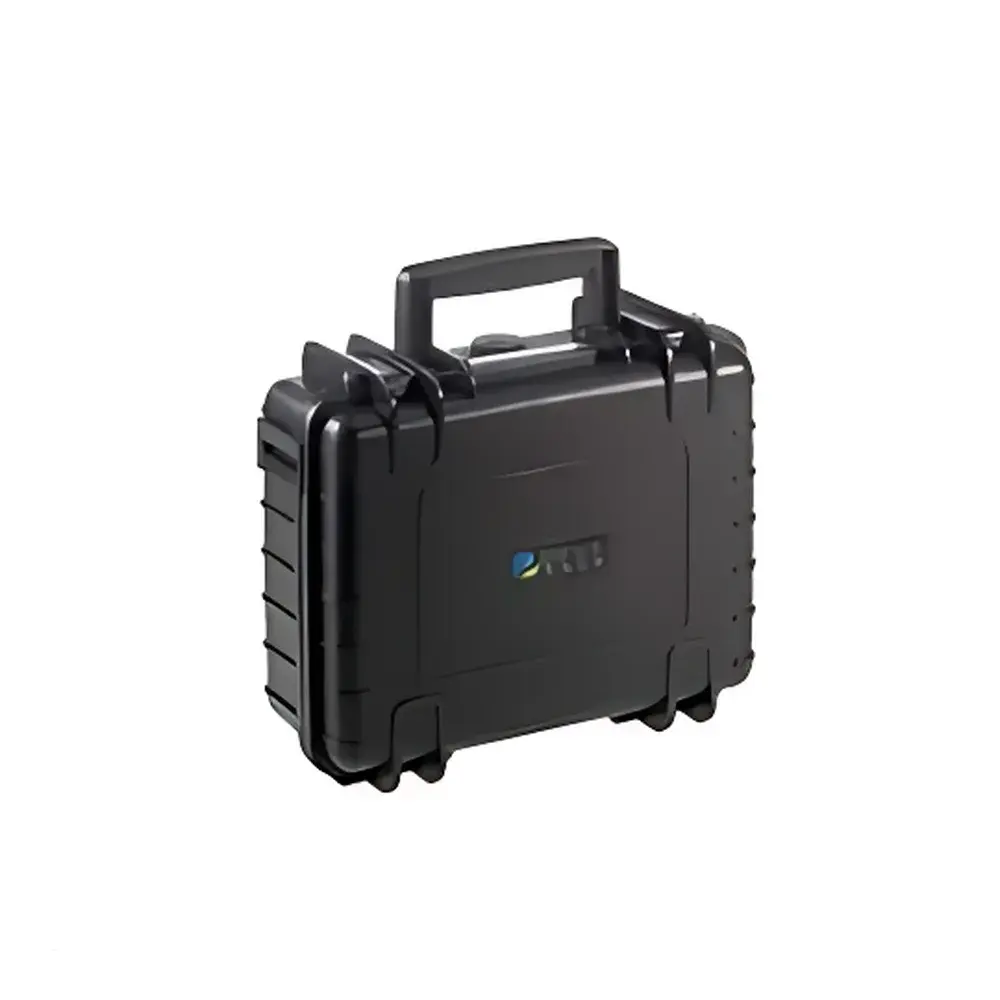
Pri-eco PRI-503 Dual-NDIR CO₂, CH₄, and H₂O Gas Analyzer
| Brand | Pri-eco |
|---|---|
| Origin | Beijing, China |
| Manufacturer Type | Direct Manufacturer |
| Model | PRI-503 |
| Detection Principle | Dual-Wavelength Non-Dispersive Infrared (Dual-NDIR) |
| Measurable Gases | CO₂, CH₄, H₂O |
| CO₂ Range Options | 0–0.2%, 0.5%, 1%, 5%, 10%, 100% |
| CH₄ Range Options | 0–5%, 10%, 30% |
| H₂O Range | 0–6% |
| CO₂/CH₄ Accuracy | ±2% (±1.5% after calibration) |
| Zero Stability (CO₂/CH₄) | ±2% over >12 months |
| Repeatability (Zero/Span) | ±0.3%/±1.5% |
| Zero Drift (Constant Temp.) | ±2%/year |
| Zero Drift (Ambient Temp.) | ±0.03%/°C |
| H₂O Accuracy | ±2% |
| Operating Temperature | −20 to +45 °C |
| Operating Pressure | 800–1150 mbar |
| Sample Flow Rate | 1 L/min (adjustable) |
| T90 Response Time | 10 s (adjustable) |
| Warm-up Time | 1 min |
| Humidity Limit | <99% RH, non-condensing |
| Outputs | RS-232, Analog (4–20 mA / 0–10 V) |
| Dimensions | 250 × 160 × 90 mm |
| Weight | 2.2 kg |
| Power Supply | 7–28 V DC |
Overview
The Pri-eco PRI-503 Dual-NDIR CO₂, CH₄, and H₂O Gas Analyzer is an engineered solution for continuous, field-deployable measurement of three critical atmospheric constituents—carbon dioxide (CO₂), methane (CH₄), and water vapor (H₂O)—using dual-wavelength non-dispersive infrared (Dual-NDIR) spectroscopy. Unlike single-beam NDIR systems, the PRI-503 employs a silicon wafer-based dual-channel infrared source with matched reference and measurement wavelengths, enabling real-time compensation for source intensity drift, optical window contamination, and thermal lensing effects. This architecture delivers high reproducibility in variable environmental conditions without requiring frequent recalibration. The analyzer integrates embedded pressure and temperature sensors for automatic ambient compensation, ensuring traceable concentration outputs across operating ranges of 800–1150 mbar and −20 to +45 °C. Its compact form factor (250 × 160 × 90 mm, 2.2 kg) supports both portable survey applications and permanent installation in ambient air monitoring stations, eddy covariance flux towers, landfill gas networks, and biogas upgrading facilities.
Key Features
- Dual-wavelength NDIR optical engine with silicon wafer IR source—designed for long-term spectral stability and immunity to mechanical shock
- Onboard microprocessor with adaptive signal processing algorithms that continuously correct for baseline drift induced by optical fouling or source aging
- Integrated absolute pressure and PT100-class temperature sensing for real-time thermobaric compensation per ISO 4223 and ASTM D6245 standards
- Simultaneous, independent quantification of CO₂, CH₄, and H₂O within a single optical path—eliminating cross-interference through wavelength-specific filtering and digital lock-in detection
- Configurable gas range options: CO₂ (0–0.2% up to 0–100%), CH₄ (0–5% up to 0–30%), and H₂O (0–6%)—enabling application-specific sensitivity optimization
- Low power consumption (7–28 V DC) and rapid 60-second warm-up support battery- or solar-powered remote deployments
- Robust mechanical design rated for outdoor use (IP54 equivalent enclosure); no moving parts or consumables required
Sample Compatibility & Compliance
The PRI-503 accepts dry or humidified sample streams with dew points up to 99% relative humidity (non-condensing). It is compatible with standard ¼″ OD stainless steel or PTFE sampling lines and operates reliably at flow rates from 0.5 to 2.0 L/min. All internal wetted materials—including the optical cell, inlet manifold, and sensor housing—are chemically inert (316L SS, fused silica, Kalrez® seals), minimizing adsorption artifacts for reactive trace gases. The instrument complies with electromagnetic compatibility requirements per IEC 61326-1 (industrial environment) and meets functional safety guidelines aligned with IEC 61508 SIL 2 for continuous emission monitoring. Data integrity conforms to GLP/GMP principles: analog and digital outputs include timestamped metadata, and internal diagnostics log all calibration events, sensor health metrics, and environmental parameters for audit readiness.
Software & Data Management
The PRI-503 communicates via RS-232 serial interface (ASCII protocol) and configurable analog outputs (4–20 mA or 0–10 V). A standardized Modbus RTU option is available for integration into SCADA or PLC-based infrastructure. Pri-eco provides the optional PRI-Link PC software for local configuration, real-time data visualization, and automated report generation compliant with EPA Method TO-15 and ISO 14064-2 reporting templates. All firmware updates are delivered via signed binary packages with SHA-256 verification. Internal memory stores ≥30 days of 1-second resolution data (CO₂, CH₄, H₂O, T, P) with cyclic overwrite—accessible via USB-C port for offline retrieval. Audit trails meet FDA 21 CFR Part 11 requirements when paired with validated third-party data acquisition systems.
Applications
- Ambient air quality monitoring networks measuring urban and background greenhouse gas gradients
- Eddy covariance flux systems for ecosystem-scale CO₂ and CH₄ exchange studies (aligned with FLUXNET protocols)
- Landfill gas collection and flare efficiency assessment per U.S. EPA SW-846 Method 0030
- Biogas composition monitoring in anaerobic digesters and upgrading units (EN 16714-1 compliance support)
- Soil respiration chambers and closed-loop incubation experiments requiring simultaneous H₂O compensation
- Calibration transfer validation between cavity ring-down spectrometers (CRDS) and NDIR platforms
- Mobile platform integration (e.g., UAV-mounted or vehicle-based surveys) due to low mass and shock resistance
FAQ
Does the PRI-503 require zero/span gas cylinders for routine operation?
No—its dual-wavelength architecture and active thermal/pressure compensation eliminate the need for daily zeroing. Field calibration is recommended annually using certified gas standards traceable to NIST or BIPM.
Can the instrument operate unattended for extended periods in remote locations?
Yes—designed for continuous duty with onboard diagnostics, low-power electronics, and non-volatile memory. Battery life exceeds 72 hours on a 12 V, 10 Ah LiFePO₄ pack under typical sampling conditions.
Is cross-sensitivity between CO₂ and CH₄ corrected in firmware?
Yes—spectral interference is mitigated through hardware-level bandpass filtering and software-based multivariate regression using factory-characterized response matrices.
What maintenance is required beyond annual calibration?
Only periodic inspection of inlet particulate filters and optical windows; no optical alignment or lamp replacement is necessary over the 5-year design lifetime.
How does the PRI-503 handle condensation in high-humidity samples?
It does not tolerate liquid water ingress. Users must install a Nafion™ dryer or chilled mirror dew point controller upstream if sample dew point exceeds instrument-rated limits.







