
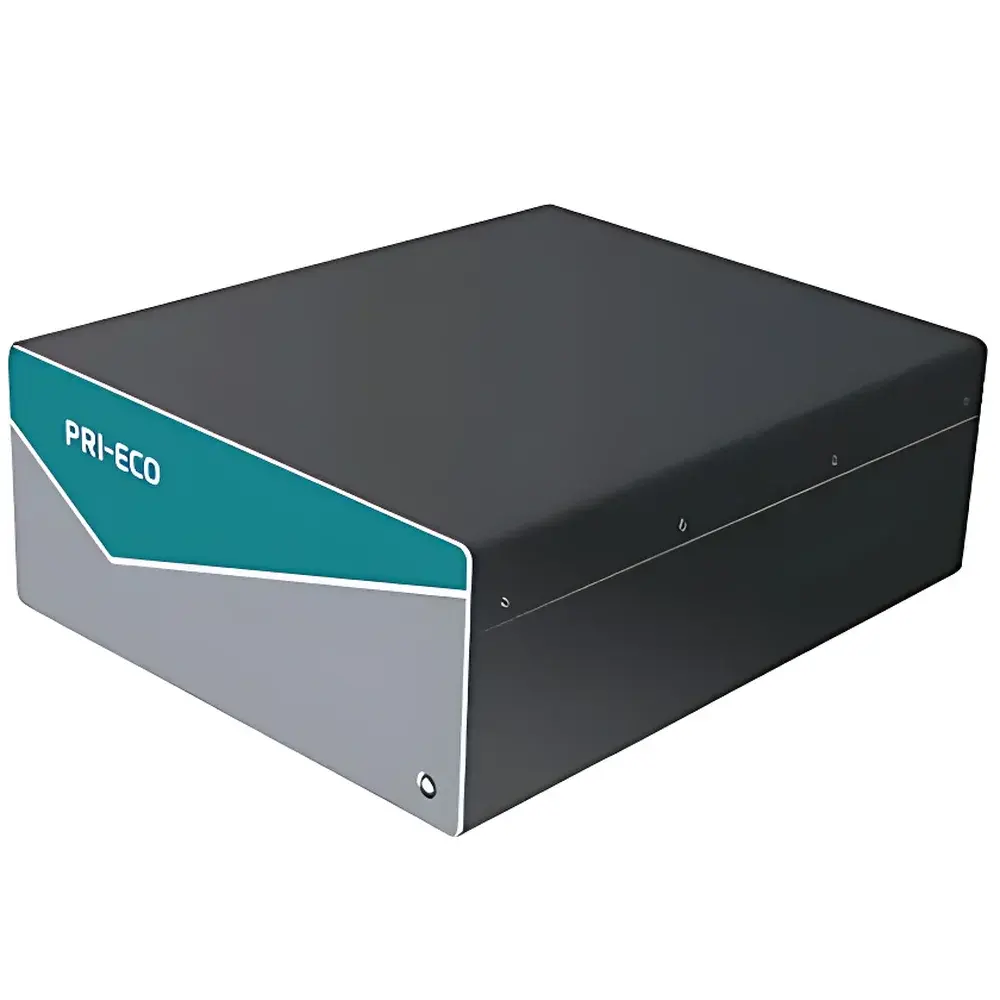
Pri-eco PRI-5231 CO₂, N₂O, and H₂O Analyzer
| Brand | Pri-eco |
|---|---|
| Origin | Beijing, China |
| Manufacturer Type | Manufacturer |
| Origin Category | Domestic |
| Model | PRI-5231 |
| Price | Upon Request |
| Application Field | Environmental Monitoring |
| Detection Principle | Mid-Infrared Laser Direct Absorption Spectroscopy (MIRLAS) |
| Measured Gases and Ranges | CO₂ (0–3500 ppm), N₂O (0–500 ppb), H₂O (0–3 %v/v) |
Overview
The Pri-eco PRI-5231 CO₂, N₂O, and H₂O Analyzer is a high-precision, field-deployable trace gas analyzer engineered for continuous, simultaneous quantification of carbon dioxide (CO₂), nitrous oxide (N₂O), and water vapor (H₂O) in ambient air or controlled sampling streams. It employs mid-infrared laser direct absorption spectroscopy (MIRLAS), leveraging the fundamental vibrational–rotational absorption bands of target molecules in the 4–12 µm spectral region. Unlike near-infrared (NIR) techniques, MIRLAS provides orders-of-magnitude higher absorption cross-sections—enabling sub-ppb detection limits for N₂O and sub-0.1 ppm precision for CO₂ at 1 Hz acquisition rate—without requiring optical cavities, high-finesse mirrors, or complex multipass cells. The instrument’s compact, temperature- and pressure-stabilized measurement cell ensures minimal thermal drift and high spectral fidelity. Designed to meet World Meteorological Organization (WMO) Global Atmosphere Watch (GAW) compatibility criteria for greenhouse gas (GHG) observatories, the PRI-5231 delivers metrologically traceable data suitable for long-term trend analysis, flux tower integration, mobile platform deployment (e.g., aircraft, vessels, ground vehicles), and regulatory-grade monitoring networks.
Key Features
- Simultaneous, real-time detection of CO₂, N₂O, and H₂O at 1 Hz native data acquisition rate
- Mid-infrared (MIR) laser source targeting fundamental rovibrational transitions—ensuring superior selectivity, reduced interferences, and intrinsic calibration stability
- Optimized low-volume measurement cell (~120 mL) enabling rapid gas exchange, precise thermobaric control, and minimized memory effects
- Ruggedized mechanical architecture validated under MIL-STD-810G shock and vibration profiles—certified for mobile and remote deployments
- Integrated temperature and pressure sensors with active feedback control; measurement uncertainty propagated per ISO 5725 and GUM guidelines
- Low power consumption (50 W steady-state, 90 W warm-up) and universal AC input (110–230 V) for global operational flexibility
- Factory pre-calibrated with NIST-traceable standards; zero and span verification supported via integrated valve manifold or external gas standards
Sample Compatibility & Compliance
The PRI-5231 accepts sample gas within a temperature range of −10 °C to +45 °C and relative humidity up to 99 % RH (non-condensing). Sample flow rate is optimized at ~180 mL/min, compatible with standard 1/4″ PFA or stainless-steel inlet tubing. The analyzer complies with WMO GAW Data Quality Objectives for GHG measurements, including requirements for precision (≤0.04 ppm CO₂ at 5 min averaging; ≤0.03 ppb N₂O), long-term stability (<0.2 ppm CO₂ / 0.2 ppb N₂O over 24 h), and linearity across full dynamic ranges. Its design supports GLP-compliant operation: audit trails, user access logs, and timestamped raw spectra are retained internally. While not FDA 21 CFR Part 11 certified out-of-the-box, the firmware architecture permits configuration for electronic signature and data integrity workflows in regulated environmental laboratories.
Software & Data Management
The PRI-5231 ships with Pri-eco’s proprietary GasView™ software suite (Windows-compatible), providing real-time spectral visualization, automated baseline correction, multi-component fitting using Voigt line profiles, and configurable alarm thresholds. All raw interferograms and fitted concentration time series are stored in HDF5 format—self-describing, compressible, and interoperable with Python (h5py), MATLAB, and netCDF ecosystems. Data export supports ASCII CSV, JSON, and Modbus TCP protocols. Remote monitoring and configuration are enabled via RS-232 serial interface or USB virtual COM port; optional Ethernet module adds SNMP and HTTP API support. Firmware updates and spectral diagnostics are performed without hardware disassembly.
Applications
- Long-term atmospheric GHG monitoring at WMO/GAW stations and national observatories
- Eddy covariance flux measurements over forests, agricultural soils, wetlands, and urban interfaces
- Mobile platform deployments: airborne campaigns (e.g., NOAA AOS, ICOS airborne labs), shipboard ocean-atmosphere exchange studies, and vehicle-based urban emission mapping
- Soil respiration and chamber-based ecosystem flux experiments
- Calibration transfer and reference standard validation for secondary analyzers
- Supporting national MRV (Measurement, Reporting, Verification) frameworks aligned with UNFCCC and Paris Agreement implementation
FAQ
What is the minimum detectable concentration for N₂O at 1-second integration?
The 1σ noise-equivalent concentration is ≤0.2 ppb for N₂O under standard operating conditions (25 °C, 1013 hPa, dry air matrix).
Does the analyzer require periodic mirror alignment or optical recalibration?
No—MIRLAS eliminates cavity-enhanced optics; the fixed-path, monolithic optical bench requires no user alignment and exhibits <0.5 % signal drift over 6 months.
Can the PRI-5231 be integrated into an existing eddy covariance system?
Yes—it outputs synchronized analog voltage (0–5 V) and digital (RS-232/USB) streams with microsecond-level timestamping compatible with Campbell Scientific CR6, LI-COR LI-7550, and similar data loggers.
Is humid gas measurement compensated in real time?
Yes—H₂O concentration is measured concurrently and used to correct CO₂ and N₂O absorbance via pressure-broadening and dilution algorithms embedded in the spectral fitting engine.
What maintenance is required on an annual basis?
Annual verification includes inlet filter replacement, zero/span check with certified gases, and internal pressure sensor calibration—typically completed in <2 hours by trained personnel.
Related Products







