
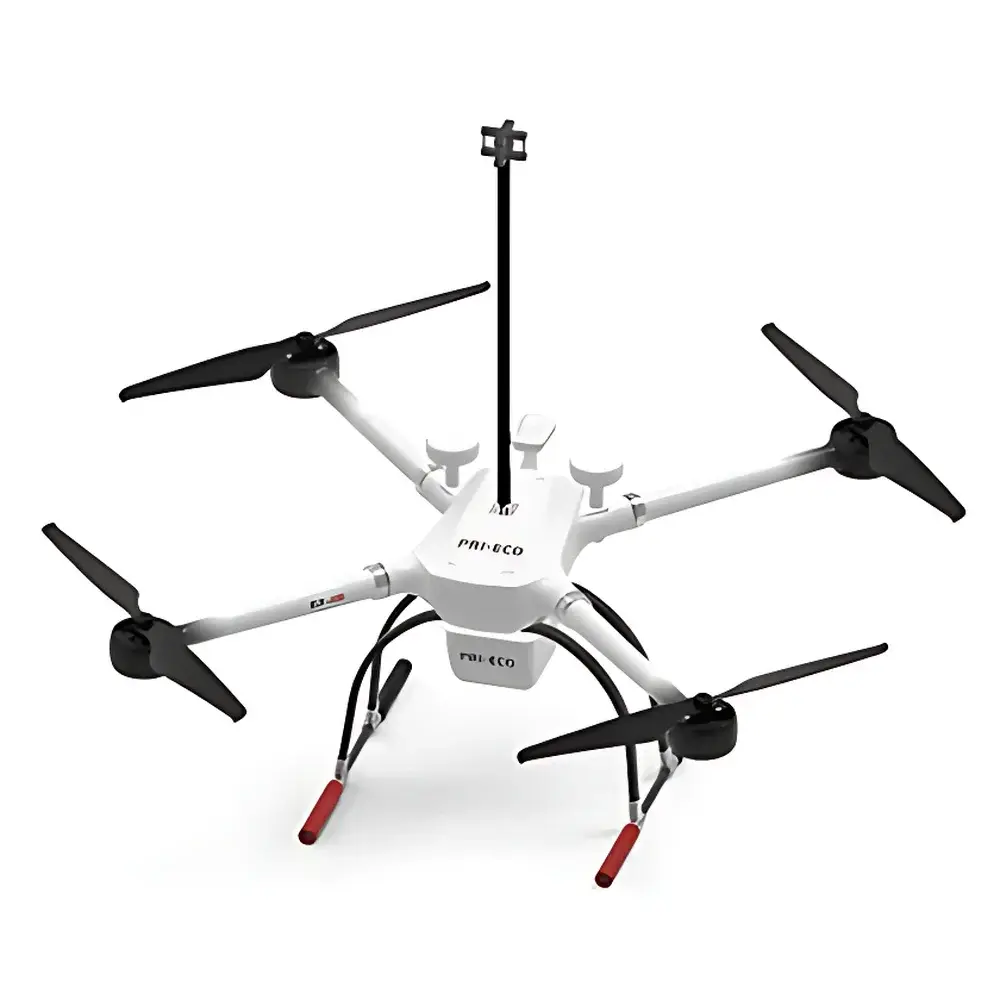
Pri-eco PRI-5231f CO₂, N₂O, and H₂O Analyzer
| Brand | Pri-eco |
|---|---|
| Origin | Beijing, China |
| Manufacturer Type | Manufacturer |
| Country of Origin | Domestic (China) |
| Model | PRI-5231f |
| Power Input | 110–230 V AC |
| Weight | 1.86 kg |
| Sampling Flow Rate | ~180 mL/min |
| Operating Temperature | −10 to 45 °C |
| Relative Humidity Limit | <99% RH (non-condensing) |
| Data Output | Wi-Fi, USB, RS-232 |
| Power Consumption | 50 W (steady-state), 90 W (warm-up) |
| CO₂ Precision (1 s) | 0.2 ppm |
| N₂O Precision (1 s) | 0.2 ppb |
| H₂O Precision (1 s) | 50 ppm |
| CO₂ Precision (5 s) | 0.12 ppm |
| N₂O Precision (5 s) | 0.12 ppb |
| H₂O Precision (5 s) | 40 ppm |
| CO₂ Range | 0–3500 ppm |
| N₂O Range | 0–500 ppb |
| H₂O Range | 0–3 %v/v |
| 24-h Drift (CO₂) | 0.3 ppm |
| 24-h Drift (N₂O) | 0.3 ppb |
| Sampling Frequency | 1 or 2 Hz |
| Measurement Principle | Mid-Infrared Laser Absorption Spectroscopy (MIRLAS) |
Overview
The Pri-eco PRI-5231f CO₂, N₂O, and H₂O Analyzer is a field-deployable, high-fidelity multi-gas analyzer engineered for precision atmospheric monitoring in demanding environmental and scientific applications. Built around a proprietary miniaturized mid-infrared (MIR) laser sensor engine, the instrument implements direct absorption spectroscopy (MIRLAS) — a physics-based measurement principle that leverages strong fundamental vibrational absorption bands in the 4–12 µm spectral region. This enables simultaneous, independent quantification of carbon dioxide (CO₂), nitrous oxide (N₂O), and water vapor (H₂O) with sub-part-per-trillion sensitivity for N₂O and sub-part-per-billion resolution for CO₂. Unlike near-infrared (NIR) systems requiring high-finesse optical cavities or retroreflective mirrors, the MIRLAS architecture achieves high signal-to-noise ratio through intrinsic molecular absorption strength, resulting in simplified optical path design, inherent long-term stability, and minimal zero/span drift. The analyzer is explicitly optimized for integration onto unmanned aerial systems (UAS), including small fixed-wing and multirotor platforms, where strict constraints on mass (1.86 kg), power draw (50 W steady-state), and volumetric footprint are non-negotiable.
Key Features
- Triple-species detection: Real-time, synchronous measurement of CO₂, N₂O, and H₂O using a single compact optical bench.
- ppb-level N₂O sensitivity: Achieves 0.2 ppb (1σ, 1 s) detection limit — meeting World Meteorological Organization (WMO) Global Atmosphere Watch (GAW) compatibility criteria for background greenhouse gas monitoring.
- Thermally stabilized MIR laser source and precision pressure-controlled sample cell ensure <0.3 ppm (CO₂) and <0.3 ppb (N₂O) 24-hour drift, enabling unattended operation over extended campaigns.
- Robust environmental tolerance: Validated for continuous operation across −10 to +45 °C ambient temperature and up to 99% RH (non-condensing).
- Modular interface architecture: Native support for Wi-Fi (IEEE 802.11 b/g/n), USB 2.0, and RS-232 serial output — compatible with standard telemetry stacks and ground control software used in UAS operations.
- Low-power, aviation-grade thermal management: Optimized heat dissipation and cold-start performance facilitate rapid deployment in variable field conditions without external cooling.
Sample Compatibility & Compliance
The PRI-5231f accepts ambient air samples at flow rates of approximately 180 mL/min, with no requirement for chemical scrubbing, drying, or catalytic conversion prior to analysis. Its optical measurement path is inherently insensitive to particulate loading typical of boundary-layer and lower-tropospheric sampling. The analyzer complies with key metrological frameworks governing atmospheric composition measurements, including WMO GAW data quality objectives for CO₂ and N₂O (WMO No. 254, 2022 edition) and ISO 17025:2017 requirements for calibration traceability to NIST-certified reference standards. All factory calibrations are performed against gravimetrically prepared primary gas standards, with documented uncertainty budgets per component. The system supports GLP-compliant audit trails when paired with Pri-eco’s optional data acquisition firmware (v3.2+), including timestamped calibration events, diagnostic logs, and sensor health metrics.
Software & Data Management
Data acquisition and configuration are managed via Pri-eco’s cross-platform Command & Control (C&C) Suite — a lightweight, command-line and GUI-enabled application supporting Windows, Linux, and macOS. Raw spectra, concentration time series, and auxiliary metadata (temperature, pressure, flow, laser current/voltage) are logged in HDF5 format, ensuring interoperability with Python (h5py), MATLAB, and R ecosystems. The suite includes built-in tools for spectral fitting validation, baseline correction diagnostics, and outlier flagging based on Allan variance analysis. For integration into automated observatory networks or UAS telemetry pipelines, the analyzer exposes a RESTful API over TCP/IP and supports MQTT publishing to cloud-based ingestion services (e.g., AWS IoT Core, Azure IoT Hub). Firmware updates are delivered via signed binary packages with SHA-256 verification, satisfying secure boot and integrity-check requirements under ISO/IEC 27001-aligned IT infrastructure policies.
Applications
- Vertical profiling of greenhouse gas gradients from UAV platforms for flux partitioning and source attribution studies.
- Mobile ground-based surveys of urban emissions, landfill plumes, agricultural soil fluxes, and wetland CH₄/N₂O co-emission dynamics.
- Calibration transfer and intercomparison campaigns between stationary towers and mobile platforms under WMO GAW protocols.
- Long-term eddy covariance site support, where real-time H₂O correction of CO₂/N₂O mixing ratios improves flux calculation fidelity.
- Validation of satellite remote sensing products (e.g., OCO-2, TROPOMI, GOSAT) through coordinated airborne underflights.
- Process monitoring in carbon capture utilization and storage (CCUS) pilot facilities requiring simultaneous trace gas accountability.
FAQ
What is the minimum detectable concentration for N₂O under field conditions?
The instrument achieves a 1σ detection limit of 0.2 ppb for N₂O at 1-second integration time, verified under controlled laboratory conditions using certified reference gases and validated during outdoor flight tests at altitudes up to 1,500 m ASL.
Does the analyzer require periodic zero/span calibration in the field?
No routine zero/span is required for stable operation. Drift is mitigated by active temperature and pressure stabilization; however, biannual verification against traceable standards is recommended for regulatory-grade reporting.
Can the PRI-5231f be integrated with third-party inertial measurement units (IMUs) or GPS modules?
Yes — the RS-232 and USB interfaces support NMEA 0183 and custom ASCII protocols for synchronized geotagging of gas concentration data.
Is the optical path susceptible to contamination in dusty or high-humidity environments?
The sample inlet incorporates a hydrophobic particulate filter (0.2 µm pore size) and a passive Nafion™ dryer stage; internal optics are sealed and purged with dry nitrogen during manufacturing to prevent condensation-induced scattering.
What certification standards does the device meet for electromagnetic compatibility (EMC)?
The analyzer complies with EN 61326-1:2013 (industrial environment) and FCC Part 15 Subpart B Class A for conducted and radiated emissions. Full test reports are available under NDA upon request.







