
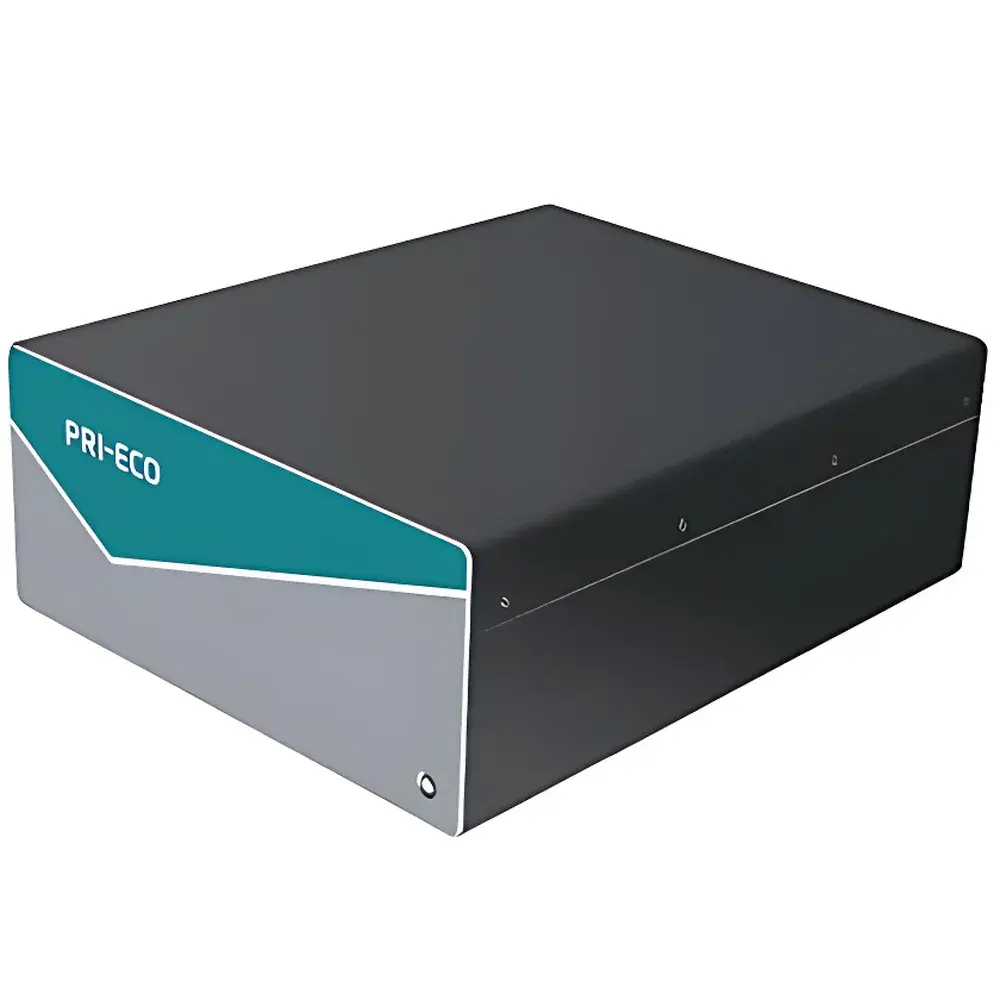
PRI-ECO PRI-5232 CO, N₂O, and H₂O Analyzer
| Brand | PRI-ECO |
|---|---|
| Model | PRI-5232 |
| Detection Principle | Mid-Infrared Laser Absorption Spectroscopy (MIRLAS) |
| Measured Gases | CO, N₂O, H₂O |
| Accuracy (1 s) | 0.6 ppb (CO), 0.4 ppb (N₂O), 50 ppm (H₂O) |
| Accuracy (1 min) | 0.4 ppb (CO), 0.08 ppb (N₂O), 40 ppm (H₂O) |
| Accuracy (5 min) | 0.2 ppb (CO), 0.05 ppb (N₂O), 10 ppm (H₂O) |
| Measurement Range | 0–500 ppm (CO), 0–500 ppm (N₂O), 0–3 %v/v (H₂O) |
| 24-h Drift | ≤0.3 ppb (CO), ≤0.2 ppb (N₂O) |
| Sampling Flow Rate | ~200 mL/min (standard), optional 1000 mL/min pump |
| Sampling Temperature | −10 to +45 °C |
| Sampling Humidity | <99% RH, non-condensing |
| Data Output | WiFi, USB, RS-232 |
| Power Supply | 110–230 V AC |
| Power Consumption | 40 W (steady-state), 60 W (warm-up) |
| Dimensions | 440 × 190 × 530 mm |
| Weight | 12 kg |
| Compliance | WMO GHG Observing Guidelines |
Overview
The PRI-ECO PRI-5232 CO, N₂O, and H₂O Analyzer is a field-deployable, mid-infrared laser absorption spectroscopy (MIRLAS) instrument engineered for high-precision, simultaneous, real-time quantification of carbon monoxide (CO), nitrous oxide (N₂O), and water vapor (H₂O) in ambient air and emission streams. Unlike near-infrared (NIR) or electrochemical sensors, MIRLAS leverages the fundamental vibrational-rotational absorption bands of target molecules—particularly strong and spectrally resolved in the 3–12 µm range—enabling unambiguous molecular identification, minimal cross-sensitivity, and intrinsic calibration stability. The analyzer operates on direct absorption spectroscopy principles: a tunable quantum cascade laser (QCL) scans across narrow spectral features of CO (e.g., ~2150 cm⁻¹), N₂O (~2225 cm⁻¹), and H₂O (~1370 cm⁻¹), while a thermoelectrically cooled photodetector measures attenuated intensity. Beer–Lambert law inversion yields absolute concentration values without reliance on reference cells or high-finesse optical cavities. Designed to meet the stringent metrological requirements of the World Meteorological Organization (WMO) Global Atmosphere Watch (GAW) Programme, the PRI-5232 delivers ppb-level precision at 1 Hz acquisition rate, making it suitable for eddy covariance flux studies, mobile platform deployments (vehicle, aircraft, marine vessel), and long-term observatory networks.
Key Features
- Triple-species detection (CO, N₂O, H₂O) with independent, simultaneous spectral channels and no chemical interference
- Compact, low-volume multipass optical cavity (< 100 mL) enabling rapid gas exchange, precise thermal stabilization, and robust pressure control—critical for minimizing temperature-induced baseline drift
- Factory-pre-aligned and fully pre-calibrated using NIST-traceable standard gases; zero and span verification intervals extend to ≥12 months under stable environmental conditions
- Passively stabilized optical bench with integrated shock-absorbing mounts and reinforced chassis—validated per MIL-STD-810G for vibration, drop, and thermal cycling resilience
- Low-power architecture (40 W steady-state) optimized for solar-battery hybrid systems and remote off-grid operation
- Real-time internal diagnostics including cavity pressure, cell temperature, laser current/temperature, and detector responsivity monitoring with automated compensation algorithms
Sample Compatibility & Compliance
The PRI-5232 accepts untreated, unfiltered ambient air or stack gas samples within −10 to +45 °C and <99% RH (non-condensing). An integrated Peltier-cooled Nafion™ dryer option is available for high-humidity applications requiring sub-10 ppm H₂O residual control. Sample flow is maintained at ~200 mL/min by an oil-free diaphragm pump; a high-flow (1000 mL/min) external pump module can be added for fast-response boundary layer profiling or integration into multi-analyzer manifolds. All measurement protocols and uncertainty budgets align with WMO GAW Recommended Practices (2022 Edition) and ISO 14644-1 cleanroom air quality guidelines for trace gas monitoring. Data provenance meets GLP audit requirements via embedded time-stamped metadata (UTC GPS-synced clock), hardware-enforced write-once logging, and configurable audit trails compliant with FDA 21 CFR Part 11 Annex 11 principles.
Software & Data Management
The analyzer ships with PRI-ECO’s proprietary GasVision™ firmware (v4.2+), supporting local configuration via touchscreen GUI or remote access through encrypted WiFi/RS-232/USB interfaces. Raw absorbance spectra, calibrated concentrations, diagnostic flags, and environmental parameters (T, P, RH) are output at 1 Hz in ASCII CSV or binary HDF5 format. Optional cloud synchronization enables automatic upload to PRI-ECO’s secure data portal (with TLS 1.3 encryption), where users access QA/QC dashboards, drift-corrected time-series plots, and automated WMO-compliant reporting templates (e.g., GAW Station Report, ICOS Tier-1 submission formats). All software modules undergo annual third-party validation against NPL and PTB reference datasets.
Applications
- Atmospheric research: Long-term greenhouse gas trend analysis at WMO GAW stations and regional monitoring networks
- Eddy covariance flux towers: High-temporal-resolution CO/N₂O/H₂O co-measurements for partitioning biosphere-atmosphere exchange
- Mobile monitoring: On-road vehicle emissions mapping, urban pollution gradient surveys, and aircraft-based vertical profiling
- Industrial compliance: Continuous emissions monitoring (CEMS) for landfill gas, wastewater treatment plants, and fertilizer production facilities
- Calibration transfer labs: Reference-grade source for secondary analyzers and intercomparison campaigns (e.g., ACTRIS, ICOS)
- Climate model validation: Ground-truthing satellite retrievals (e.g., TROPOMI, OCO-2/3) through coordinated campaign deployments
FAQ
Does the PRI-5232 require daily calibration or frequent span adjustments?
No. The instrument is factory calibrated using gravimetrically prepared standards traceable to NIST SRMs. Under typical field conditions, zero and span checks are recommended every 30 days; full recalibration is required only after major component replacement or exposure to extreme contamination events.
Can the analyzer operate unattended for extended periods?
Yes. With redundant power inputs, internal watchdog timers, and auto-recovery from brownout events, the PRI-5232 supports >12-month continuous operation. Remote firmware updates and diagnostic alerts minimize on-site service visits.
Is H₂O measurement used only for correction, or is it a primary output?
H₂O is a fully quantitative primary output—not merely a correction parameter—with accuracy specified to ±10 ppm (5-min average) across 0–3 %v/v. This enables direct use in humidity-dependent flux calculations and isotopic water vapor studies when paired with compatible δD/δ¹⁸O analyzers.
What data integrity safeguards are implemented?
All measurements include embedded UTC timestamps (GPS-synchronized), sensor health flags, and raw spectral files. Write-once storage prevents post-acquisition modification, and audit logs record all user actions, configuration changes, and calibration events—fully compliant with ISO/IEC 17025 and EPA Method TO-15A documentation requirements.







