
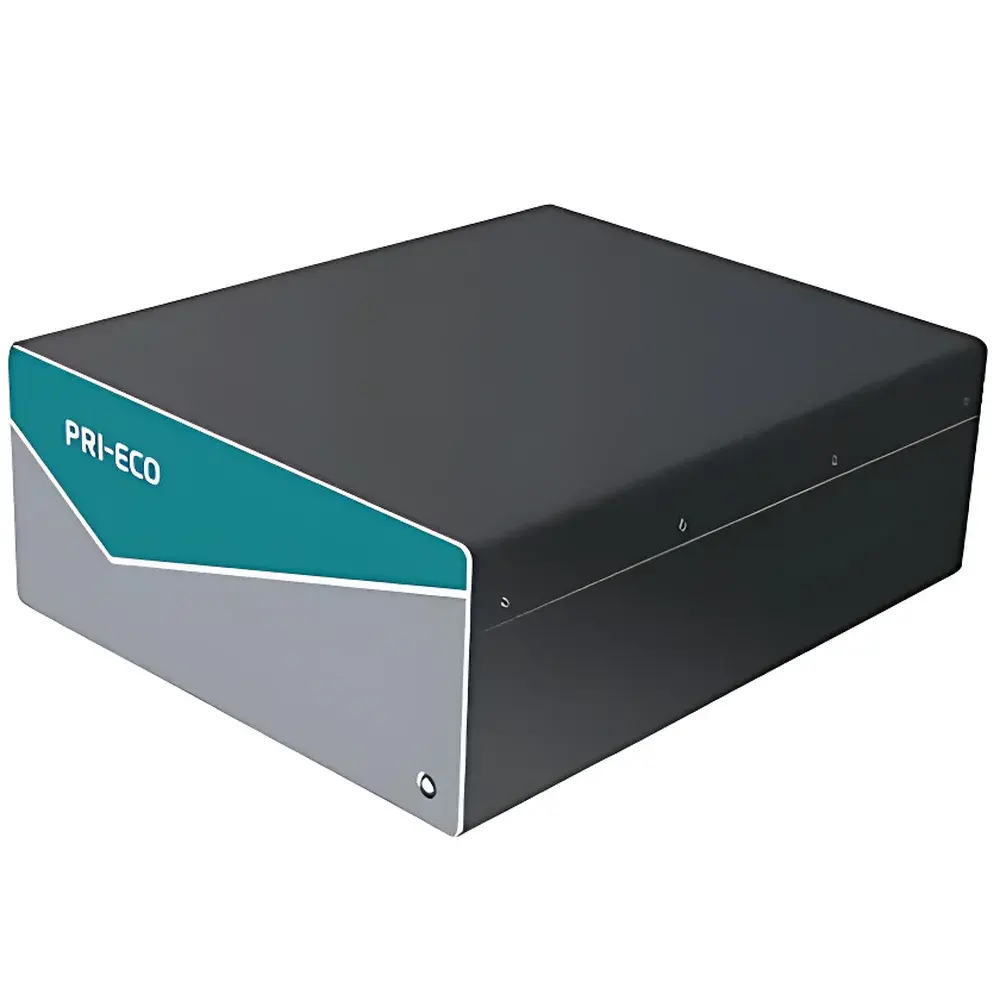
Pri-eco PRI-5233 CH₄/C₂H₆/H₂O Analyzer
| Brand | Pri-eco |
|---|---|
| Origin | Beijing, China |
| Manufacturer Type | Original Equipment Manufacturer (OEM) |
| Model | PRI-5233 |
| Detection Principle | Mid-Infrared Laser Direct Absorption Spectroscopy (MIRLAS) |
| Measured Gases | CH₄ (0–500 ppm), C₂H₆ (0–500 ppm), H₂O (0–3 %v/v) |
| Precision (1 s) | 1 ppb CH₄, 0.5 ppb C₂H₆, 50 ppm H₂O |
| Precision (1 min) | 0.3 ppb CH₄, 0.10 ppb C₂H₆, 40 ppm H₂O |
| Precision (5 min) | 0.2 ppb CH₄, 0.08 ppb C₂H₆, 10 ppm H₂O |
| Sampling Flow Rate | ~180 mL/min |
| Operating Temperature | –10 to +45 °C |
| Relative Humidity Limit | <99% RH, non-condensing |
| Data Output | USB, RS-232 |
| Power Supply | 110–230 V AC |
| Power Consumption | 50 W (steady-state), 90 W (warm-up) |
| Weight | 10.5 kg |
Overview
The Pri-eco PRI-5233 CH₄/C₂H₆/H₂O Analyzer is a factory-precalibrated, field-deployable gas analyzer engineered for high-fidelity, real-time quantification of methane (CH₄), ethane (C₂H₆), and water vapor (H₂O) in ambient or process air streams. It employs mid-infrared laser direct absorption spectroscopy (MIRLAS), leveraging the fundamental vibrational-rotational absorption bands of target gases in the 2.5–4 µm spectral region. This physical measurement principle ensures exceptional selectivity—free from cross-interference between CH₄ and C₂H₆—and eliminates reliance on optical cavities or high-reflectivity mirrors, thereby reducing sensitivity to alignment drift and contamination. The compact, thermally stabilized multipass measurement cell enables precise pressure and temperature control, directly supporting traceable concentration calculations per the Beer–Lambert law. Designed for long-term unattended operation, the instrument delivers sub-part-per-trillion (ppt)-level stability over multi-month intervals, with calibration traceability maintained via internal reference spectra and factory-established line-shape parameters.
Key Features
- Mid-infrared (MIR) direct absorption spectroscopy operating at fundamental rovibrational transitions—providing intrinsic specificity for CH₄ and C₂H₆ without chemical separation or catalytic conversion.
- Integrated thermal and pressure regulation within a low-volume optical cell (~150 mL), enabling rapid gas exchange (<2 s residence time) and minimizing memory effects during transient sampling.
- Ruggedized mechanical architecture validated under MIL-STD-810G shock and vibration profiles—certified for mobile deployment in vehicle-mounted, airborne (unpressurized cabin), and marine environments.
- Low-maintenance design: no consumables, no moving parts in the optical path, and <1 annual service requirement under continuous operation.
- Real-time data output at 1 Hz native acquisition rate, with onboard averaging algorithms supporting user-selectable integration times (1 s, 1 min, 5 min) and corresponding precision tiers.
- Embedded environmental monitoring: simultaneous, co-located measurement of sample temperature, pressure, and relative humidity to support full thermodynamic correction of spectral line broadening and intensity.
Sample Compatibility & Compliance
The PRI-5233 accepts untreated, filtered (2.5 µm particulate cutoff) ambient or stack gas samples across a wide operational envelope: –10 to +45 °C inlet temperature and up to 99% RH (non-condensing). Its robust flow control system maintains stable velocity (~180 mL/min) independent of backpressure fluctuations, ensuring consistent optical path length and signal-to-noise ratio. The analyzer meets IEC 61000-6-2/6-3 for electromagnetic compatibility and complies with CE marking requirements for industrial instrumentation. While not intrinsically safe certified, it is routinely deployed in Zone 2 hazardous locations when installed with appropriate barrier systems. Data integrity protocols align with GLP and ISO/IEC 17025 laboratory quality frameworks; audit trails, calibration logs, and raw spectral metadata are retained internally and exportable for regulatory reporting (e.g., EPA Method 21 follow-up, OGMP 2.0 reporting, or EU MRV compliance).
Software & Data Management
The instrument operates via Pri-eco’s proprietary Analytical Control Suite (ACS v3.x), a Windows-based application supporting real-time visualization, remote configuration, and automated report generation. ACS implements full 21 CFR Part 11–compliant user access control, electronic signatures, and immutable audit logging—including timestamps for all parameter changes, calibration events, and data exports. Raw interferograms and fitted absorbance spectra are stored in HDF5 format, enabling third-party reprocessing using HITRAN-based forward models. Data streams are accessible via ASCII-over-serial (RS-232), USB CDC ACM virtual COM port, or optional Ethernet TCP/IP interface. Integration with SCADA, GIS mapping platforms, or cloud-based emissions dashboards (e.g., AWS IoT Core, Azure IoT Hub) is supported through Modbus RTU/TCP and JSON/CSV export modules.
Applications
- Oil & gas fugitive emission surveys: quantifying CH₄/C₂H₆ ratios to distinguish biogenic vs. thermogenic sources and localize leaks across well pads, compressor stations, and pipeline corridors.
- Airborne methane mapping: integration into light aircraft or UAV payloads for regional-scale plume detection, flux inversion modeling, and source attribution at facility-level resolution.
- Landfill and biogas facility monitoring: continuous CH₄ oxidation efficiency assessment via concurrent H₂O and CH₄ tracking, coupled with C₂H₆ as a tracer for fossil-derived gas intrusion.
- Urban ambient network deployment: high-sensitivity background monitoring for city-scale greenhouse gas budgeting and policy impact evaluation.
- Calibration transfer and reference standard verification: serving as a transportable primary standard for field validation of open-path or point-sensor networks.
FAQ
What is the recommended calibration interval for the PRI-5233?
Factory calibration is valid for 12 months under normal operating conditions. A full performance verification using NIST-traceable span gases is advised every 6 months for regulatory reporting applications.
Can the PRI-5233 operate unattended for extended periods?
Yes—the analyzer supports continuous operation for >6 months without intervention when powered by stable AC supply and housed in climate-controlled enclosures. Internal diagnostics monitor laser health, detector responsivity, and cell temperature stability.
Is external gas conditioning required?
No active drying or heating is needed. However, inlet filtration (particulate and hydrophobic membrane) is mandatory to prevent condensation and optical contamination in high-humidity environments.
How does the instrument handle spectral interference from CO₂ or N₂O?
MIRLAS targets isolated, non-overlapping fundamental bands: CH₄ at 3.31 µm, C₂H₆ at 3.37 µm, and H₂O at 2.7 µm. Cross-sensitivity to CO₂ and N₂O is negligible (<0.1% of full scale) due to spectral separation exceeding 10 cm⁻¹.
Does the system support simultaneous multi-gas quantification?
Yes—all three analytes are measured concurrently from a single broadband MIR scan, with independent least-squares fitting applied to each target absorption feature without sequential modulation or filter switching.
Related Products







