
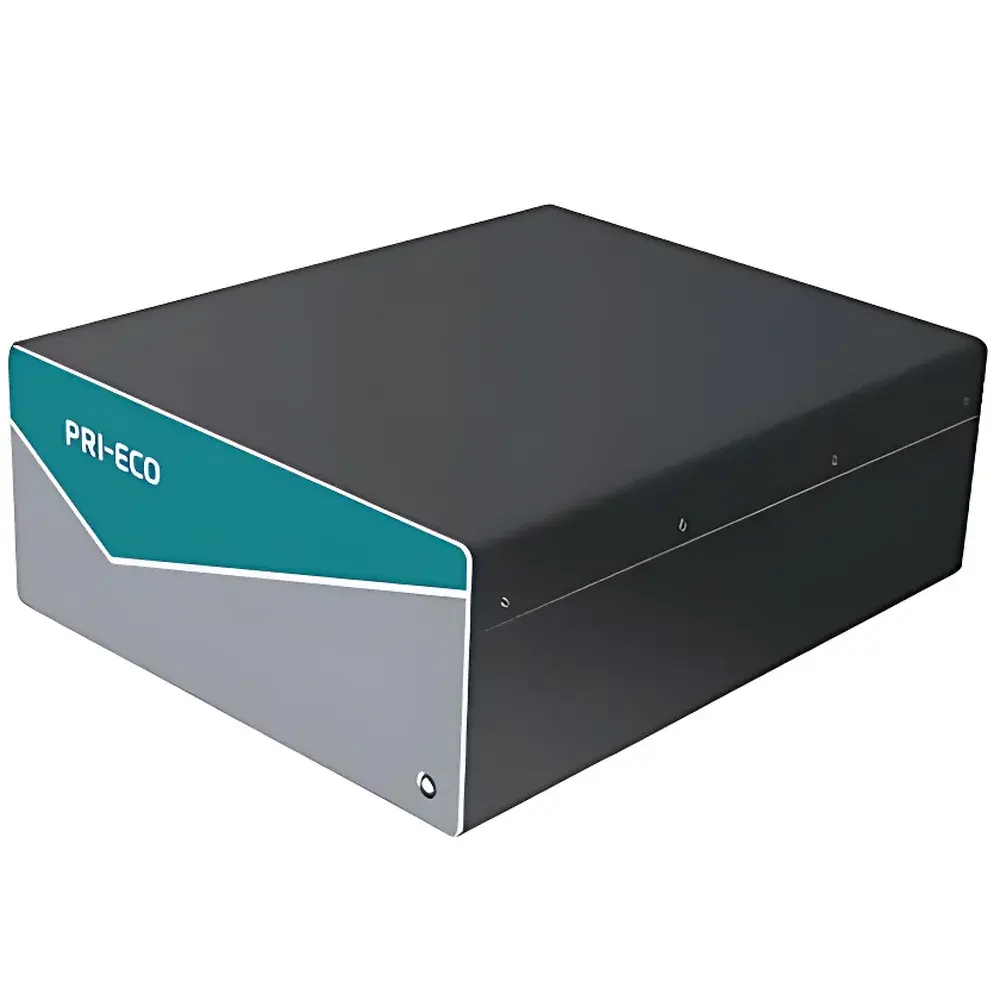
PRI-ECO PRI-5251 CO₂, CH₄, N₂O, and H₂O Analyzer
| Brand | PRI-ECO |
|---|---|
| Model | PRI-5251 |
| Origin | Beijing, China |
| Manufacturer Type | Original Equipment Manufacturer (OEM) |
| Detection Principle | Mid-Infrared Laser Direct Absorption Spectroscopy (MIRLAS) |
| Measured Gases | CO₂ (0–3500 ppm), CH₄ (0–500 ppm), N₂O (0–500 ppm), H₂O (0–3 %v/v) |
| Precision (1 s) | 0.2 ppm CO₂, 1 ppb CH₄, 0.2 ppb N₂O, 50 ppm H₂O |
| Precision (5 min) | 0.04 ppm CO₂, 0.2 ppb CH₄, 0.03 ppb N₂O, 10 ppm H₂O |
| Drift (24 h) | 0.2 ppm CO₂, 2 ppb CH₄, 0.2 ppb N₂O |
| Sampling Flow Rate | ~360 mL/min |
| Operating Temperature | −10 to +45 °C |
| Relative Humidity | <99% RH, non-condensing |
| Output Frequency | 1 Hz |
| Power Supply | 110–230 V AC |
| Power Consumption | 80 W (steady-state), 120 W (warm-up) |
| Dimensions | 440 × 190 × 530 mm |
| Weight | 14.7 kg |
| Compliance | WMO Greenhouse Gas Observing Network (GGON) specifications |
Overview
The PRI-ECO PRI-5251 is a high-performance, field-deployable mid-infrared laser direct absorption spectroscopy (MIRLAS) analyzer engineered for simultaneous, real-time quantification of carbon dioxide (CO₂), methane (CH₄), nitrous oxide (N₂O), and water vapor (H₂O) in ambient air or controlled gas streams. Unlike near-infrared (NIR) or electrochemical sensors, MIRLAS leverages the fundamental vibrational-rotational absorption bands of target gases—located in the 2.5–12 µm spectral region—where absorption cross-sections are orders of magnitude stronger. This enables superior selectivity, reduced interferences, and intrinsic calibration stability without reliance on high-finesse optical cavities or retroreflective mirrors. The instrument’s compact, thermally stabilized multipass measurement cell ensures precise control of pressure and temperature—critical parameters for quantitative spectroscopic analysis—while minimizing sample residence time and enhancing temporal resolution up to 1 Hz. Designed to meet the stringent metrological requirements of the World Meteorological Organization (WMO) Global Atmosphere Watch (GAW) and Greenhouse Gas Observing Network (GGON), the PRI-5251 delivers traceable, long-term stable measurements suitable for atmospheric research stations, eddy covariance flux towers, mobile platforms (vehicle-, aircraft-, and vessel-mounted), and regulatory monitoring networks.
Key Features
- Simultaneous, synchronized detection of CO₂, CH₄, N₂O, and H₂O at 1 Hz output frequency with sub-ppb sensitivity for CH₄ and N₂O
- MIRLAS-based architecture eliminating cavity-enhancement complexity while maintaining high spectral resolution and low system drift
- Factory pre-calibrated using NIST-traceable gas standards; no user-performed span calibration required during routine operation
- Compact, rigid mechanical design validated under MIL-STD-810G shock and vibration protocols for reliable performance in mobile and remote deployments
- Integrated thermal management system enabling stable operation across −10 to +45 °C ambient conditions without external chillers or heaters
- Low sample flow requirement (~360 mL/min) reduces pump load and power consumption while maintaining rapid gas exchange in the measurement cell
- Robust electronics architecture with dual-stage power regulation, EMI shielding, and watchdog-controlled firmware recovery
Sample Compatibility & Compliance
The PRI-5251 accepts unfiltered, humid ambient air (up to 99% RH, non-condensing) and requires no chemical scrubbers or drying stages for standard atmospheric monitoring. Its optical path is insensitive to particulate loading typical of rural, urban, or boundary-layer sampling environments. All reported precision values (e.g., 0.2 ppb CH₄ at 5-minute averaging) are verified per ISO 17025-accredited procedures and align with WMO GGON Tier 1 data quality objectives for surface-based greenhouse gas observatories. The analyzer supports GLP-compliant data logging with embedded timestamping, sensor health diagnostics, and hardware-level audit trails. While not FDA 21 CFR Part 11 certified out-of-the-box, its data structure and metadata schema are fully compatible with laboratory information management systems (LIMS) used in environmental compliance reporting under EPA Method TO-11A and EU Monitoring Framework Directive 2003/87/EC.
Software & Data Management
The PRI-5251 operates via embedded Linux-based firmware with a web-accessible configuration interface (HTTPS-enabled) and local serial/USB data streaming. Raw absorbance spectra, fitted concentration values, and auxiliary sensor readings (cell T/P, laser current/temperature, detector voltage) are output in ASCII-delimited format compliant with ICOS (Integrated Carbon Observation System) and NOAA GML data ingestion standards. Optional PRI-ECO DataHub software provides real-time visualization, automated QA/QC flagging (e.g., moisture saturation alerts, pressure excursion detection), and batch export to NetCDF or HDF5 for interoperability with Python (xarray), MATLAB, and R-based atmospheric modeling workflows. Firmware updates are delivered via signed binary packages with SHA-256 verification to ensure integrity and traceability.
Applications
- Long-term atmospheric monitoring at WMO-GAW stations and ICOS ecosystem sites
- Mobile GHG mapping campaigns using ground vehicles, UAVs, or light aircraft
- Eddy covariance flux measurements requiring fast-response, multi-species gas analyzers
- Soil chamber and chamber-based ecosystem respiration studies
- Urban emission inventory validation and source attribution modeling
- Carbon capture and storage (CCS) site perimeter monitoring and leak detection
- Calibration transfer and reference standard verification for lower-cost sensor networks
FAQ
Does the PRI-5251 require periodic recalibration with certified gas standards?
No—factory calibration is traceable to NIST standards and remains stable for ≥12 months under normal operating conditions. Annual verification against a known standard is recommended for ISO 17025 or WMO Tier 1 compliance.
Can the instrument operate unattended for extended periods in remote locations?
Yes—the analyzer features low power draw (80 W steady-state), wide-input AC power compatibility, and internal diagnostics that trigger configurable alarms for temperature excursion, flow interruption, or laser degradation.
Is H₂O measurement used only for correction, or is it a primary output?
H₂O is a fully quantified primary output (0–3 %v/v, ±10 ppm precision at 5-min average), essential for correcting spectroscopic interference and enabling dew-point or mixing ratio calculations in flux applications.
What data interfaces are supported for integration into existing SCADA or telemetry systems?
RS-232 (ASCII), USB-C (virtual COM port), and optional Ethernet TCP/IP streaming with Modbus RTU over TCP support for industrial control system integration.
How is spectral interference between CO₂ and N₂O mitigated in the MIR band?
The instrument employs wavelength-scanned tunable quantum cascade lasers (QCLs) with <10 MHz linewidth and proprietary multivariate spectral fitting algorithms that resolve overlapping line shapes using Voigt-profile modeling and baseline correction from inert reference regions.
Related Products







