
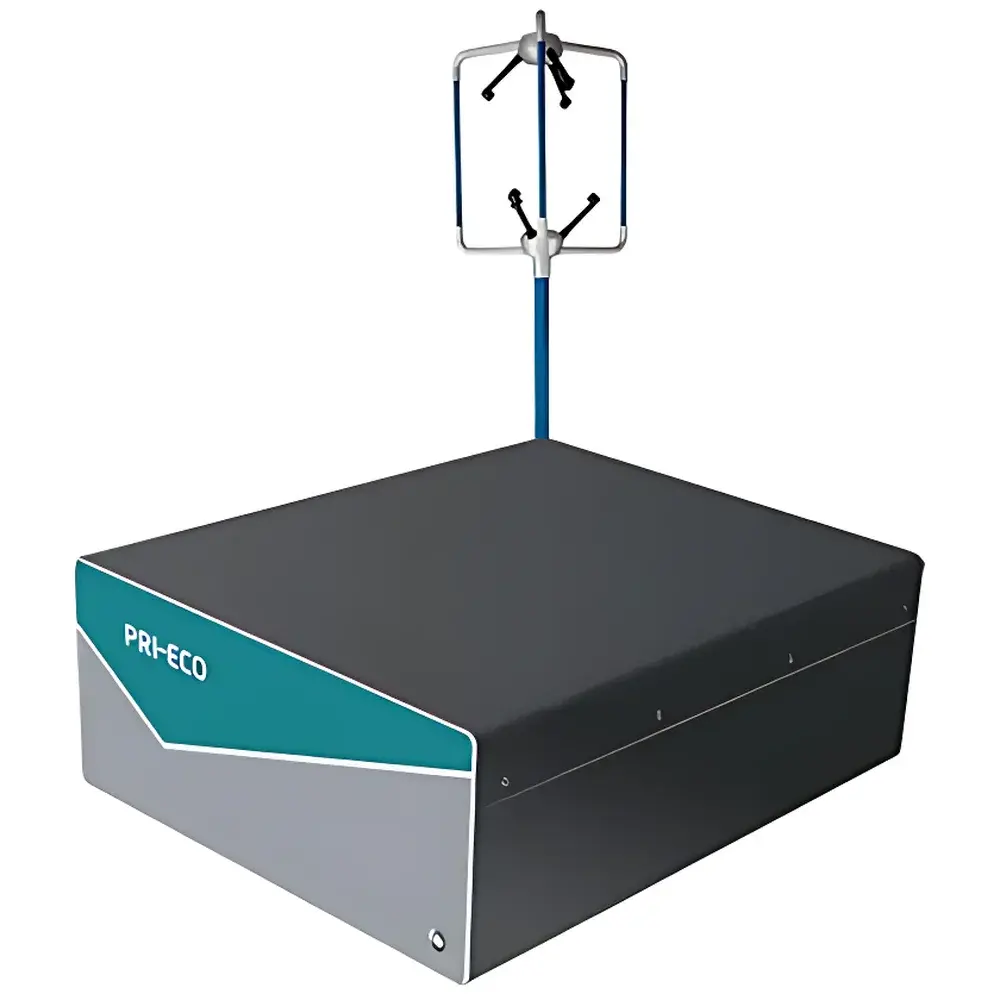
PRI-ECO PRI-5251e CO₂/CH₄/N₂O/H₂O Eddy Covariance Measurement System
| Brand | PRI-ECO |
|---|---|
| Origin | Beijing, China |
| Manufacturer Type | Original Equipment Manufacturer (OEM) |
| Model | PRI-5251e |
| Detection Principle | Mid-Infrared Laser Direct Absorption Spectroscopy (MIRLAS) |
| Measured Gases | CO₂, CH₄, N₂O, H₂O |
| Measurement Frequency | 10 Hz |
| Accuracy (0.1 s) | 0.25 ppm CO₂, 1 ppb CH₄, 0.4 ppb N₂O, 50 ppm H₂O |
| 24-h Drift | 1 ppm CO₂, 2 ppb CH₄, 1 ppb N₂O |
| Sample Temperature Range | −10 to 45 °C |
| Sample Humidity Range | <99% RH, non-condensing |
| Sample Flow Rate | ~12 L/min |
| Power Supply | 110–230 V AC |
| Power Consumption | 200 W (steady-state), 250 W (warm-up) |
| Dimensions | 440 × 190 × 530 mm |
| Weight | 25 kg |
Overview
The PRI-ECO PRI-5251e CO₂/CH₄/N₂O/H₂O Eddy Covariance Measurement System is a field-deployable, closed-path eddy covariance (EC) platform engineered for high-temporal-resolution, multi-species greenhouse gas (GHG) flux quantification in terrestrial and aquatic ecosystems. At its core lies the PRI-5251e — a factory-calibrated, mid-infrared laser direct absorption spectroscopy (MIRLAS) gas analyzer — integrated with a triaxial ultrasonic anemometer. The system operates at a synchronized 10 Hz data acquisition rate, enabling simultaneous, time-aligned measurement of CO₂, CH₄, N₂O, H₂O vapor, and three-dimensional wind velocity components (u, v, w). Unlike near-infrared (NIR) or cavity-enhanced techniques, MIRLAS leverages fundamental vibrational-rotational absorption bands in the 2.5–12 µm range, where target gases exhibit orders-of-magnitude stronger and spectrally isolated absorption features. This physical advantage translates into superior selectivity, reduced cross-sensitivity, and enhanced long-term stability without reliance on high-finesse optical cavities or complex mirror alignment protocols.
Key Features
- True closed-path architecture with heated sample line and pressure-temperature-controlled measurement cell — eliminates inlet clogging and condensation artifacts under rain, snow, fog, dust, and high-humidity conditions.
- Optimized small-volume optical cell (< 50 mL) enabling rapid gas turnover (~12 L/min flow) while maintaining precise thermal and barometric regulation — critical for minimizing high-frequency attenuation in EC flux calculations.
- Integrated automatic filter exchange module reduces field maintenance intervals to annual cycles; no manual filter replacement required during continuous operation.
- Robust mechanical design validated per IEC 60068-2 environmental stress standards — including shock, vibration, and thermal cycling tests — ensuring operational integrity across remote, unattended sites.
- No consumables or reagents; zero moving parts in the optical path; laser source lifetime exceeds 20,000 hours.
- Comprehensive onboard diagnostics, real-time spectral validation, and automated baseline correction algorithms ensure data integrity across diurnal and seasonal temperature gradients.
Sample Compatibility & Compliance
The PRI-5251e accepts ambient air samples within −10 to +45 °C and up to 99% relative humidity (non-condensing). Its closed-path configuration ensures compatibility with standard EC tower infrastructure, including aspirated intake manifolds, laminar flow controllers, and differential pressure transducers. The system conforms to widely adopted GHG flux reporting frameworks, including the AmeriFlux and ICOS metadata standards, and supports traceability to NIST-traceable calibration gases (CO₂, CH₄, N₂O certified per ISO 6141). While not inherently 21 CFR Part 11-compliant, raw data streams and audit logs are structured to support integration into GLP/GMP-aligned data management systems when deployed in regulatory monitoring contexts (e.g., EPA Method TO-15 adjunct applications or UNFCCC Tier 3 inventory verification).
Software & Data Management
Data acquisition and preprocessing are managed via PRI-ECO’s proprietary EC-Analyzer Suite — a Linux-based, real-time application supporting raw signal streaming, coordinate rotation (double rotation), planar-fit correction, spectral correction (Kaimal filtering), and flux partitioning (e.g., u* thresholding, Webb-Pearman-Leuning correction for density effects). All outputs comply with CF-netCDF conventions (Climate and Forecast Metadata Conventions v1.8) and include embedded provenance metadata (instrument ID, firmware version, calibration timestamp, QA/QC flags). Export formats include ASCII (CSV), NetCDF4, and HDF5. Remote monitoring, firmware updates, and diagnostic telemetry are supported over Ethernet or LTE (optional). Audit trails record all parameter modifications, calibration events, and system restarts — essential for scientific reproducibility and regulatory review.
Applications
- Long-term eddy covariance flux towers for carbon and nitrogen budgeting across forests, grasslands, wetlands, agricultural fields, and permafrost regions.
- Urban GHG emission inventories and source attribution studies using mobile or fixed-site deployments.
- Validation of satellite-based GHG retrievals (e.g., OCO-2/3, TROPOMI, GOSAT) through ground-truth reference networks.
- Process-level investigations of microbial soil respiration, nitrification/denitrification kinetics, and plant stomatal conductance under climate manipulation experiments (e.g., FACE, warming chambers).
- Integration with energy balance modules (available as optional add-on) for complete surface energy closure assessment in micrometeorological studies.
FAQ
What is the fundamental advantage of MIRLAS over NIR or CRDS for eddy covariance?
MIRLAS accesses fundamental rovibrational transitions with absorption strengths 10–100× greater than overtone bands in the NIR, enabling higher signal-to-noise ratios at 10 Hz without optical enhancement — resulting in lower detection limits, reduced sensitivity to alignment drift, and intrinsic immunity to water vapor interference in key spectral windows.
Can the PRI-5251e be used in open-path configurations?
No — it is exclusively designed as a closed-path analyzer. Its performance specifications, including stated precision and drift, are validated only under controlled, pressurized, temperature-stabilized sampling conditions.
Is factory calibration transferable between instruments?
Each unit undergoes individual spectral characterization and multi-point gas-phase calibration using NIST-traceable standards; calibration coefficients are embedded in firmware and are not interchangeable across units.
How does the system handle water vapor cross-sensitivity in CH₄ and N₂O measurements?
The MIRLAS engine employs chemometric spectral fitting with constrained H₂O absorption models, and the measurement cell’s active temperature stabilization minimizes thermally induced baseline shifts that could otherwise propagate into CH₄/N₂O quantification errors.
What level of technical support is available for international users?
PRI-ECO provides remote engineering support, application-specific data processing consultation, and on-site installation training through authorized regional partners — documentation and software interfaces are fully English-localized and compliant with ISO 9001 quality management requirements.







