
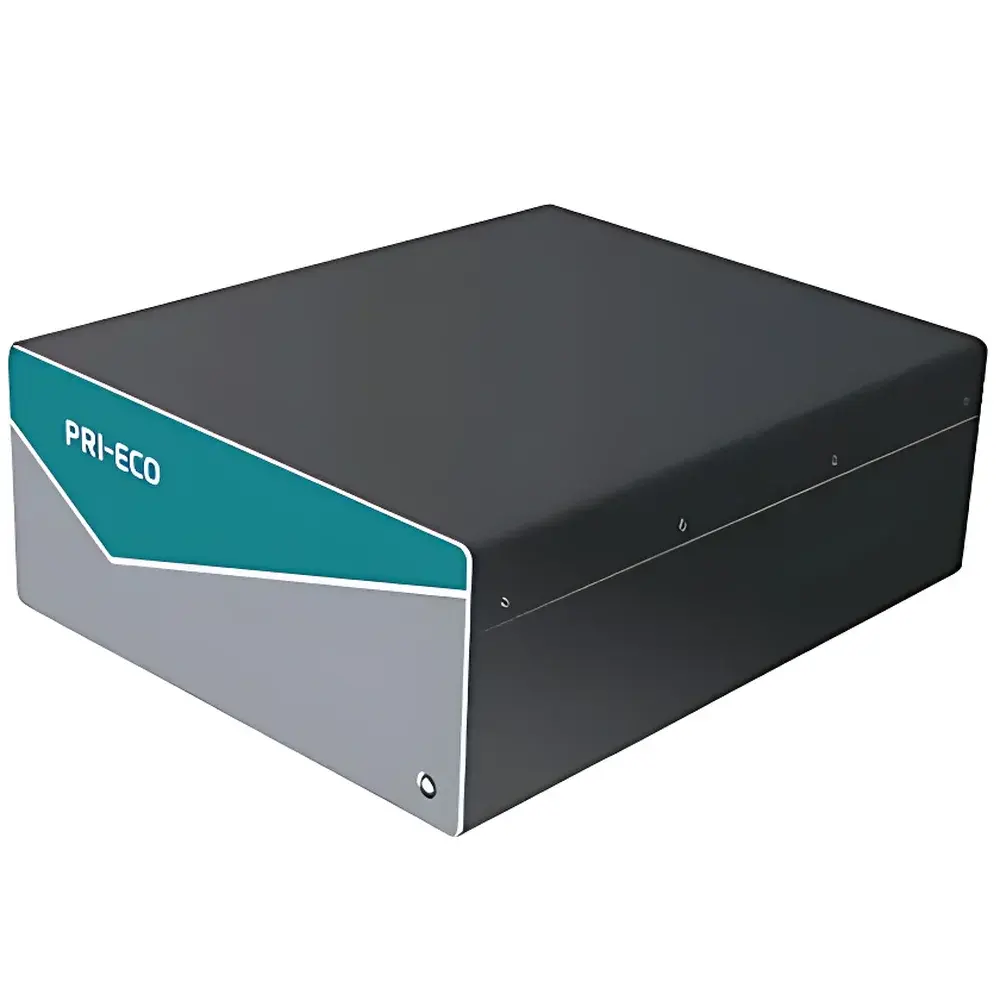
Pri-eco PRI-5352i High-Precision CO₂ Isotope Analyzer
| Brand | Pri-eco |
|---|---|
| Origin | Beijing, China |
| Manufacturer Type | Direct Manufacturer |
| Model | PRI-5352i |
| Detection Principle | Mid-Infrared Laser Direct Absorption Spectroscopy (MIRLAS) |
| Target Gas | CO₂ |
| δ¹³C Precision | <0.1 ‰ @ 1 s, 0.03 ‰ @ 300 s |
| δ¹⁸O Precision | <0.2 ‰ @ 1 s, 0.03 ‰ @ 300 s |
| CO₂ Range | 0–1000 ppmv |
| H₂O Range | 0–3 % (accuracy-critical), 0–7 % (operational) |
| Max Peak-to-Peak Drift | <1 ‰ over >24 h |
| Sample Temp | −10 to +45 °C |
| Sample Humidity | <99 % RH (non-condensing) |
| Flow Rate | ~300 mL/min |
| Output Interfaces | USB, RS-232 |
| Power | 110–230 V AC or battery |
| Dimensions | 440 × 190 × 530 mm |
| Weight | 10.5 kg |
Overview
The Pri-eco PRI-5352i High-Precision CO₂ Isotope Analyzer is an integrated, factory-calibrated mid-infrared laser absorption spectrometer engineered for simultaneous, real-time quantification of CO₂ concentration and stable carbon and oxygen isotope ratios (δ¹³C and δ¹⁸O) in ambient air and extracted gas streams. Leveraging Mid-Infrared Laser Direct Absorption Spectroscopy (MIRLAS), the instrument exploits the fundamental vibrational-rotational absorption bands of CO₂ near 4.3 µm — a region where absorption cross-sections are orders of magnitude stronger than in the near-infrared. This physical advantage enables high spectral specificity, minimal interferences from water vapor or other atmospheric constituents, and intrinsic long-term stability without reliance on optical cavities or high-finesse mirrors. The compact, temperature- and pressure-controlled measurement cell (~100 mL volume) ensures rapid gas exchange, precise thermodynamic control (<±0.05 °C, <±0.1 hPa), and robust signal-to-noise performance across variable environmental conditions — critical for field-deployable isotope monitoring in ecological, atmospheric, and biogeochemical research.
Key Features
- Simultaneous, dual-isotope measurement: δ¹³C and δ¹⁸O reported with traceable accuracy and reproducibility — <0.03 ‰ (1σ, 300 s averaging) for both isotopic ratios.
- MIRLAS-based architecture: Eliminates cavity-enhancement complexity while delivering high sensitivity and resistance to optical misalignment or contamination.
- Integrated thermal and pressure stabilization: Active feedback control of cell temperature and absolute pressure ensures metrological consistency under dynamic ambient conditions.
- Field-hardened mechanical design: Shock- and vibration-resistant chassis qualified for mobile deployment — including vehicle-mounted, aircraft-integrated, and marine platform installations.
- Low-flow operation: Optimized at ~300 mL/min, enabling seamless coupling with peripheral systems such as elemental analyzers, TOC combustors, acid-digestion modules, and dissolved inorganic carbon (DIC) extraction units.
- Flexible power architecture: Supports both AC mains (110–230 V) and external DC battery sources, with warm-up power draw capped at 90 W and steady-state consumption at 50 W.
Sample Compatibility & Compliance
The PRI-5352i accepts gaseous samples across a broad operational envelope: −10 to +45 °C inlet temperature, <99 % RH (non-condensing), and CO₂ concentrations from 0 to 1000 ppmv. Its water vapor tolerance (0–7 % v/v) permits direct analysis of humid air, soil flux chambers, and headspace gases without mandatory drying — preserving isotopic integrity during sample transfer. When interfaced with offline preparation systems (e.g., EA-IRMS-compatible combustion lines or phosphoric acid digestion manifolds), the analyzer supports solid, liquid, carbonate, and DIC carbon isotope analysis per established protocols (ASTM D7654-22, ISO 13877:2021). All firmware and data handling routines comply with GLP-aligned audit trail requirements, and raw spectral logs retain full timestamped metadata (T, P, flow, laser current, detector voltage) to support ISO/IEC 17025 method validation.
Software & Data Management
The instrument operates via Pri-eco’s proprietary IsoView™ acquisition and processing suite, running on embedded Linux. Real-time spectral fitting employs Voigt-line modeling with simultaneous multi-parameter optimization (absorption depth, baseline offset, pressure-broadening coefficient, temperature-dependent line shape). Isotopic ratios are calculated using a two-point calibration approach referenced to NIST-traceable CO₂ standards (e.g., IAEA-CO-1, USGS40), with optional integration of internal reference gas injections for drift correction. Data export supports CSV, HDF5, and NetCDF-4 formats — compatible with MATLAB, Python (xarray, pandas), and commercial statistical platforms. Remote configuration, firmware updates, and diagnostic logging are accessible via Ethernet or USB CDC interface. Full audit trails (user actions, calibration events, system alerts) meet FDA 21 CFR Part 11 readiness when deployed in regulated environmental monitoring programs.
Applications
- Atmospheric carbon cycle studies: Discrimination of anthropogenic vs. biospheric CO₂ sources using dual-isotope signatures in boundary layer and tall-tower networks.
- Ecosystem flux partitioning: Quantifying gross primary production (GPP) and ecosystem respiration (Reco) via eddy covariance-coupled δ¹³C/δ¹⁸O measurements.
- Plant physiological ecology: In vivo assessment of stomatal conductance, mesophyll limitation, and photorespiration rates through leaf-level isoflux modeling.
- Soil biogeochemistry: High-temporal-resolution δ¹³C and δ¹⁸O dynamics in soil respiration linked to microbial community activity and substrate use efficiency.
- Carbonate paleoclimatology: Rapid screening of δ¹³C and δ¹⁸O in geological carbonates following offline phosphoric acid digestion and cryo-trapping.
- Water cycle tracing: Coupled analysis of CO₂ isotopes and H₂O vapor isotopes (via optional integrated hygrometer module) for evapotranspiration source apportionment.
FAQ
Does the PRI-5352i require daily calibration with reference gases?
No — it is shipped pre-calibrated using NIST-traceable standards and maintains stability with <1 ‰ peak-to-peak drift over 24 hours. Optional periodic verification (e.g., weekly) with certified reference gases is recommended for ISO/IEC 17025 compliance.
Can the analyzer be used with continuous air intake systems?
Yes — its low-flow design (~300 mL/min) and wide operating humidity range make it suitable for integration into unattended atmospheric monitoring stations, including those compliant with WMO GAW specifications.
Is spectral raw data accessible for custom post-processing?
Yes — all interferogram-equivalent absorbance spectra (wavenumber vs. intensity) are logged with full metadata and available for export in open binary or ASCII formats.
What peripheral interfaces are supported for automated sample introduction?
Standard analog/digital I/O (TTL, 0–10 V) and RS-232/USB serial protocols enable synchronization with autosamplers, valve manifolds, and external analyzers such as EA, TOC, or acid-digestion modules.
Does the system meet electromagnetic compatibility (EMC) requirements for mobile deployment?
Yes — the PRI-5352i conforms to EN 61326-1:2013 (industrial environment) and carries CE marking for EMC and safety, validated under shock and vibration profiles per MIL-STD-810G Method 514.6.
Related Products







