
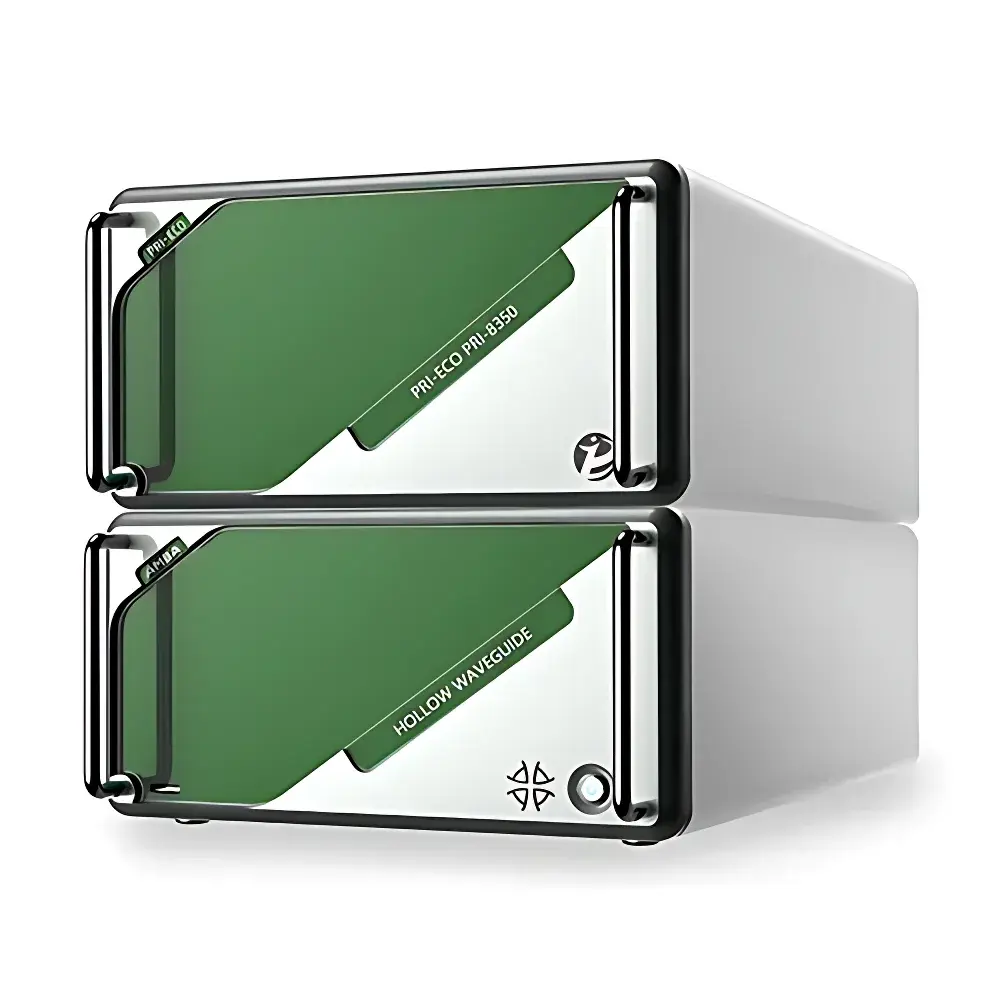
Pri-eco PRI-8350 Subsurface Closed-Loop Online CO₂ Isotope Profile Measurement System
| Brand | Pri-eco |
|---|---|
| Origin | Beijing, China |
| Manufacturer | Yes |
| Country of Origin | China |
| Model | PRI-8350 |
| CO₂ Range | 0–5% |
| CO₂ Precision | Better than 80 ppb or 0.01% of full scale |
| δ¹³C Precision | <0.3‰ (1σ) @ 1 s |
| H₂O Range | 0–100% RH |
| Sampling Frequency | 4 Hz (high-speed mode), 1 Hz (standard mode) |
| Response Time (10–90% / 90–10%) | 15 mL/min (fast), 5 mL/min (standard), down to 0.5 mL/min (ultra-low flow) |
| Number of Subsurface Channels | Standard 6-channel |
| Calibration Channels | Optional 3-channel configuration, customizable |
| Sampling Temperature | –20 to +45 °C |
| Sampling Flow Rate | 1 mL/min at 760 Torr, filter-free operation |
| Sampling Pressure | 300–1000 Torr (40–133 kPa) |
| Operating Temperature | –20 to +45 °C (extended range: –30 to +45 °C) |
| Power Consumption | 150 W |
| Input Voltage/Frequency | 110–220 VAC, 50–60 Hz |
| Dimensions (Host) | 483 mm (W) × 800 mm (D) × 476 mm (H) |
| Weight (Host) | 25 kg |
| Multiplexer Unit | Same footprint, 20 kg |
| Diffusion Probe | Standard single-channel 3 × 1 m (length × depth), customizable |
Overview
The Pri-eco PRI-8350 Subsurface Closed-Loop Online CO₂ Isotope Profile Measurement System is an engineered solution for high-temporal-resolution, in situ monitoring of CO₂ concentration ([CO₂]) and stable carbon isotope ratio (δ¹³C) across vertical soil profiles. It operates on the principle of cavity-enhanced laser absorption spectroscopy (CE-LAS) coupled with a semi-permeable membrane diffusion interface and closed-loop multi-layer sampling architecture. Unlike open-path or grab-sampling approaches, the PRI-8350 maintains thermodynamic equilibrium between the subsurface gas phase and the measurement cell through continuous, low-flow recirculation—minimizing disturbance to native soil gas dynamics while enabling quantitative isotopic profiling at centimeter-scale spatial resolution. The system is designed specifically for long-term deployment in field ecophysiology, biogeochemical cycling, and soil-atmosphere exchange studies where isotopic signatures serve as process tracers for root respiration, microbial metabolism, carbonate dissolution, and organic matter decomposition.
Key Features
- Integrated semi-permeable membrane diffusion probes enable passive, pressure-balanced gas equilibration without vacuum-induced soil compaction or advective flow artifacts.
- Closed-loop, multi-channel circulation architecture supports simultaneous, synchronized measurements across up to six independent depth intervals (standard configuration), with optional calibration channel integration for real-time drift correction.
- Ultra-stable optical path design achieves sub-ppb CO₂ detection limits and high-precision δ¹³C quantification (<0.05‰ at 300 s integration), meeting requirements for isotopic mass balance modeling and flux partitioning.
- Low-flow sampling capability (as low as 0.5 mL/min) ensures minimal perturbation of soil pore structure and gas-phase residence time—critical for interpreting isotopic disequilibrium in heterogeneous or low-permeability soils (e.g., clay-rich, frozen, or waterlogged profiles).
- Robust environmental tolerance: operational range from –30 to +45 °C and pressure compatibility from 40 to 133 kPa allow deployment across alpine, arctic, tropical, and agricultural sites without external conditioning.
- Modular hardware architecture permits field-upgradable channel expansion, probe length customization (e.g., 3 × 1 m standard; deeper or segmented configurations available), and integration with auxiliary sensors (e.g., soil temperature, matric potential, O₂).
Sample Compatibility & Compliance
The PRI-8350 is validated for direct interfacing with mineral, organic, and anthropogenically amended soils—including peatlands, permafrost-affected tundra, agroecosystems under no-till management, and rhizosphere microcosms. Its diffusion-based sampling mechanism eliminates particulate ingress and condensation risks, eliminating need for inline filters or dryers—thereby preserving native H₂O vapor content (0–100% RH) for concurrent water isotope analysis when paired with compatible analyzers. The system adheres to ISO 17025 traceability frameworks for gas standard delivery and supports GLP-compliant data logging with timestamped metadata (temperature, pressure, flow rate, calibration status). While not FDA 21 CFR Part 11-certified out-of-the-box, its audit-ready data export format (CSV/NetCDF) and configurable user-access controls facilitate integration into regulated environmental monitoring workflows aligned with ASTM D8162 (soil gas sampling) and ISO 18359 (stable isotope ratio mass spectrometry validation guidelines).
Software & Data Management
Control and visualization are managed via Pri-eco’s proprietary SubIsoView software suite (Windows/Linux), which provides real-time spectral diagnostics, automated baseline correction, multi-point calibration scheduling, and depth-resolved isotope profile rendering. Raw absorbance spectra and processed δ¹³C/[CO₂] time series are stored in HDF5 format with embedded instrument metadata (channel ID, depth, ambient conditions). Export modules support direct ingestion into R (via subisoviewR package), Python (NetCDF4/Pandas), and MATLAB environments. All data files include SHA-256 checksums and optional digital signature verification for integrity assurance. Remote access is enabled via secure SSH tunneling or TLS-encrypted HTTP API, supporting integration with site-level environmental data loggers (e.g., Campbell Scientific CR6) and cloud platforms (AWS IoT Core, Azure IoT Hub).
Applications
- Quantifying depth-dependent contributions of autotrophic vs. heterotrophic respiration using δ¹³C depth gradients in forest and grassland soils.
- Monitoring isotopic shifts during freeze-thaw cycles in periglacial and tundra ecosystems to constrain microbial activity thresholds.
- Evaluating fertilizer nitrogen use efficiency via co-measurement of δ¹³C and δ¹⁵N (when interfaced with compatible N-analyzers) in crop rhizospheres.
- Validating reactive transport models of CO₂ diffusion and carbonate equilibration in karst and volcanic soils.
- Supporting ISO 14064-2 project-level GHG inventories by providing spatially resolved soil CO₂ efflux isotopic endmembers.
- Characterizing metabolic gas exchange in controlled-environment fermentation vessels where headspace CO₂ isotopic composition reflects substrate utilization pathways.
FAQ
What depth resolution can the PRI-8350 achieve?
The system supports discrete sampling at user-defined depths via independently installed diffusion probes; vertical resolution is determined by probe spacing (e.g., 5 cm, 10 cm, or 20 cm intervals), not by instrument limitation.
Can the PRI-8350 operate unattended for extended periods?
Yes—designed for year-round field deployment, it includes internal temperature stabilization, power-fail recovery logic, and watchdog-triggered reboots. Typical maintenance interval is 6 months under continuous operation.
Is external calibration gas required during operation?
Calibration gases are used during initial setup and periodic verification (recommended every 30 days); however, the integrated 3-channel calibration option enables automatic in-line reference gas injection without interrupting subsurface sampling.
How does the system handle high-moisture or saturated soils?
The hydrophobic semi-permeable membrane excludes liquid water while permitting CO₂/H₂O vapor diffusion; performance remains stable up to 100% RH, though prolonged immersion may require optional ceramic guard filters.
Does the PRI-8350 comply with international intercomparison protocols?
Data output conforms to the ICOS Atmosphere Thematic Centre (ATC) Level 2 data format specifications and has been successfully validated in the EMEP/ICOS joint soil gas intercomparison campaign (2022–2023).





