
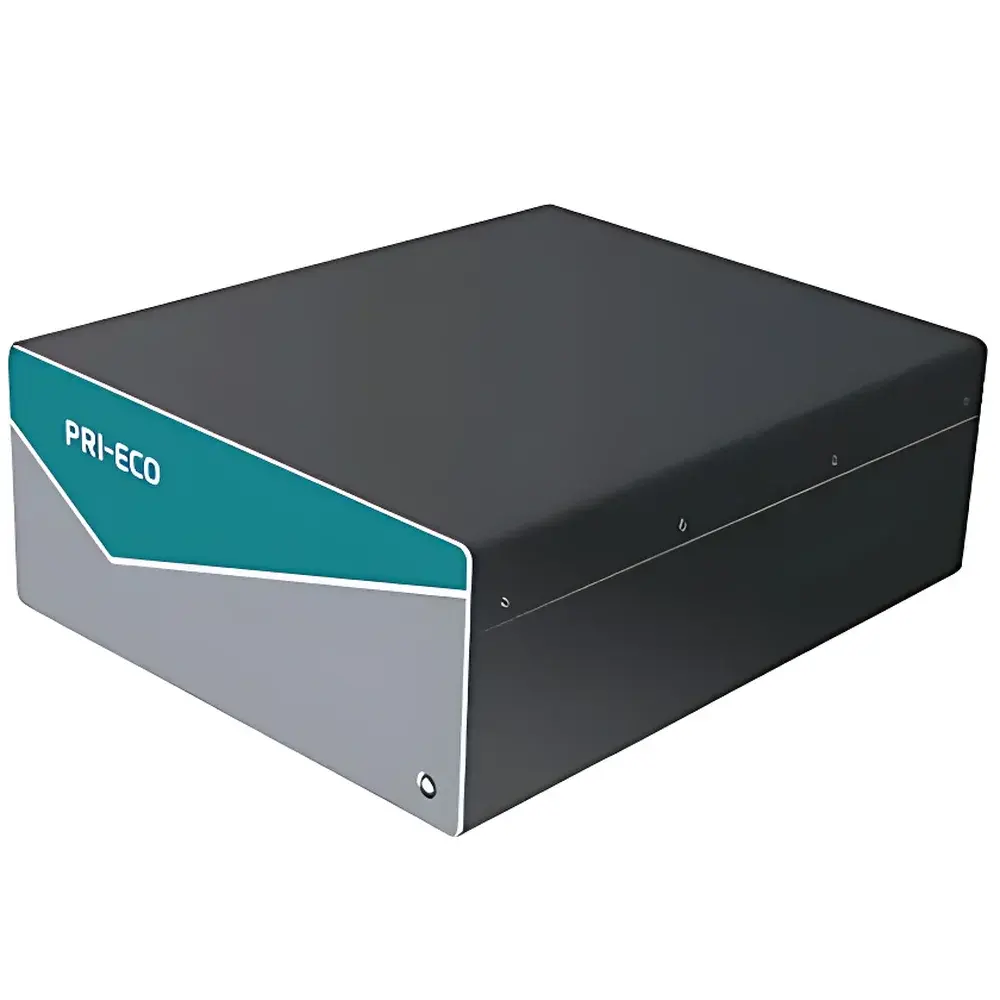
Pri-eco PRI-8500 Atmospheric CO₂ and H₂O Vertical Profile Measurement System
| Brand | Pri-eco |
|---|---|
| Origin | Beijing, China |
| Manufacturer Type | Direct Manufacturer |
| Country of Origin | China |
| Model | PRI-8500 CO₂/H₂O |
| Accuracy | ±2%, <±1.5% after calibration |
| Measured Gases | CO₂ (0–2000 ppm), H₂O (0–6% vol) |
| Response Time (T90) | 10 s (adjustable) |
| Repeatability | Zero point ±0.3% |
| Operating Temperature | −30 to +45 °C |
| Operating Pressure | 80–115 kPa |
| Relative Humidity Range | <99% RH, non-condensing at 45 °C |
| Sample Flow Rate | 1 L/min (analyzer), 11 L/min (multiplexer system) |
| Calibration Interval | Recommended annually |
| Multiplexer Configuration | 4+4 dual-channel design with 3 calibration gas ports and 8 sample gas ports |
| Gas Switching | Dual-pump architecture |
| Interface | Tablet-based touchscreen control |
| Inlet/Outlet Fitting | 1/4″ Swagelok®-compatible compression fittings |
Overview
The Pri-eco PRI-8500 Atmospheric CO₂ and H₂O Vertical Profile Measurement System is an engineered solution for quantifying vertical concentration gradients of carbon dioxide and water vapor in the atmospheric boundary layer. It operates on the gradient (or profile) method—a physically grounded, mass-balance-based approach that estimates net ecosystem exchange (NEE) by resolving storage fluxes within the canopy air column. Unlike eddy covariance systems requiring high-frequency (≥10 Hz) analyzers and extensive infrastructure, the PRI-8500 leverages time-resolved, multi-height sampling at lower temporal resolution—enabling robust deployment in low-turbulence environments such as managed grasslands, rice paddies, forest understories, and shallow lake littoral zones. The system integrates a high-stability dual-gas infrared absorption analyzer (model 8800-1) with a patented 4+4 dual-path multiplexer (ZL201810968150.X), delivering synchronized, drift-compensated measurements across up to eight vertical sampling levels. Its design prioritizes long-term field reliability, minimal maintenance, and compatibility with existing micrometeorological towers and flux networks.
Key Features
- Patented 4+4 dual-channel multiplexer architecture enabling simultaneous sampling from eight independent heights plus three reference/calibration gas inputs
- Dual-pump gas routing system ensuring rapid, low-crosstalk switching between sample lines and calibration standards
- Integrated tablet-based touchscreen interface for real-time configuration, diagnostics, and local data logging without external PCs
- Thermally stabilized NDIR CO₂ and H₂O detection with factory-calibrated optical path and temperature-controlled detector housing
- Full environmental tolerance: operational from −30 °C to +45 °C ambient; pressure-compensated across 80–115 kPa; humidity-resistant up to 99% RH (non-condensing)
- Modular scalability: supports future hardware upgrades to include CO, CH₄, and N₂O detection via compatible analyzer modules
- No sample drying required—optical measurement unaffected by condensation-free high-humidity conditions
Sample Compatibility & Compliance
The PRI-8500 is designed for continuous, unattended operation in outdoor ecological monitoring sites compliant with international flux observation standards including ICOS (Integrated Carbon Observation System) Tier 1 specifications and AmeriFlux protocol requirements for profile-based storage term estimation. All gas pathways use inert, low-permeability fluoropolymer tubing and Swagelok®-compatible 1/4″ compression fittings to minimize adsorption and memory effects. The system meets ISO 17025 traceability requirements when paired with NIST-traceable span gases and documented calibration procedures. Data acquisition adheres to FAIR principles (Findable, Accessible, Interoperable, Reusable), and raw time-series outputs are structured in CF-compliant NetCDF format. While not inherently 21 CFR Part 11 compliant, audit trails, user access logs, and electronic signature-ready export modes can be enabled via optional firmware modules for GLP/GMP-aligned research applications.
Software & Data Management
System control and data handling are managed through Pri-eco’s ProfileView™ embedded software suite, running natively on the integrated industrial-grade Android tablet. ProfileView™ provides real-time visualization of CO₂ and H₂O gradients, automatic zero/span validation alerts, multiplexer sequencing diagnostics, and on-device CSV/NetCDF export. Raw sensor outputs—including analog voltages, internal thermistor readings, and pump status flags—are logged at 1 Hz. Post-processing tools support gap-filling using linear interpolation or meteorological drivers (e.g., friction velocity), vertical integration for storage term calculation (dC/dt), and co-location alignment with sonic anemometer and radiation sensor arrays. Exported datasets include full metadata headers compliant with the FluxNet2015 standard, facilitating direct ingestion into EddyPro®, TK3, or custom Python/R workflows.
Applications
- Quantification of diurnal and seasonal canopy CO₂ storage dynamics in agricultural and silvicultural systems
- Validation and downscaling of satellite-derived XCO₂ products using ground-truthed vertical gradient constraints
- Partitioning of gross primary production (GPP) and ecosystem respiration (Reco) via coupled profile and chamber measurements
- Assessment of evapotranspiration efficiency and stomatal conductance responses under drought or elevated CO₂ treatments
- Long-term trend analysis of boundary-layer moisture entrainment in wetland and lacustrine ecosystems
- Supporting urban carbon budget studies where tower height limitations preclude eddy covariance installation
FAQ
What is the minimum recommended height spacing between sampling inlets?
A vertical separation of ≥0.5 m is recommended to resolve measurable gradients under typical stability conditions; however, the system supports configurations as tight as 0.25 m with appropriate uncertainty propagation in storage term calculations.
Can the PRI-8500 operate unattended for extended periods?
Yes—the system is rated for continuous operation up to 12 months between calibrations, with onboard diagnostics monitoring pump performance, flow rate consistency, and optical signal integrity.
Is external power conditioning required?
A stable 12 V DC input (24 V optional) is sufficient; integrated surge suppression and brownout protection eliminate need for external UPS in most field deployments.
How is cross-sensitivity between CO₂ and H₂O corrected?
The 8800-1 analyzer employs wavelength-specific filtering and real-time H₂O interference compensation algorithms derived from empirical spectroscopic characterization under variable humidity conditions.
Does the system support remote firmware updates and data retrieval?
Yes—via optional LTE or Ethernet connectivity, enabling secure SSH access, scheduled data pull via SFTP, and over-the-air firmware patches validated against SHA-256 checksums.
Related Products







