
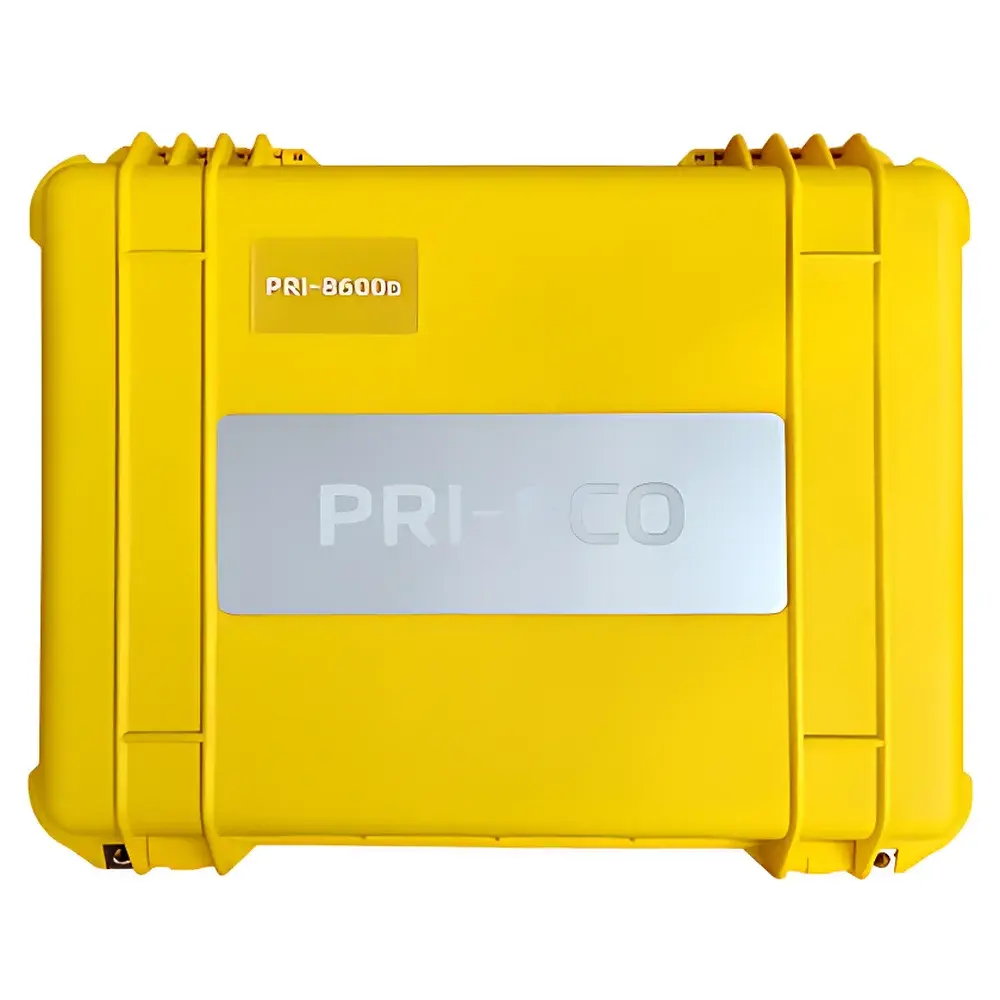
Pri-eco PRI-8600D Multi-Channel Soil Respiration and Ecosystem Photosynthesis Measurement System
| Brand | Pri-eco |
|---|---|
| Origin | Beijing, China |
| Manufacturer Type | OEM Manufacturer |
| Country of Origin | China |
| Model | PRI-8600D |
| Instrument Type | Multi-Function Soil Respiration & Ecosystem Gas Exchange Analyzer |
| Channel Options | 8(9), 16(18), 24(27), 32(36) or customizable |
| Gas Path Length | 15–100 m (factory-configured per pump specification) |
| Standard Flow Rate | 4.0 L/min into measurement chambers |
| Operating Temperature | −10 to 45 °C |
| Operating Pressure | 80–115 kPa |
| Relative Humidity Range | <99% RH (non-condensing at 45 °C) |
| Calibration Channels | 3 |
| Touchscreen Control | Integrated tablet interface |
Overview
The Pri-eco PRI-8600D Multi-Channel Soil Respiration and Ecosystem Photosynthesis Measurement System is an engineered field-deployable platform designed for high-temporal-resolution, spatially distributed quantification of soil CO2 efflux, ecosystem-level net photosynthesis, and multi-gas exchange dynamics (CO2, CH4, N2O) across heterogeneous terrestrial environments. Grounded in closed-chamber gas accumulation methodology, the system operates on a sequential multiplexing principle—cycling sample air through discrete measurement chambers via a patented dual-cycle pneumatic routing architecture. This design decouples chamber pressurization from analytical flow delivery, enabling stable, low-drift measurements even under variable ambient wind conditions and across extended gas path lengths (up to 100 m). The system is explicitly optimized for long-term unattended operation in remote ecological sites, agricultural fields, forest understories, permafrost zones, landfill monitoring stations, and seismic research plots—where spatial heterogeneity necessitates statistically robust sampling across ≥16 locations.
Key Features
- Patented dual-cycle gas routing architecture (ZL201810968150.X) minimizes cross-channel contamination and reduces switching dead time—critical for maintaining measurement fidelity when scaling beyond 16 channels or operating with low-flow analyzers.
- Dynamic pressure-balanced chamber interface (ZL201710708393.5, ZL201420354126.4, ZL202010450149.5) actively equalizes internal chamber pressure with ambient atmospheric pressure in real time, eliminating barometric artifacts and wind-induced flux bias during both dark respiration and light-saturated photosynthesis measurements.
- Modular analyzer compatibility: accepts NDIR-based CO2/H2O analyzers (e.g., 8800-1 module), quantum cascade laser (QCL) or off-axis integrated cavity output spectroscopy (OA-ICOS) analyzers for simultaneous CO2, CH4, and N2O concentration and δ13C/δ18O isotopic analysis.
- Scalable channel architecture: supports 8(9), 16(18), 24(27), 32(36), or custom-configured channel counts; all channels independently addressable with programmable dwell time and sequence logic.
- Integrated 3-port standard gas calibration manifold enables automated zero/span verification without manual intervention—fully compliant with GLP audit requirements for traceable calibration records.
- Ruggedized field enclosure (440 × 260 × 260 mm; 7.5 kg) with IP65-rated electronics, −20 to +45 °C operational range, and embedded Android-based touchscreen HMI for local configuration, diagnostics, and real-time flux visualization.
Sample Compatibility & Compliance
The PRI-8600D accommodates a broad spectrum of chamber configurations—including opaque soil respiration collars (8600-2012), transparent ecosystem photosynthesis chambers (8600-1000), and hybrid light/dark cycling chambers—each fitted with dynamic pressure compensation. All chambers integrate calibrated air temperature sensors (±0.2 °C), optional soil temperature (8600-201) and volumetric water content probes (8600-202), ensuring full environmental context for flux partitioning. The system meets ASTM D6573 and ISO 16634 standards for soil respiration measurement methodology. Its data acquisition firmware supports timestamped metadata logging aligned with US EPA Method TO-15 and IPCC Tier 2 reporting frameworks. Full 21 CFR Part 11 compliance is achievable via optional audit-trail-enabled software modules with electronic signature support.
Software & Data Management
The PRI-8600D runs on embedded Linux-based firmware with web-accessible RESTful API and local SQLite database storage. Field-collected raw concentration-time series, chamber pressure differentials, temperature/humidity logs, and pump status telemetry are automatically timestamped and stored onboard. Data export formats include CSV, NetCDF4, and CF-compliant HDF5—structured for direct ingestion into eddy covariance post-processing pipelines (e.g., EddyPro, TK3) or ecosystem modeling platforms (e.g., DALEC, SIPNET). Remote firmware updates, script-based measurement scheduling, and configurable alarm thresholds (e.g., pressure deviation > ±50 Pa, humidity saturation) are supported via secure SSH or HTTPS interfaces. Optional cloud synchronization enables centralized fleet management across distributed research networks.
Applications
- Ecosystem carbon budgeting: Quantifying diel and seasonal patterns of soil autotrophic vs. heterotrophic respiration across gradients of land use, fertilization, or drought stress.
- Permafrost carbon feedback studies: Monitoring CH4 and CO2 pulse emissions from thawing organic soils under controlled thermal regimes.
- Agricultural GHG mitigation trials: Evaluating nitrification inhibitor efficacy on N2O flux and cover crop impacts on rhizosphere respiration.
- Landfill biogas oxidation assessment: Spatially resolved mapping of aerobic methane oxidation efficiency in final cover soils.
- Post-seismic soil gas anomaly detection: High-frequency monitoring of CO2 efflux anomalies preceding tectonic activity.
- Forest canopy–soil coupling analysis: Synchronizing aboveground photosynthetic uptake (via transparent chambers) with concurrent belowground C allocation signals.
FAQ
What is the maximum recommended distance between the PRI-8600D main unit and remote chambers?
The standard configuration supports up to 15 m; extended configurations (up to 100 m) require factory calibration of pump head pressure and flow rate to maintain ≥4.0 L/min delivery at each chamber inlet.
Can the system operate autonomously for extended deployments without human intervention?
Yes—field-tested deployments exceeding 12 months have been documented using solar-charged battery banks and cellular telemetry; onboard memory retains ≥30 days of high-frequency data at 1-minute resolution.
Is the dual-cycle gas routing architecture compatible with third-party analyzers?
Yes—the system provides standardized 1/4″ Swagelok fittings, RS-232 and analog voltage outputs, and open protocol documentation for integration with non-Pri-eco gas analyzers meeting flow and pressure specifications.
How does the dynamic pressure balance mechanism improve flux accuracy?
It eliminates pressure-driven advective flux errors by maintaining zero differential pressure across the chamber seal—critical for low-flux measurements (<0.1 µmol CO2 m−2 s−1) under windy conditions.
Does the system support isotopic ratio measurements?
Yes—when paired with OA-ICOS or QCL-based isotope analyzers, the PRI-8600D delivers synchronized δ13C-CO2, δ18O-CO2, and δ15N-N2O data streams aligned to chamber closure timing with ≤100 ms precision.







