
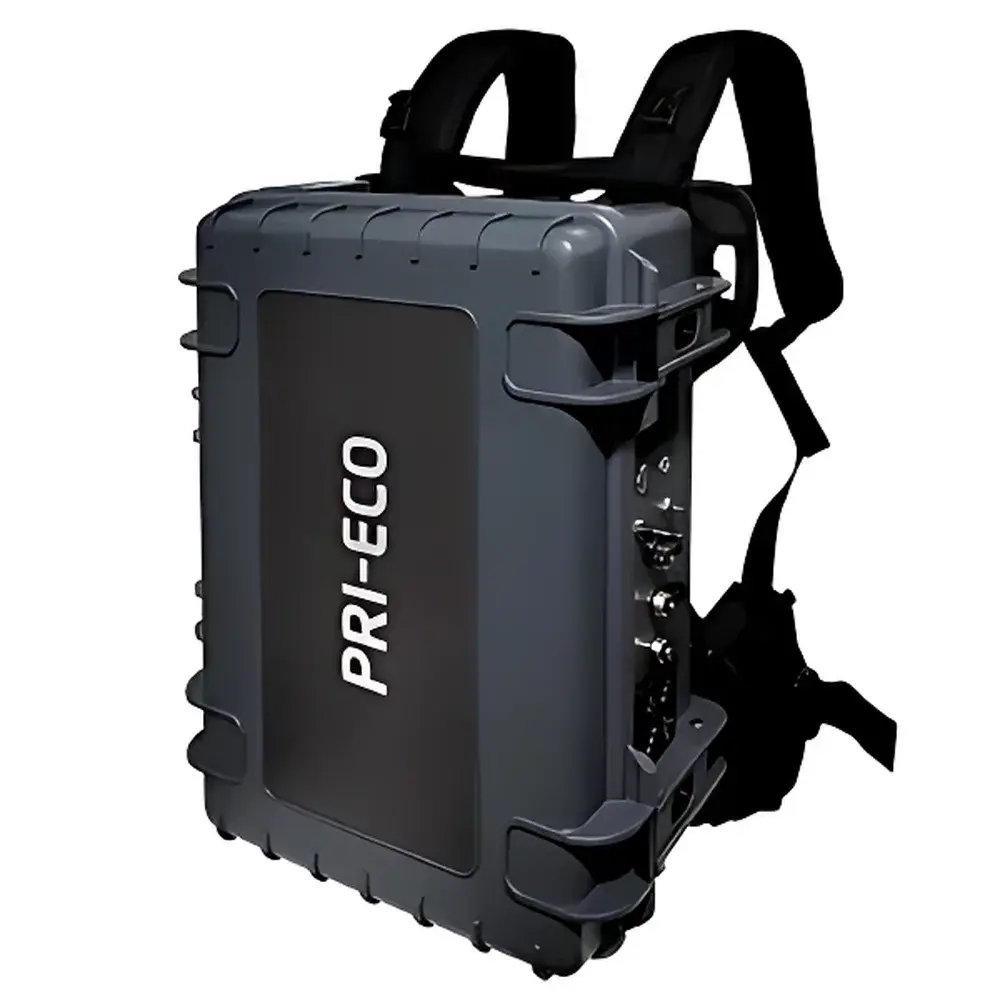
Pri-eco PRI-8640 Portable Multi-Gas Soil Respiration Measurement System
| Brand | Pri-eco |
|---|---|
| Origin | Beijing, China |
| Manufacturer Type | Direct Manufacturer |
| Country of Origin | China |
| Model | PRI-8640 |
| Instrument Type | Multi-Component Soil Respiration Analyzer |
| Power Consumption (Steady State) | < 50 W |
| Power Supply | 12 V Rechargeable Lithium Battery |
| Dimensions | 435 × 304 × 170 mm |
| Weight | 12 kg (Analyzer Unit) |
| CO₂ Precision (5 min) | 0.04 ppm |
| CH₄ Precision (5 min) | 0.2 ppb |
| N₂O Precision (5 min) | 0.03 ppb |
| H₂O Precision (5 min) | 10 ppm |
| Sample Flow Rate | 800 mL/min (adjustable) |
| Pressure Range (Chamber) | 350–1150 mbar |
| Pressure Accuracy | ±2 mbar |
| Chamber Diameter | 220 mm |
| Chamber Height | 120 mm |
| Chamber Volume | 3718 cm³ |
| Soil Surface Area | 314 cm² |
| Temperature Range (Soil/Air Sensor) | −55 to +125 °C |
| Temp. Accuracy | ±0.4 °C |
| Soil Moisture Range | 0–100% |
| Moisture Accuracy | ±3% |
| Relative Humidity Tolerance | <99% RH (non-condensing) |
| Patented Dynamic Pressure Compensation | Yes (Patent No. ZL201420354126.4) |
Overview
The Pri-eco PRI-8640 Portable Multi-Gas Soil Respiration Measurement System is an engineered field-deployable instrument designed for high-fidelity, simultaneous quantification of CO₂, CH₄, N₂O, and H₂O fluxes from soil surfaces. It employs Mid-Infrared Laser Absorption Spectroscopy (MIRLAS), a physics-based optical detection method that exploits fundamental vibrational absorption bands of target gases in the 2–10 µm spectral region. Unlike electrochemical or NDIR sensors with cross-sensitivity limitations, MIRLAS delivers inherent selectivity and long-term stability by resolving gas-specific rovibrational transitions. The system integrates real-time thermobaric compensation—via precision-controlled temperature stabilization (±0.05 °C) and active pressure regulation—to eliminate density-dependent artifacts in gas concentration calculations. Its dual-chamber architecture (analysis unit + soil chamber) ensures traceable mass balance under dynamic field conditions, supporting rigorous flux computation via the Hsieh–Gould–Wilson (HGW) or linear regression methods per ASTM D6558 and ISO 16634 standards.
Key Features
- Simultaneous, real-time measurement of CO₂, CH₄, N₂O, and H₂O vapor at sub-ppb resolution—enabling integrated greenhouse gas (GHG) budgeting without sequential sampling or calibration drift.
- Patented dynamic pressure compensation (ZL201420354126.4) maintains equilibrated pressure between the soil chamber and ambient atmosphere, suppressing advective bias induced by wind or barometric transients—critical for low-flux sites (<10 mg C–CO₂·m⁻²·h⁻¹).
- Field-ruggedized design: IP54-rated enclosure, −20 °C to +50 °C operational range, and shock-absorbing chassis optimized for off-road transport and repeated deployment in remote ecosystems.
- Integrated environmental sensing suite: co-located soil/air temperature (±0.4 °C), volumetric water content (±3%), and absolute pressure (±2 mbar) with synchronized timestamping for covariance correction.
- Low-power architecture: draws <50 W during steady-state operation; powered exclusively by a sealed 12 V Li-ion battery pack (≥8 h continuous use, configurable duty cycling).
- Modular chamber options: manual 220 mm-diameter chamber (1.8 kg) for spot measurements; automated 260 mm-diameter chamber (4.8 kg) with motorized lid actuation and programmable incubation sequences.
Sample Compatibility & Compliance
The PRI-8640 is validated for use across heterogeneous soil matrices—including mineral soils, organic peats, permafrost-affected tundra, and agricultural croplands—with minimal disturbance to natural diffusive gradients. Its non-destructive, closed-chamber methodology conforms to internationally recognized protocols: USDA ARS Soil Respiration Guidelines (2021), IPCC 2019 Refinement Tier 2 methodology, and EU JRC GHG Inventory Reporting Annex IV. All internal optical paths are purged with zero-air prior to each measurement cycle to prevent memory effects; calibration traceability is maintained against NIST-traceable gas standards (CO₂: 350–3500 ppm; CH₄: 0.1–500 ppb; N₂O: 0.1–500 ppb). Data output complies with FAO’s Global Soil Laboratory Network (GLOSOLAN) metadata schema and supports GLP-compliant audit trails when paired with optional secure logging firmware.
Software & Data Management
Operation is managed via a ruggedized Android tablet running Pri-eco FieldLink™ v4.2—a purpose-built application with offline-first architecture and encrypted local storage. The interface supports: (i) pre-defined measurement templates (e.g., diurnal cycles, freeze-thaw events); (ii) real-time flux visualization with statistical confidence intervals; (iii) automatic QA/QC flagging based on pressure deviation (>±5 mbar), moisture saturation (>99% RH), or signal-to-noise ratio thresholds; and (iv) export in CF-compliant NetCDF format for interoperability with R/Python workflows (eddyR, fluxnetr) and GIS platforms. Firmware updates include FIPS 140-2–validated cryptographic signing; raw spectra and processed time-series data are stored with SHA-256 checksums to ensure forensic integrity for regulatory submissions.
Applications
- Long-term eddy covariance validation and gap-filling at FLUXNET sites.
- Process-level studies of microbial denitrification (N₂O), methanogenesis (CH₄), and rhizosphere priming (CO₂) under climate manipulation experiments (e.g., warming, drought, CO₂ enrichment).
- Carbon accounting in regenerative agriculture—quantifying net ecosystem exchange (NEE) partitioning and soil carbon sequestration rates per Verra VM0042 methodology.
- Permafrost thaw monitoring in Arctic and alpine zones, where concurrent CH₄/N₂O pulses indicate anaerobic microsite development.
- EPA Region 10 and Environment Canada Tier 3 emissions reporting for landfill cover soils and reclaimed mine tailings.
FAQ
Does the PRI-8640 require external calibration gases during routine field operation?
No—zero/span verification is performed automatically using internal reference cells and factory-characterized laser wavelength locks. Optional field calibration kits (certified multi-gas standards) are available for annual metrological verification.
Can the system operate unattended for extended periods (e.g., >72 h)?
Yes—when configured with external solar charging (12 V input compatible) and scheduled measurement intervals, the PRI-8640 supports autonomous deployments up to 14 days with onboard 64 GB storage.
Is the MIRLAS analyzer susceptible to interference from volatile organic compounds (VOCs) or aerosols?
No—mid-infrared absorption bands used (e.g., CO₂ at 4.26 µm, CH₄ at 3.31 µm) exhibit negligible overlap with common biogenic VOCs; particulate filtration (0.2 µm PTFE membrane) prevents optical contamination.
How does the dynamic pressure compensation mechanism function physically?
A differential pressure transducer continuously monitors chamber-to-ambient offset; a proportional solenoid valve modulates vent flow to maintain ΔP < ±1 mbar, eliminating pressure-driven advection errors without altering chamber geometry or flow dynamics.
What software licenses or subscription fees apply post-purchase?
FieldLink™ software, firmware updates, and technical support are included for life—no recurring SaaS fees or feature gating. Source code for data processing algorithms is available under NDA for academic collaboration.







