
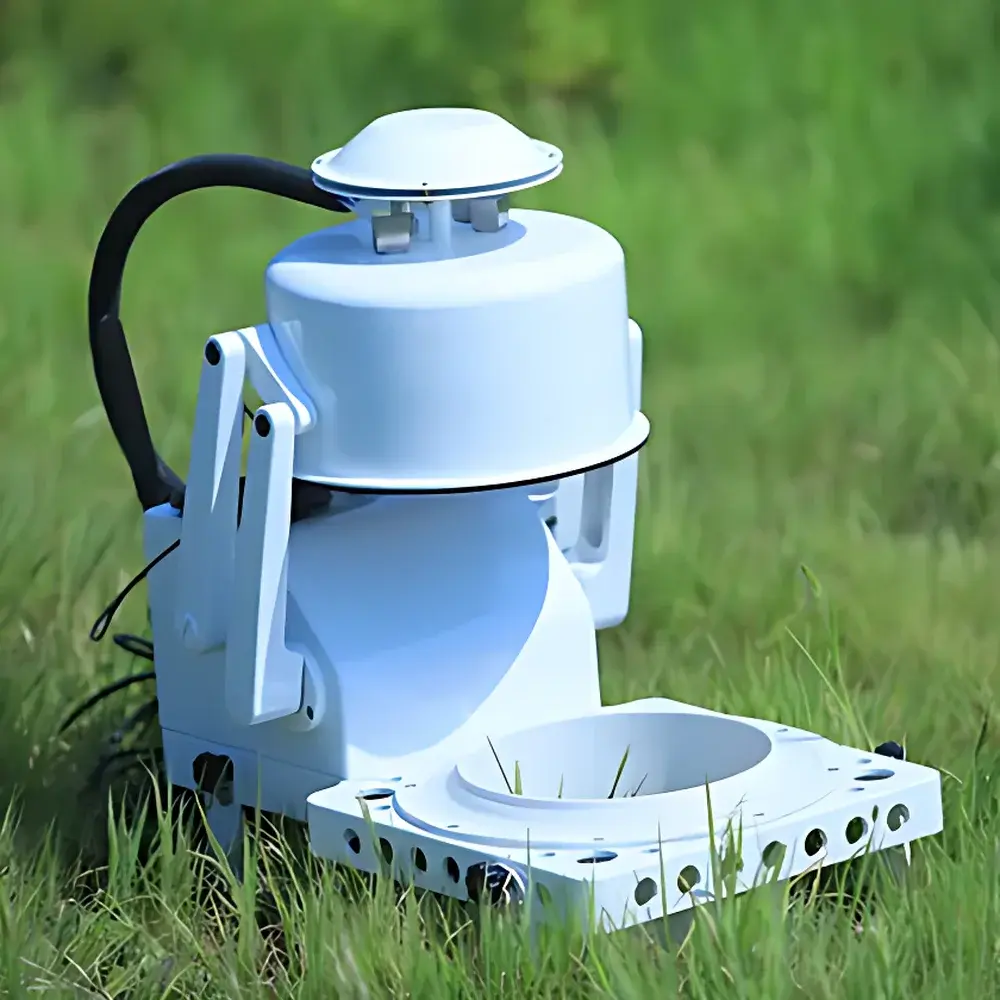
PRI-eco PRI-8650 Distributed Soil Respiration Measurement System
| Brand | PRI-eco |
|---|---|
| Origin | Beijing, China |
| Manufacturer | Yes |
| Country of Origin | China |
| Model | PRI-8650 |
| Instrument Type | Multi-point In-situ Soil Respiration Analyzer |
| Power Consumption | 12 W |
| Power Supply | 12 V DC |
| Dimensions (L×W×H) | 55 × 26 × 26 cm |
| CO₂ Measurement Range | 0–2000 ppm |
| CO₂ Accuracy | ±50 ppm or ±5% of reading |
| H₂O Vapor Range | 0–6% |
| H₂O Accuracy | ±2% |
| Air Temperature Range | −40 to +85 °C |
| Air Temperature Accuracy | ±0.2 °C |
| Soil Temperature Range | −40 to +85 °C |
| Soil Temperature Accuracy | ±0.2 °C |
| Soil Moisture Range | 0–100% |
| Soil Moisture Accuracy | ±3% (±2% after calibration) |
| Sampling Flow Rate | 0.5 mL/min at 760 Torr |
| Response Time (T90) | 2 s |
| Measurement Interval | 0.5 s |
| Operating Temperature | −10 to +50 °C (extended range: −30 to +50 °C) |
| Sampling Temperature | −20 to +50 °C |
| Node Scalability | Unlimited |
| Weight (incl. solar panel) | 18 kg |
Overview
The PRI-eco PRI-8650 Distributed Soil Respiration Measurement System is an engineered solution for high-frequency, spatially distributed, and temporally synchronized in-situ quantification of soil CO₂ efflux. It operates on the principle of non-dispersive infrared (NDIR) spectroscopy—leveraging dual-wavelength absorption detection to deliver stable, interference-resistant CO₂ concentration measurements in real time. Integrated with low-power IoT communication modules and edge-based synchronization logic, the PRI-8650 enables autonomous, timestamp-aligned operation across geographically dispersed nodes without requiring centralized hardware controllers. Unlike legacy multi-chamber systems constrained by cable length, manual triggering, or sequential sampling protocols, the PRI-8650 architecture eliminates temporal aliasing and spatial undersampling—critical limitations in studies of diel cycles, pulse responses to precipitation, or spatial heterogeneity in carbon fluxes.
Key Features
- Modular node design: Each PRI-8650 unit functions as a fully independent soil respiration analyzer—capable of autonomous deployment, self-calibration, and local data logging without network dependency.
- Wireless mesh-enabled synchronization: Nodes initiate simultaneous measurement sequences via precision time-synchronized triggers (±10 ms alignment), ensuring inter-node comparability for spatiotemporal flux modeling.
- Integrated multi-parameter sensing: Simultaneous acquisition of CO₂ concentration, air temperature, soil temperature (at multiple depths), volumetric soil moisture (via calibrated capacitance), and ambient humidity within a single compact enclosure.
- Low-power, field-deployable architecture: Rated at 12 W nominal consumption and compatible with 12 V DC input—including solar-rechargeable battery systems—enabling year-round operation in remote off-grid locations.
- Robust environmental rating: Designed for continuous outdoor exposure across −30 to +50 °C ambient conditions; sealed NDIR optical path and particulate filtration ensure long-term stability under dust, condensation, and variable pressure conditions (760 Torr reference).
- Cloud-native data pipeline: Encrypted TLS 1.2 transmission to secure cloud infrastructure with configurable retention policies, automatic metadata tagging (GPS-derived location, firmware version, sensor health flags), and audit-trail logging compliant with GLP-aligned workflows.
Sample Compatibility & Compliance
The PRI-8650 is optimized for direct insertion into mineral and organic soils across diverse ecosystems—including forests, grasslands, agricultural fields, and permafrost-affected tundra. Its low-flow (0.5 mL/min), pressure-compensated sampling head minimizes disturbance to natural diffusion gradients while maintaining sufficient residence time for NDIR signal integration. All sensors comply with IEC 60068-2 environmental stress testing standards for operational reliability. Data integrity meets requirements for ISO 14064-3 verification pathways and supports traceable calibration against NIST-traceable CO₂ standards. Firmware implements secure boot and cryptographic signing to satisfy FDA 21 CFR Part 11 expectations for electronic records in environmental monitoring applications subject to regulatory review.
Software & Data Management
The system is managed through PRI-eco’s Web-Based Environmental Data Platform (WEDP), accessible via role-based authentication. WEDP provides real-time dashboards with configurable flux calculation engines (e.g., Hsieh, linear regression, exponential decay models), automated QA/QC flagging (e.g., outlier detection based on temporal variance thresholds), and batch export in CF-compliant NetCDF or ISO-standardized OGC SensorML format. Raw sensor logs include embedded timestamps synchronized to UTC via NTP or GNSS time sources. Audit logs record all user-initiated actions—including parameter edits, calibration events, and data purges—with immutable SHA-256 hashing. Local SD card storage (optional) ensures redundancy during extended connectivity outages, with automatic delta-sync upon reconnection.
Applications
- Long-term eddy covariance validation and gap-filling of ecosystem-scale carbon budgets
- Spatial mapping of rhizosphere respiration gradients in agroecosystem trials
- Monitoring thaw-induced CO₂ pulses in Arctic and alpine permafrost zones
- Assessing land-use change impacts on soil carbon turnover rates (e.g., afforestation, tillage reduction)
- Calibration and ground-truthing of satellite-based soil moisture and surface temperature products
- Controlled-environment mesocosm studies requiring parallel replication with sub-minute temporal resolution
FAQ
Can the PRI-8650 be deployed without cellular coverage?
Yes. Units operate autonomously with onboard memory and support LoRaWAN, NB-IoT, or satellite uplink options depending on regional infrastructure availability.
Is factory calibration traceable to international standards?
All CO₂ sensors are calibrated against NIST SRM 1971 certified gas mixtures; calibration certificates include uncertainty budgets per ISO/IEC 17025 guidelines.
How is soil moisture accuracy improved to ±2% post-calibration?
Users apply site-specific dielectric calibration curves derived from gravimetric sampling; the platform supports import of custom calibration lookup tables.
Does the system support third-party API integration?
Yes—RESTful JSON APIs enable bidirectional integration with institutional LIMS, FluxNet databases, or custom modeling environments (e.g., R, Python, MATLAB).
What maintenance intervals are recommended for field deployments exceeding 12 months?
Biannual inspection of inlet filters and desiccant cartridges; annual NDIR zero/span verification using certified span gases; no optical alignment required due to monolithic optical bench design.
Related Products







