
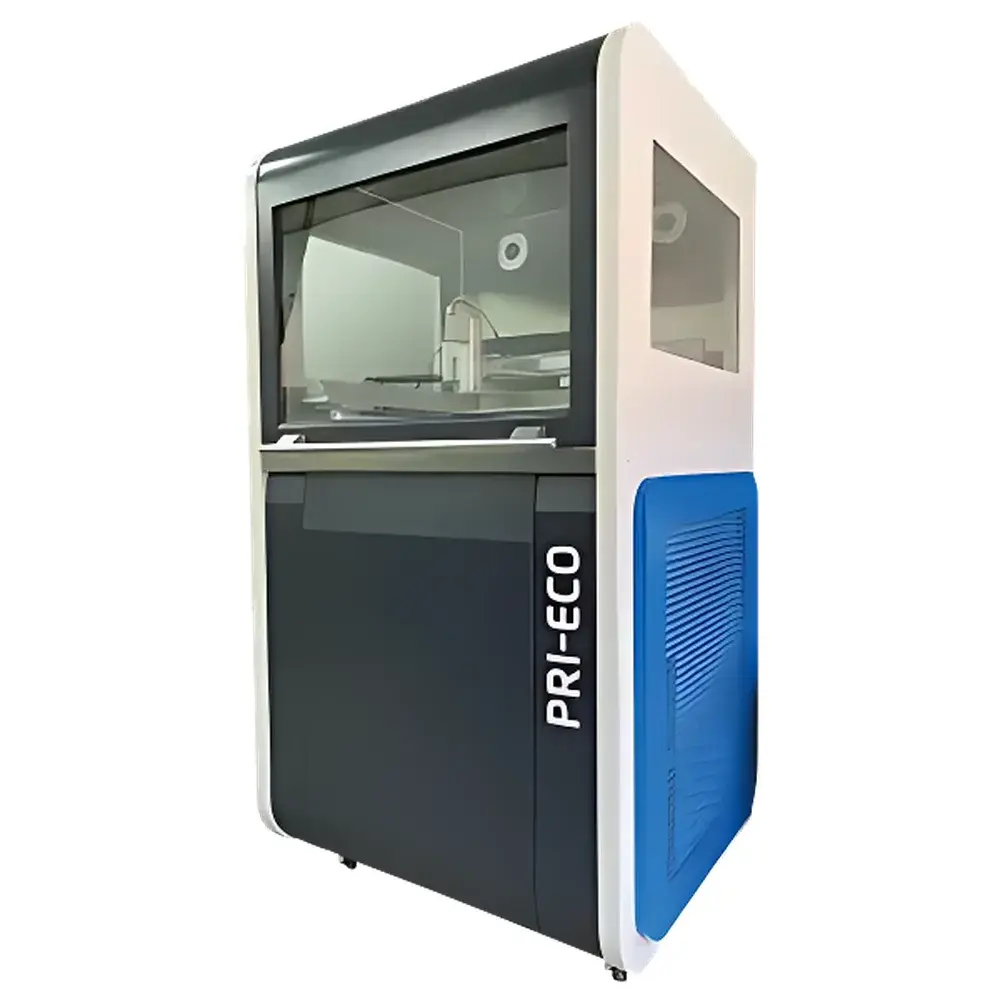
Pri-eco PRI-8800 Plus Automated Temperature-Controlled Soil Incubation System for Online Greenhouse Gas Monitoring
| Brand | Pri-eco |
|---|---|
| Origin | Beijing, China |
| Manufacturer | Yes |
| Country of Origin | China |
| Model | PRI-8800 Plus |
| Pricing | Upon Request |
| Sample Chamber Dimensions | 8 cm D × 50 cm H |
| Sample Positions | 9 |
| Temperature Range | −15 to 60 °C |
| Temperature Stability | ±0.05 °C |
| Avg. Ramp Rate (5–30 °C) | 1 °C / 5 min |
| Internal Cavity | 530 mm W × 530 mm D × 500 mm H |
| Auto-sampler Positioning Accuracy | 0.02 mm |
| Barometric Sensor Accuracy | ±0.05% FS |
| Soil Temp. Sensor Accuracy | ±0.15 °C |
| Gas Flow Rate | 1 L/min |
| Tubing | 1/8″ SS or PTFE |
| Purge Gas | Ambient air buffer or cylinder gas |
| Power | 100–240 VAC, 50/60 Hz |
| Overall Dimensions | 762 mm W × 950 mm D × 1700 mm H |
Overview
The Pri-eco PRI-8800 Plus is an engineered platform for automated, temperature-programmed soil incubation and real-time greenhouse gas (GHG) flux quantification under controlled environmental conditions. It operates on the principle of dynamic headspace sampling coupled with high-fidelity gas analysis—enabling continuous, non-destructive monitoring of CO2, CH4, N2O, and H2O emissions from intact or repacked soil cores across defined thermal, hydric, and biogeochemical gradients. The system integrates precision thermoregulation (−15 to 60 °C), programmable ramp/soak profiles, and modular gas detection—supporting both steady-state and transient kinetic studies of soil respiration, methanogenesis, denitrification, and redox-sensitive biogeochemical turnover. Its architecture conforms to core requirements for climate-relevant process studies: traceable temperature control (±0.05 °C stability), reproducible sample positioning (0.02 mm repeatability), and compatibility with GLP-aligned data acquisition workflows.
Key Features
- Automated 9-position incubation carousel with standardized 8 cm diameter × 50 cm height sample tubes—optimized for undisturbed monoliths or structured repacked columns.
- High-stability thermal chamber featuring dual-mode compressor-based cooling and resistive heating; achieves ±0.05 °C temperature uniformity across the 530 × 530 × 500 mm active zone.
- Programmable thermal protocols: fixed-temperature holds, linear ramps (≥1 °C/5 min between 5–30 °C), multi-step cycles—including freeze-thaw simulation (−15 to +60 °C) and wet-dry cycling via integrated water-level control.
- Modular gas analysis interface: accepts OEM analyzers including CO2/H2O dual-channel NDIR (0–2000 ppm CO2, ±2% accuracy), high-precision CO2/CH4/N2O/H2O analyzers, and cavity ring-down spectrometers for 13C/12C-CO2 or 13C/12C-CH4 isotopic ratio determination.
- Integrated environmental sensor ports supporting optional in situ measurement of soil volumetric water content (±2%), bulk electrical conductivity (±10% @ 0–1 S/m), matric potential (±1 mbar), and temperature (±0.15 °C).
- Full-system automation via embedded industrial PC with deterministic timing control—enabling unattended operation over days to months, with timestamped metadata logging for each sample event.
Sample Compatibility & Compliance
The PRI-8800 Plus accommodates a broad spectrum of terrestrial and engineered substrates: mineral soils (clay loam to sandy), organic histosols, permafrost monoliths, constructed wetland mesocosms, cementitious materials, and biochar-amended matrices. Its mechanical design supports ASTM D4971 (water retention), ISO 11274 (soil water characteristic curves), and USP <1251> (moisture content by loss-on-drying validation). When configured with compliant gas analyzers and audit-trail-enabled software, the system meets FDA 21 CFR Part 11 requirements for electronic records and signatures—facilitating regulatory submissions in environmental consulting, carbon accounting verification, and academic GLP-compliant research. All fluidic pathways use electropolished stainless steel or inert PTFE tubing to prevent adsorption artifacts and ensure analytical integrity during long-term deployments.
Software & Data Management
Control and acquisition are managed through Pri-eco’s proprietary LabView-based platform, which provides intuitive graphical protocol scripting (ramp rates, dwell times, sensor polling intervals), real-time gas concentration overlays, and automatic calibration event scheduling. Raw data—including temperature setpoints, measured chamber conditions, gas concentrations, and sensor outputs—are stored in HDF5 format with embedded metadata (ISO 19115-compliant geospatial tags where applicable). Export options include CSV, NetCDF, and MATLAB-compatible binaries. The software supports batch processing for Q10 calculation (Arrhenius-derived), moisture response curve fitting (e.g., Gaussian or logistic models), and multivariate regression against ancillary parameters (e.g., EC, θv, ψm). Audit trails record all user actions, parameter modifications, and instrument state changes—enabling full traceability for peer review or regulatory audits.
Applications
- Climate-Driven Biogeochemistry: Quantifying temperature sensitivity (Q10) across ≥20 discrete thermal setpoints per sample—addressing Robinson’s 2017 recommendation for robust Arrhenius modeling of soil respiration kinetics.
- Frozen Soil Dynamics: Simulating seasonal freeze-thaw cycles to resolve hysteresis effects on microbial community structure, dissolved organic carbon leaching, and anaerobic CH4 pulse generation.
- Wetland Hydrology-GHG Coupling: Co-varying inundation depth (via programmable water reservoirs) and temperature to isolate controls on CH4 ebullition versus diffusion and CO2 mineralization pathways.
- Soil Amendments & Carbon Sequestration: Tracking temporal evolution of GHG fluxes following biochar, compost, or nitrification inhibitor application—under realistic diel or seasonal thermal regimes.
- Cement Hydration Kinetics: Measuring water content and ionic conductivity in curing concrete specimens across subzero to 60 °C—supporting ASTM C1747 and EN 480-11 standard development.
- Microbial Inoculation Studies: Assessing functional redundancy and thermal niche partitioning by comparing native vs. exogenous inoculant responses across thermal gradients.
FAQ
Can the PRI-8800 Plus operate without external gas analyzers?
Yes—the base system includes a calibrated CO2/H2O analyzer. All other analyzers (e.g., CH4/N2O, isotopic) are optional modules requiring separate configuration.
What is the maximum duration for unattended operation?
With stable power and ambient cooling, the system supports continuous runs exceeding 30 days. Scheduled maintenance (e.g., desiccant replacement, zero-gas validation) is recommended every 7–10 days for optimal accuracy.
Is remote monitoring supported?
Yes—via secure SSH or VNC access to the embedded PC. Real-time data streaming to cloud repositories (e.g., AWS S3, FTPS) is configurable using user-defined scripts.
How is temperature uniformity verified across the 9-sample zone?
Factory calibration includes NIST-traceable multi-point thermistor mapping at three vertical planes (top/mid/base) within the chamber, with reports supplied with each unit.
Does the system comply with ISO/IEC 17025 for testing laboratories?
While the PRI-8800 Plus itself is not accredited, its metrological specifications (temperature stability, flow control, sensor traceability) enable users to establish method validation per ISO/IEC 17025 Clause 7.2 when paired with certified reference materials and documented uncertainty budgets.



