
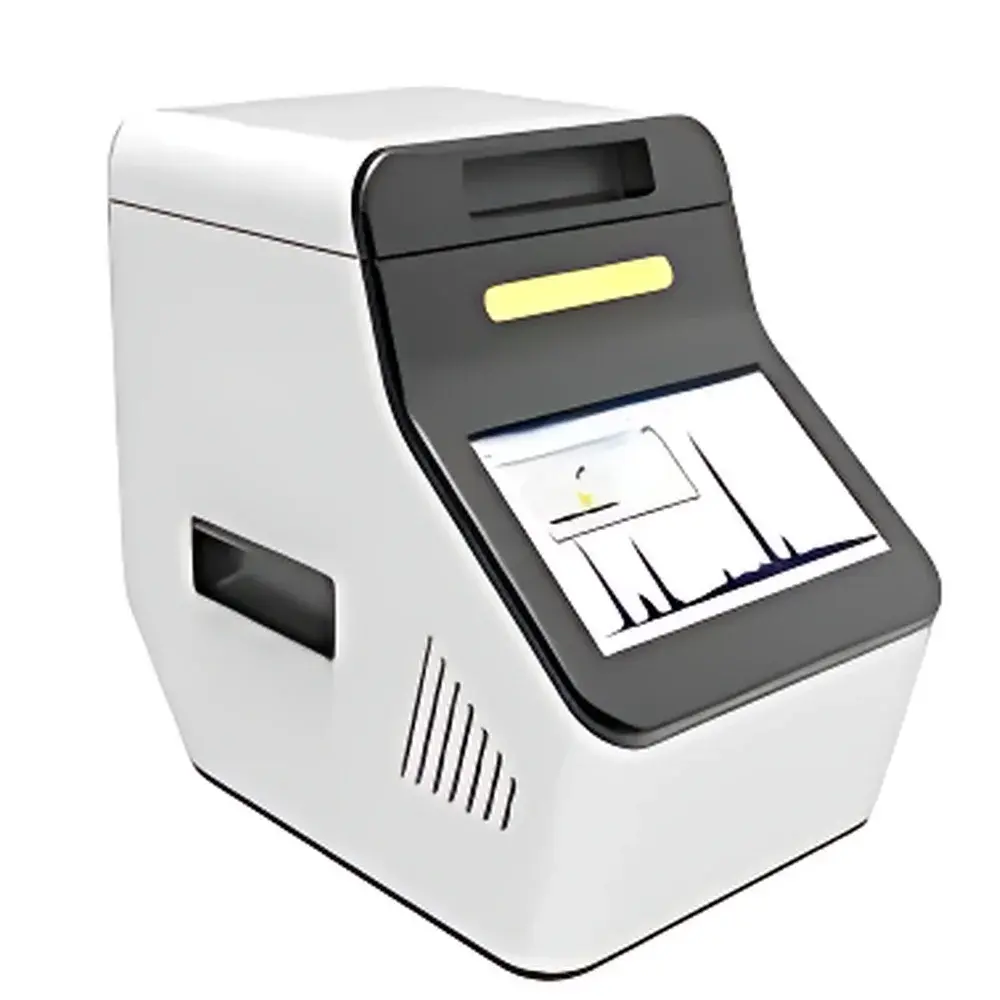
Pri-eco PRI-XRF1 High-Precision Soil Heavy Metal Analyzer
| Brand | Pri-eco |
|---|---|
| Origin | Beijing, China |
| Manufacturer Type | Original Equipment Manufacturer (OEM) |
| Country of Manufacture | China |
| Model | PRI-XRF1 |
| Pricing | Available Upon Request |
| X-ray Tube | Integrated End-window Tube (65 kV / 100 W) |
| Detector | Factory-Integrated Fast Silicon Drift Detector (SDD), Energy Resolution ≤125 eV (Mn Kα, 5.889 keV) |
| Detection Limits (3σ) | Hg 0.39 ppm, As 0.42 ppm, Pb 0.72 ppm, Cd 0.16 ppm, Cr 2.20 ppm, Ni 1.56 ppm, Cu 1.38 ppm, Zn 0.93 ppm |
| Quantification Limits (10σ) | Hg 1.31 ppm, As 1.41 ppm, Pb 2.39 ppm, Cd 0.54 ppm, Cr 7.32 ppm, Ni 5.19 ppm, Cu 4.58 ppm, Zn 3.09 ppm |
| Elemental Range | ppm to 99.99 wt% |
| Minimum Measurement Time | 30 s |
| Power Supply | Rechargeable Li-ion Battery (DC 12 V) |
| AC Input | 220 ±22 V, 50/60 Hz |
| Battery Life | 8–10 h |
| Connectivity | 4G Cellular Data Transmission |
| Radiation Safety | Triple-layer X-ray Protection (Mechanical Maze + Electronic Interlock + Software-Based Beam Termination), Compliant with GBZ 115–2002 and IEC 61010-1 |
Overview
The Pri-eco PRI-XRF1 High-Precision Soil Heavy Metal Analyzer is a field-deployable, benchtop-grade energy-dispersive X-ray fluorescence (ED-XRF) spectrometer engineered for rapid, non-destructive quantification of heavy metals in heterogeneous soil matrices. It operates on the fundamental principle of X-ray fluorescence: a high-voltage end-window X-ray tube emits primary radiation that excites inner-shell electrons in target atoms; upon electron relaxation, characteristic secondary X-rays are emitted at energies unique to each element. These photons are collected by a factory-integrated fast silicon drift detector (SDD) with ≤125 eV resolution at Mn Kα (5.889 keV), enabling precise peak deconvolution and robust multielement calibration—even in soils with variable organic content, clay fraction, moisture, and particle size distribution. Unlike wet-chemistry or ICP-based methods, the PRI-XRF1 requires no acid digestion, no carrier gases, no liquid reagents, and generates zero chemical waste—making it suitable for GLP-compliant field surveys, regulatory inspections, and longitudinal remediation monitoring under ISO 17025 and ASTM D6988-22 frameworks.
Key Features
- Optimized soil-specific calibration suite covering eight priority pollutants: Cd, Hg, As, Pb, Cr, Ni, Cu, and Zn—with demonstrated detection limits below regulatory thresholds for Class II agricultural soils (GB 15618–2018).
- Direct solid-sample analysis: minimal preparation—air-drying and light homogenization only; no grinding, sieving, or pelletizing required.
- Quantitative results in ≤2 minutes per element (Cd: 10 min for sub-ppm precision); full multi-element scan completed in under 5 minutes.
- Triple-layer radiation safety architecture: mechanical collimation maze, hardware-triggered electronic interlock, and software-enforced beam termination—exceeding requirements of GBZ 115–2002 and aligned with IEC 62495 for portable XRF devices.
- Integrated 4G module enables real-time geotagged data upload to cloud-hosted LIMS platforms, supporting audit-ready traceability per FDA 21 CFR Part 11 and EU Annex 11 requirements.
- Self-contained power system: rechargeable Li-ion battery (8–10 h runtime) with universal AC input (220 V ±10%, 50/60 Hz), certified to IEC 62133 for transport and field use.
Sample Compatibility & Compliance
The PRI-XRF1 is validated for direct measurement of air-dried, unprocessed soil samples across texture classes—from sandy loam to heavy clay—and accommodates organic matter content up to 15% (w/w). Its spectral deconvolution algorithm compensates for matrix effects using empirical coefficient correction and fundamental parameter (FP) modeling, minimizing bias from Fe, Ca, Si, and Al interferences. Certified reference materials (CRMs) including GSS-4, GSS-8, GSD-9, and GSD-10 were used during factory calibration and verification; measured values fall within certified uncertainty ranges (e.g., As: 12.8 ± 0.5 ppm vs. 12.7 ± 1.1 ppm in GSS-8). The instrument meets ISO 8596:2020 for field-portable XRF performance validation and supports compliance reporting for national soil monitoring programs (e.g., China’s National Soil Pollution Survey Protocol, US EPA Region 10 Field Screening Guidance).
Software & Data Management
The embedded firmware runs on a real-time Linux OS with deterministic acquisition timing and hardware-level spectral stabilization. The companion desktop application (Windows/macOS) provides full spectrum review, peak fitting diagnostics, CRM matching reports, and customizable QA/QC dashboards—including spike recovery tracking, drift correction logs, and daily calibration verification records. All measurement metadata—GPS coordinates, operator ID, sample ID, ambient temperature/humidity, and acquisition parameters—are embedded in exportable .CSV and .XLSX files. Audit trails are time-stamped and digitally signed, satisfying GLP/GMP documentation requirements and enabling seamless integration with laboratory information management systems (LIMS) via RESTful API or secure SFTP.
Applications
- Regulatory field screening: rapid assessment of contaminated sites during environmental due diligence, brownfield redevelopment, or enforcement actions under China’s Soil Pollution Prevention and Control Law.
- Agricultural land monitoring: longitudinal tracking of heavy metal accumulation pre-/post-remediation, fertilizer application impact studies, and phytoremediation efficacy evaluation.
- Research & education: method development for XRF-based soil analysis, inter-laboratory comparison studies, and teaching spectroscopic quantification principles in environmental science curricula.
- Contract laboratory support: high-throughput triage prior to confirmatory ICP-MS analysis—reducing lab backlog by >60% in multi-site surveys.
- Geochemical mapping: integration with GIS platforms for spatial interpolation of elemental distributions across watershed or regional scales.
FAQ
Does the PRI-XRF1 require sample digestion or acid leaching?
No. It performs direct solid-state analysis on air-dried, homogenized soil—eliminating digestion-related contamination risks and analytical delays.
Can it quantify elements beyond the eight regulated metals?
Yes. The SDD detector supports simultaneous quantification of over 25 elements (e.g., Mn, Fe, Co, Se, Rb, Sr, Ba, Zr), subject to matrix-dependent sensitivity and CRM availability.
Is the instrument compliant with international radiation safety standards?
Yes. Its triple-protection design exceeds GBZ 115–2002 and conforms to IEC 62495:2013 for portable analytical X-ray equipment, with type-tested dose rates <0.5 µSv/h at 5 cm from housing.
How is measurement accuracy verified in the field?
Through routine analysis of on-site CRMs (e.g., GSS series) and daily calibration verification checks using built-in reference foils—logs automatically appended to each measurement file.
What data security protocols are implemented for remote transmission?
4G communications use TLS 1.2 encryption; user authentication follows OAuth 2.0; all cloud-uploaded data is stored in ISO 27001-certified infrastructure with role-based access control.
Related Products







