
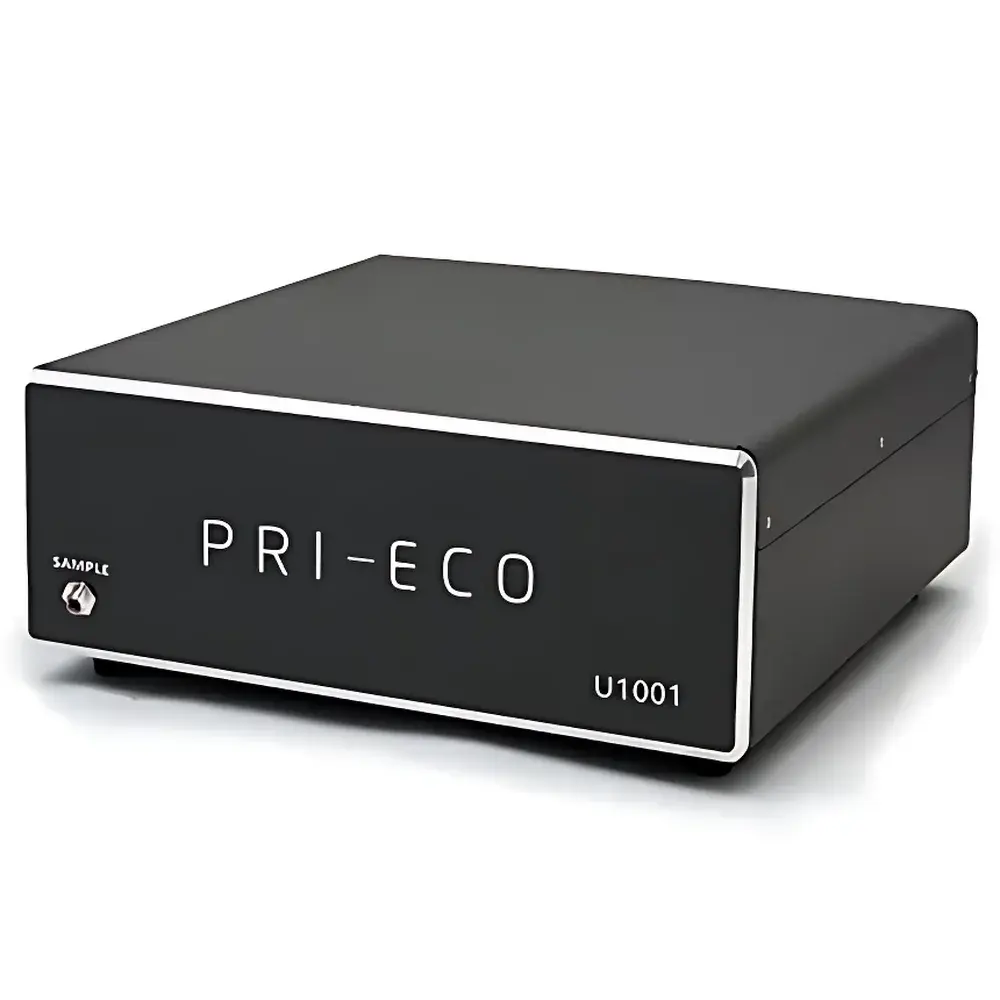
Pri-eco U1001 Micro-Sample Introduction Module
| Brand | Pri-eco |
|---|---|
| Origin | Beijing, China |
| Manufacturer Type | Original Equipment Manufacturer (OEM) |
| Country of Origin | China |
| Model | U1001 |
| Pricing | Upon Request |
Overview
The Pri-eco U1001 Micro-Sample Introduction Module is an engineered interface designed for precise, low-volume gas introduction into high-sensitivity analytical instruments—particularly isotope ratio infrared spectrometers (IRIS), cavity ring-down spectrometers (CRDS), and other trace-gas analyzers requiring strict control over sample mass, residence time, and carryover. Operating on the principle of controlled volumetric aspiration and pressure-regulated flow modulation, the U1001 enables reproducible delivery of sub-50 mL gaseous samples while maintaining laminar flow dynamics and minimizing dead volume. Its core function is to bridge the gap between limited-sample availability (e.g., headspace vials, incubation bags, microcosm headspaces) and instrument-specific inlet requirements—especially where native sample volumes fall below minimum detection thresholds or exceed linear dynamic range. Unlike passive sampling adapters, the U1001 integrates active flow management, internal dilution capability, and programmable sequence control, making it suitable for both manual benchtop workflows and automated multi-sample campaigns.
Key Features
- Micro-volume compatibility: Delivers accurate analysis from as little as 20 mL of ambient-level CO₂ or CH₄—enabling isotopic characterization of small-batch biological incubations, soil microcosms, or cell culture headspaces.
- Dual-mode operation: Supports manual injection via syringe or gas-tight bag connection (1/8″ stainless-steel Swagelok fitting), as well as automated sequencing when integrated with the Pri-eco 16-port multiplexer (enabling up to 8 discrete samples per run, gas-bag only).
- On-board dilution system: Integrated precision metering valves allow programmable dilution of high-concentration standards or unknowns with zero air—critical for extending linear range without external hardware.
- Calibration-integrated workflow: Enables automatic spiking of certified reference gases into sample sequences, supporting bracketing calibration, drift correction, and real-time response normalization.
- Low-memory architecture: Optimized internal chamber geometry and purge protocol reduce carryover to <0.5% (measured using δ¹³C-CO₂ step-change tests), verified across repeated injections of isotopically distinct standards.
- Energy-efficient design: Total system power consumption <5 W; compatible with field-deployable power supplies and laboratory UPS systems.
Sample Compatibility & Compliance
The U1001 accommodates a wide range of sample containment formats including Tedlar® bags, glass serum vials (with crimp-top septa), and custom-fabricated aluminum gas cylinders (≤200 mL). It is chemically inert toward CO₂, CH₄, N₂O, CO, and H₂O vapor within standard operating temperature ranges (5–35 °C). All wetted surfaces are electropolished 316 stainless steel or PTFE-lined. The module complies with ISO 17025-recommended practices for traceability in gas metrology and supports audit-ready data logging required under GLP and FDA 21 CFR Part 11 environments when paired with Pri-eco’s validated acquisition software. No regulatory certifications (e.g., CE, UKCA) are claimed for standalone use; integration into a fully validated analytical system remains the end-user’s responsibility.
Software & Data Management
The U1001 operates natively with Pri-eco’s proprietary acquisition suite, which provides graphical real-time monitoring of pressure transients, flow stabilization curves, and spectral integration windows. Each sample event logs timestamped metadata—including injected volume, dilution factor, carrier gas pressure, and ambient temperature—stored in HDF5 format for long-term archiving and third-party interoperability (e.g., Python/Pandas, MATLAB). Software supports batch processing with configurable averaging algorithms (e.g., median-of-9, trimmed mean), outlier rejection based on signal-to-noise ratio thresholds, and export to CSV/Excel with ISO-compliant uncertainty propagation fields. Audit trail functionality records all parameter modifications, user logins, and sequence edits with SHA-256 hashing.
Applications
- Soil biogeochemistry: Isotopic analysis of ¹³CO₂ and ¹²CH₄ from microcosm incubations with ≤25 g dry soil mass.
- Clinical breath research: Quantification of ¹³C-urea hydrolysis kinetics using <20 mL exhaled breath collected in inert bags.
- Environmental forensics: High-precision δ¹⁵N-N₂O measurements from snowpack interstitial air samples.
- Method validation: Generation of matrix-matched calibration curves across 3 orders of magnitude via on-module serial dilution.
- QA/QC protocols: Automated insertion of primary standards every 4th sample to monitor instrumental drift during unattended overnight runs.
FAQ
What is the minimum detectable sample volume for CO₂ isotopic analysis?
20 mL of ambient-air-equivalent CO₂ (≈400 ppm) is sufficient for δ¹³C precision ≤0.3‰ (1σ) when coupled with a CRDS analyzer having noise-equivalent absorption coefficient <1×10⁻¹⁰ cm⁻¹ Hz⁻¹/².
Can the U1001 be used with non-Pri-eco analyzers?
Yes—provided the target instrument accepts 1/8″ SS inlet tubing, operates within 0–100 kPa absolute inlet pressure range, and supports external TTL-triggered start commands.
Is firmware upgradable in the field?
Yes—via USB-C interface using signed binary packages distributed through Pri-eco’s secure customer portal.
Does the module require external vacuum or compressed gas?
No—integrated diaphragm pump (included) generates necessary negative pressure; only zero air (for dilution/calibration) must be supplied externally.
How is carryover quantified and mitigated?
Carryover is measured using alternating high/low δ¹³C-CO₂ standards; default purge cycle (60 s at 100 mL/min) achieves <0.5% residual; extended purge protocols can be scripted for ultra-trace applications.
Related Products






