
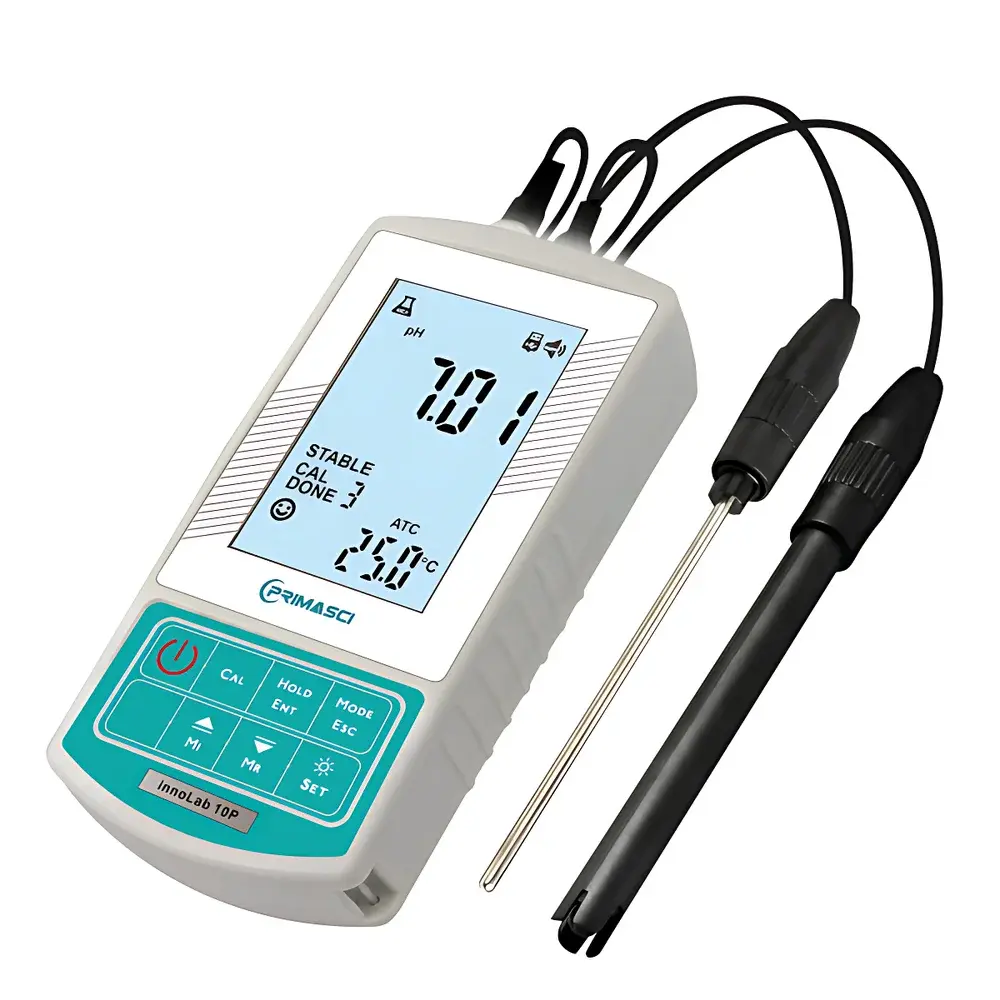
PRIMA innoLab 10P Portable pH/ORP/Temperature Meter
| Brand | PRIMA SCI (UK) |
|---|---|
| Origin | Shanghai, China |
| Model | innoLab 10P |
| Instrument Type | Portable |
| Parameter Type | Single-Parameter (pH/ORP/Temp) |
| Measurement Range | 0.00–14.00 pH (extended: –2.00 to +16.00 pH), –2000 to +2000 mV, –5.0 to 120.0 °C |
| Resolution | 0.01 pH, 0.1 mV (±600.0 mV), 1 mV (full range), 0.1 °C/0.1 °F |
| Accuracy | ±0.01 pH, ±0.2 mV (±600.0 mV), ±1 mV (full range), ±0.3 °C / ±0.5 °F |
| Calibration | Auto-recognition of 1–3 point NIST-traceable buffer calibration |
| Temperature Compensation | Automatic (ATC) or Manual (MTC), –5.0 to +120.0 °C |
| Electrode Interface | BNC + 3.5 mm temperature probe jack |
| Display | 43 × 70 mm LCD, 120° viewing angle |
| Housing Rating | IP65 |
| Dimensions | 73 × 152 × 42 mm (W × H × D) |
| Weight | 250 g |
| Power | 2 × 1.5 V AA alkaline batteries (>500 h operation) |
| Data Storage | Optional 100-point memory |
| Auto-Off | Selectable (10 min idle timeout) |
| Key Features | Differential signal circuitry, electrode health diagnostics (Slope/Offset), STABLE reading indicator, MTC fallback mode, ergonomic grip, scratch-resistant display |
Overview
The PRIMA innoLab 10P is a field-deployable, triple-parameter electrochemical meter engineered for precise, reliable measurement of pH, oxidation-reduction potential (ORP/mV), and temperature in diverse aqueous environments. Based on potentiometric principle using a glass pH electrode and reference junction system, the instrument delivers high reproducibility across its full operational range (–2.00 to +16.00 pH; –2000 to +2000 mV; –5.0 to 120.0 °C). Its design prioritizes robustness for routine use outside controlled laboratory settings — including environmental monitoring, municipal water sampling, industrial process verification, and educational fieldwork. The meter complies with fundamental electrochemical measurement standards under ISO 7888 (water quality — determination of pH), ASTM D1293 (standard test method for pH of water), and supports traceable calibration via NIST-certified buffer solutions (e.g., pH 4.01, 7.00, 10.01 at 25 °C).
Key Features
- Differential signal circuit architecture minimizes electromagnetic interference and ensures stable readings in electrically noisy field conditions.
- Large-format 43 × 70 mm LCD with 120° wide-angle viewing and anti-scratch surface enables legible data interpretation under variable lighting, including direct sunlight.
- Comprehensive electrode diagnostics: real-time display of calibration slope (%), offset (mV), and electrode status indicator — critical for verifying sensor integrity prior to measurement.
- Three-point auto-buffer recognition with multi-segment calibration curve fitting ensures linearity and accuracy across the entire pH scale, not just at nominal points.
- Intelligent temperature handling: automatic temperature compensation (ATC) when a compatible Pt1000 or thermistor probe is connected; seamless fallback to manual temperature compensation (MTC) if no probe signal is detected.
- Ergonomic, non-slip housing (IP65-rated) withstands dust ingress and low-pressure water jets — suitable for outdoor deployment in rain, humidity, or splashing environments.
- Extended battery life (>500 hours on two AA alkaline cells) and user-selectable 10-minute auto-off function optimize operational readiness during extended campaigns.
Sample Compatibility & Compliance
The innoLab 10P is validated for direct immersion measurement in aqueous samples including potable water, wastewater effluent, surface water (rivers, lakes, estuaries), cooling tower fluids, and mild chemical process streams. It is not intended for non-aqueous solvents, highly viscous media, or strong oxidizing agents that may degrade the glass membrane. Electrode compatibility is limited to standard BNC-interface pH electrodes and optional integrated temperature probes (e.g., combined pH/ATC sensors). The device meets CE marking requirements for electromagnetic compatibility (EMC Directive 2014/30/EU) and low-voltage safety (LVD Directive 2014/35/EU). While not FDA 21 CFR Part 11–compliant as a standalone unit, its calibration logs and electrode diagnostics support GLP-aligned documentation practices when used with external audit-trail procedures.
Software & Data Management
The innoLab 10P operates as a self-contained, embedded-system meter with no onboard USB or Bluetooth connectivity. Data logging is implemented via optional internal memory storing up to 100 measurement records (timestamp, pH, mV, °C, electrode slope/offset). Export requires manual transcription or integration with third-party lab notebooks. Calibration history — including date, buffer IDs, measured values, and acceptance criteria — is retained per session and displayed on-screen for immediate review. All calibration events adhere to ISO/IEC 17025–recommended practices for metrological traceability when NIST-traceable buffers are employed and documented.
Applications
- Field-based water quality assessment for regulatory compliance (e.g., EPA Method 150.1, ISO 10523).
- In-process pH monitoring during food & beverage production, pharmaceutical water systems (PW/WFI pre-check), and chemical dosing control.
- Educational use in university environmental science labs requiring rugged, intuitive instrumentation for student-led sampling exercises.
- Preventive maintenance checks on HVAC cooling towers and boiler feedwater where ORP correlates with biocide efficacy.
- Baseline characterization of soil leachates and sediment pore water in ecological surveys.
FAQ
Does the innoLab 10P support GLP-compliant calibration reporting?
It displays full calibration metadata (slope, offset, buffers used) but lacks electronic signature or export capability; manual record-keeping is required to meet GLP documentation standards.
Can it measure pH in non-aqueous or high-ionic-strength samples?
No — the meter is optimized for aqueous solutions with conductivity ≥50 µS/cm. Measurements in ethanol, oils, or saturated brines will yield unreliable results due to liquid junction potential errors.
Is the temperature probe integrated or optional?
The unit accepts external temperature probes via a dedicated 3.5 mm jack; no built-in sensor is included — ATC requires separate probe purchase.
What is the recommended recalibration frequency?
Daily calibration is advised for critical applications; otherwise, verify before each sampling session using at least two NIST buffers bracketing expected sample pH.
How is electrode performance assessed during calibration?
The meter calculates and displays slope (% of ideal 59.16 mV/pH at 25 °C) and asymmetry potential (offset); slopes ±30 mV indicate electrode conditioning or replacement is needed.
Related Products






