
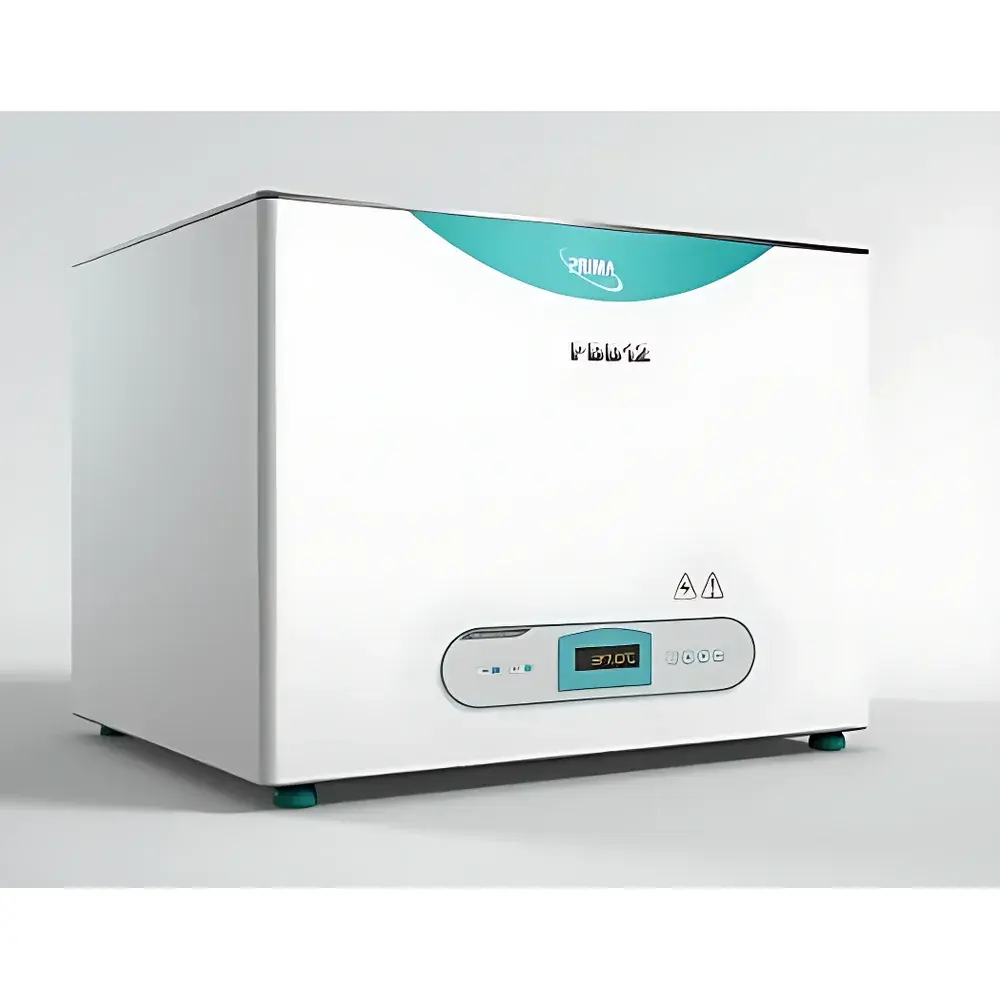
PRIMA PBB8 Precision Boiling Water Bath
| Brand | PRIMA |
|---|---|
| Model | PBB8 |
| Type | Benchtop Boiling Water Bath |
| Capacity | 8 L |
| Temperature Range | +5 °C to 100 °C |
| Temperature Stability | ±0.5 °C at 100 °C (steady-state) |
| Control System | Digital PID |
| Chamber Material | 304 Stainless Steel |
| Power Supply | 220–240 V AC, 50/60 Hz |
| Rated Power | 0.6 kW |
| External Dimensions (L×W×H) | 330 × 175 × 300 mm |
| Internal Chamber (L×W×H) | 275 × 155 × 200 mm |
| Safety Features | Dry-run protection, over-temperature cutoff, auto-restart memory, low-temperature alarm |
| Drain Valve | Integrated |
| Standard Accessory | Polycarbonate safety lid (transparent, heat-resistant) |
Overview
The PRIMA PBB8 Precision Boiling Water Bath is an entry-level, high-reliability benchtop thermal platform engineered for reproducible, stable heating of samples in aqueous media up to 100 °C. Unlike circulating water baths or immersion circulators, the PBB8 operates on a static-heating principle—utilizing resistive heating elements embedded beneath a seamless 304 stainless steel bath chamber to deliver uniform thermal energy across the entire liquid volume. Its design targets applications requiring sustained boiling-point conditions without vigorous turbulence: enzymatic reactions with temperature-sensitive catalysts, DNA denaturation protocols, sterilization validation of glassware and pipette tips, and routine dissolution testing where vapor-phase consistency matters more than fluid dynamics. The unit achieves thermal equilibrium rapidly via digital PID feedback control, minimizing overshoot and stabilizing within ±0.5 °C at 100 °C under standard load (8 L deionized water, ambient lab conditions). It complies with IEC 61010-1:2010 for laboratory electrical equipment safety and meets essential requirements for GLP-compliant environments where traceable, repeatable thermal exposure is documented.
Key Features
- Digital PID temperature controller with 0.1 °C resolution and programmable setpoint memory—retains last-used parameters after power interruption
- Stainless steel construction (AISI 304) for both outer housing and inner bath chamber—resistant to corrosion from repeated steam exposure and cleaning agents
- Integrated drain valve positioned at the lowest point of the chamber—enables complete, tool-free emptying without tilting
- Polycarbonate transparent safety lid included as standard—reduces evaporation rate by >60%, minimizes operator risk of scalding, and maintains consistent headspace humidity
- Multi-layer safety architecture: independent over-temperature cutoff (mechanical bimetal switch), dry-run sensor (prevents heater activation when water level falls below minimum), and audible/visual low-temperature alarm
- Low-profile ergonomic footprint (330 mm depth)—designed for compatibility with fume hoods, laminar flow cabinets, and shared benchtop workspaces
Sample Compatibility & Compliance
The PBB8 accommodates standard laboratory vessels—including borosilicate glass beakers (up to 1000 mL), stainless steel sample racks, and polypropylene trays—without compromising thermal uniformity. Its non-circulating design eliminates shear stress on fragile biological specimens (e.g., tissue sections during paraffin embedding prep) and avoids aerosol generation common in turbulent boiling setups. The unit conforms to ISO/IEC 17025:2017 clause 6.4.3 regarding environmental condition control for testing laboratories. While not certified for FDA 21 CFR Part 11 compliance out-of-the-box, its logging-capable firmware (via optional RS232 interface) supports audit-trail-ready data export for internal SOP alignment. All electrical components are CE-marked and tested per EN 61326-1 for electromagnetic compatibility in laboratory settings.
Software & Data Management
The PBB8 operates as a standalone instrument with no embedded software stack; temperature monitoring and control occur entirely through hardware-based PID logic. However, it features an RS232 serial port (optional accessory cable required) enabling connection to external data loggers or LIMS-compatible acquisition systems. When interfaced, users may record timestamped temperature values at user-defined intervals (1–60 sec), trigger alarms upon deviation thresholds, and export CSV-formatted logs for retrospective analysis. No proprietary drivers or cloud services are involved—ensuring full IT infrastructure independence and long-term maintainability in regulated facilities.
Applications
- Thermal validation of autoclave cycles using biological indicators immersed in controlled 100 °C water baths
- Standardized dissolution testing per USP for immediate-release solid oral dosage forms
- Pre-heating reagents prior to PCR setup to minimize condensation in reaction tubes
- Controlled boiling of culture media for agar preparation and sterilization verification
- Calibration of liquid-in-glass thermometers and RTD probes against NIST-traceable references
- Routine warming of histological staining solutions (e.g., hematoxylin, eosin) to optimize binding kinetics
FAQ
Does the PBB8 support external temperature probe input for chamber monitoring?
No—the unit relies solely on its factory-calibrated internal Pt100 sensor located at the bath base. External probe integration is not supported.
Can the PBB8 be used with oil or other non-aqueous media?
Not recommended. The chamber geometry, safety cutoff thresholds, and thermal mass calibration are optimized for water. Oil use may compromise dry-run detection accuracy and increase fire risk.
Is the polycarbonate lid autoclavable?
No—it is rated for continuous exposure up to 120 °C but not suitable for steam sterilization cycles. Wipe cleaning with 70% ethanol is advised.
What is the minimum fill volume required for safe operation?
At least 3 L must cover the heating element zone; operation below this level triggers automatic shutdown.
Does the PBB8 meet UL or CSA certification standards?
It carries CE marking per EU directives but does not hold UL 61010-1 or CSA C22.2 No. 61010-1 certification. For North American deployment, third-party field evaluation may be required.



