
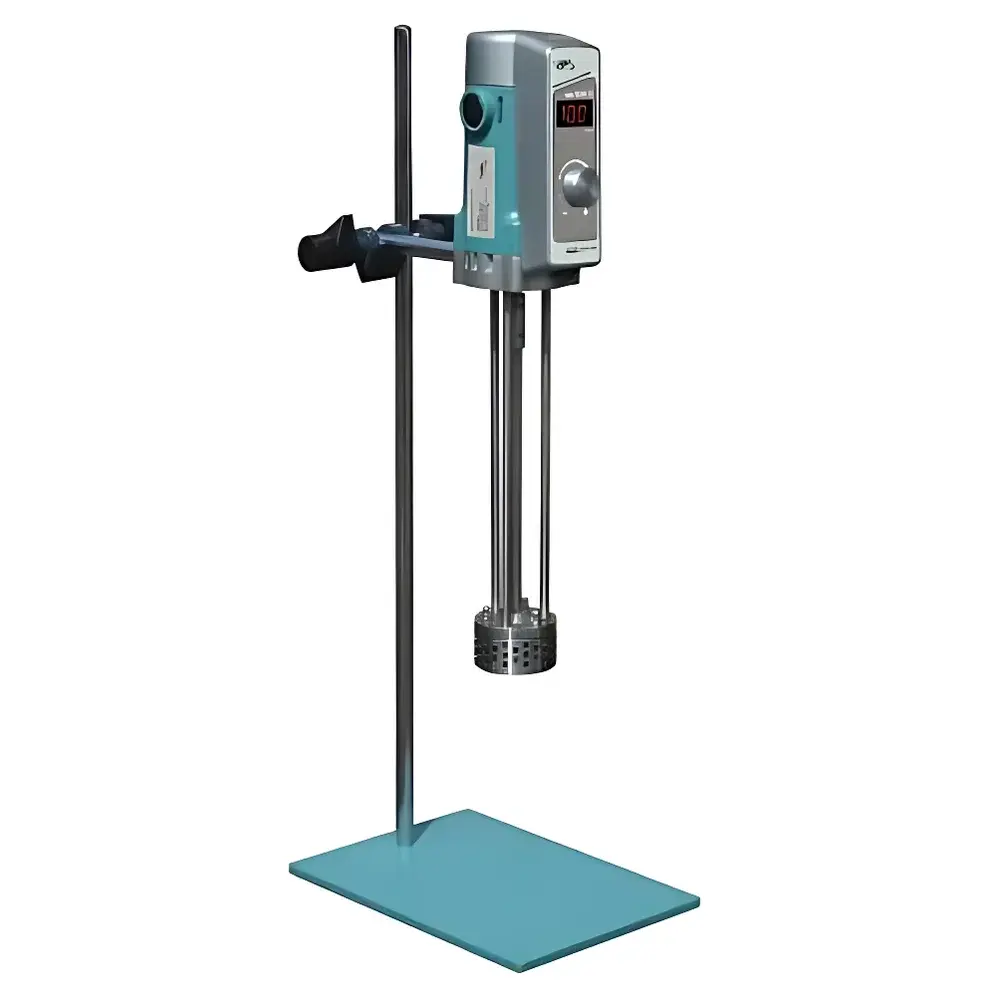
PRIMA PD300-TE High-Performance Digital Homogenizer
| Brand | PRIMA (UK) |
|---|---|
| Model | PD300-TE |
| Max. Speed | 300–15,000 rpm |
| Speed Display | LED Digital |
| Power | 300 W |
| Max. Viscosity | 5,000 cP |
| Volume Range (H₂O) | 1–10,000 mL |
| Housing | Reinforced Thermoplastic with Double Insulation |
| Rotor Material | Electropolished Stainless Steel with Epoxy Coating |
| Shaft Sleeve | Brass Alloy |
| Protection Class | IP20 |
| Dimensions (W×D×H) | 350 × 250 × 750 mm |
| Weight | 10 kg |
| Input Voltage | 220–240 V, 50–60 Hz |
| Overload Protection | Electronic Circuitry |
Overview
The PRIMA PD300-TE is a high-precision, digitally controlled laboratory homogenizer engineered for reproducible mechanical dispersion, emulsification, cell lysis, tissue homogenization, and colloidal stabilization across life science, pharmaceutical, food, and polymer research applications. It operates on the principle of high-shear rotor-stator interaction: rotational energy from the motor is transmitted to interchangeable stainless-steel rotors, generating intense hydrodynamic shear forces within the sample chamber. This mechanism enables efficient particle size reduction, uniform phase distribution, and disruption of biological matrices—including mammalian cells, bacterial cultures, plant tissues, and soft animal organs—without significant thermal degradation when operated under appropriate duty cycles. Designed for sustained operation in regulated environments, the PD300-TE integrates real-time speed feedback control to maintain setpoint accuracy despite load fluctuations or minor voltage variations—a critical requirement for GLP-compliant method transfer and batch-to-batch consistency.
Key Features
- Digital LED speed display with continuous 300–15,000 rpm adjustment, enabling precise protocol replication and method validation.
- Robust thermoplastic housing with double electrical insulation (IEC 61000-4-5 compliant), ensuring operator safety and electromagnetic compatibility in shared lab infrastructure.
- Three interchangeable rotor configurations (e.g., micro, standard, and heavy-duty) optimized for distinct viscosity regimes and volume scales—from 1 mL microsamples to 10 L bulk preparations.
- Electropolished stainless-steel rotors featuring epoxy-based surface coating to resist corrosion, minimize metal leaching, and support autoclaving at 121°C for 20 min (validated per ISO 17664).
- Brass-alloy shaft sleeves designed for rapid disassembly, chemical resistance to common sterilants (e.g., 70% ethanol, 0.5% sodium hypochlorite), and compatibility with steam sterilization cycles.
- Electronic overload protection circuitry that automatically interrupts power during stall conditions or excessive current draw, preserving motor longevity and preventing thermal runaway.
- Low-noise brushless motor architecture (<65 dB(A) at 1 m), engineered for uninterrupted operation over extended durations without speed drift or torque decay.
Sample Compatibility & Compliance
The PD300-TE accommodates aqueous, viscous, and moderately abrasive suspensions up to 5,000 cP—suitable for protein solutions, cell lysates, nanoparticle dispersions, dairy emulsions, and polymer prepolymers. All wetted parts comply with USP Class VI biocompatibility standards. The device meets CE marking requirements under Directive 2014/30/EU (EMC) and 2014/35/EU (LVD). While not intrinsically rated for hazardous locations, its IP20 enclosure is appropriate for cleanroom-adjacent laboratories (ISO 14644-1 Class 8) and QC/QA environments operating under GMP Annex 11-aligned workflows. Documentation packages include Factory Acceptance Test (FAT) reports and traceable calibration certificates for speed output (NIST-traceable tachometer verification).
Software & Data Management
The PD300-TE operates as a standalone instrument with no embedded firmware or proprietary software dependency. Speed settings are manually configured via front-panel controls; all operational parameters are retained locally without cloud connectivity or data logging. For auditability in regulated settings, users may integrate external digital tachometers or data acquisition systems (e.g., National Instruments DAQmx) to record time-stamped speed profiles. The unit supports 21 CFR Part 11 readiness through third-party electronic lab notebook (ELN) integration—provided user-defined SOPs mandate manual entry of run parameters, operator ID, and timestamped start/stop confirmation. No password protection, user role management, or electronic signature functionality is built-in.
Applications
- Biopharmaceutical development: Homogenization of monoclonal antibody formulations, lipid nanoparticle (LNP) suspension preparation, and viral vector lysis.
- Genomics & proteomics: Mechanical disruption of cultured cells and frozen tissue for nucleic acid or protein extraction (compatible with Qiagen, Thermo Fisher, and Zymo kits).
- Food science: Emulsification of dairy analogs, stabilization of plant-based beverages, and particle size reduction in functional ingredient suspensions.
- Materials science: Dispersion of carbon nanotubes, graphene oxide, and ceramic nanoparticles into polymer matrices prior to rheological or thermal characterization.
- Clinical pathology: Standardized homogenization of biopsy specimens for histopathological analysis or molecular diagnostics workflows.
FAQ
Is the PD300-TE suitable for sterile processing?
Yes—rotors and shaft sleeves are autoclavable at 121°C for 20 minutes. Always verify material integrity after ≥50 sterilization cycles.
Can it handle high-viscosity polymer melts?
No—the 5,000 cP limit applies to Newtonian liquids at 25°C; non-Newtonian or thermally sensitive melts require specialized extrusion or twin-screw equipment.
What maintenance intervals are recommended?
Inspect rotor balance and sleeve wear every 200 operational hours; replace brass sleeves after 1,000 hr or visible pitting.
Does it support external footswitch or PLC triggering?
No native I/O ports exist; however, optional relay modules (sold separately) enable dry-contact start/stop integration with process controllers.
Is technical documentation available in English with regulatory references?
Yes—full Operation & Maintenance Manual (EN/ISO 12100 compliant), Declaration of Conformity, and FAT summary are provided upon order fulfillment.



