
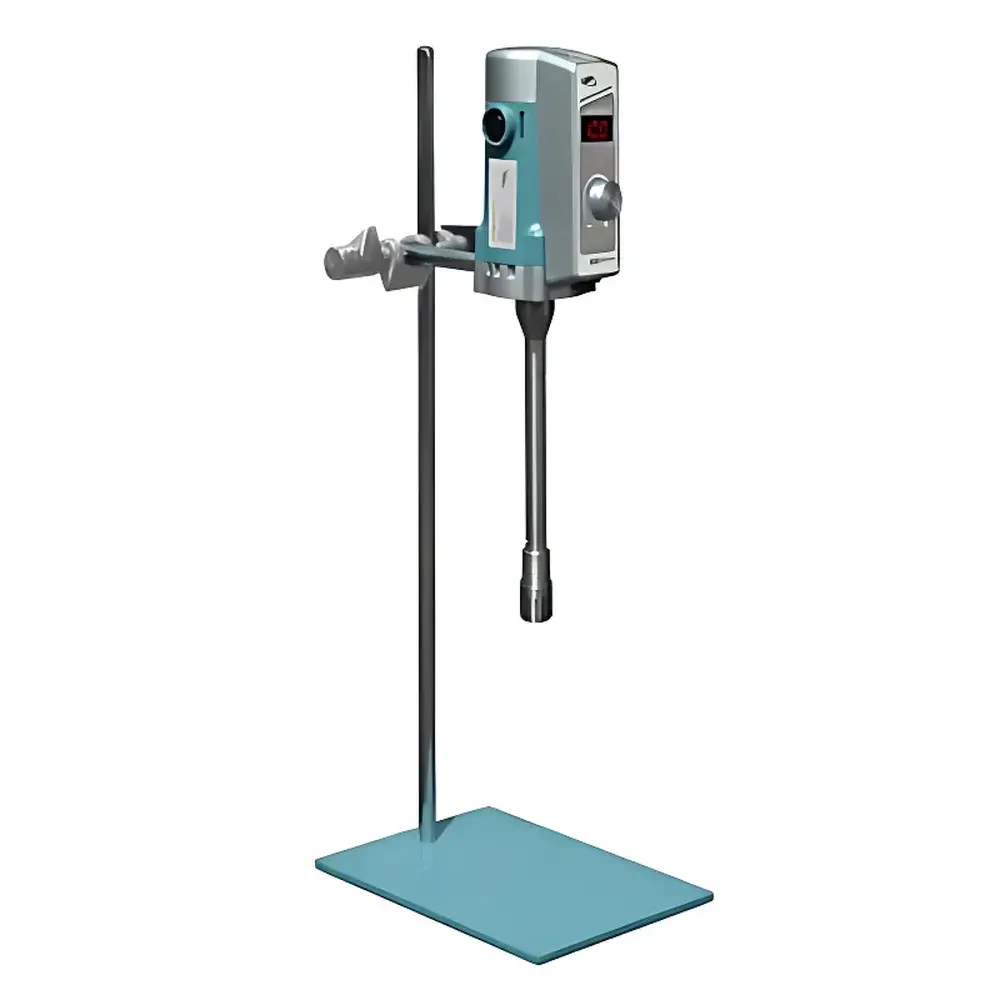
PRIMA PD500-TP High-Speed Homogenizer & Disperser
| Brand | PRIMA |
|---|---|
| Origin | UK (Imported) |
| Model | PD500-TP |
| Max. Viscosity | 8,000 cP |
| Speed Range | 300–28,000 rpm |
| Processing Volume (H₂O) | 1–13,000 mL |
| Power | 500 W |
| Display | LED Digital Speed Readout |
| Protection Class | IP20 |
| Weight | 10 kg |
| Dimensions (W×D×H) | 350×250×750 mm |
| Voltage | 220–240 V, 50–60 Hz |
| Safety | Double-Insulated Housing, Electronic Overload Protection |
| Rotor Shaft Connection | Quick-Release Interface |
| Sterilization Compatibility | Autoclavable (121°C, 20 min) |
| Optional Rotors | TP12, TP18, TP24, TP30, TP36 |
Overview
The PRIMA PD500-TP High-Speed Homogenizer & Disperser is an engineered solution for reproducible mechanical homogenization, cell disruption, emulsification, and fine dispersion in life science and industrial R&D laboratories. Based on high-torque, brushless DC motor technology, it operates on the principle of rotor-stator shear—where rapid rotation of a precision-machined stainless-steel rotor within a fixed stator generates intense hydrodynamic forces, including cavitation, turbulent flow, and high local shear gradients. This enables efficient lysis of mammalian, bacterial, and yeast cells; homogenization of tissue samples; stabilization of oil-in-water and water-in-oil emulsions; and dispersion of nanoparticles, pigments, and polymer suspensions. Designed for continuous-duty operation under variable load conditions, the PD500-TP maintains speed stability via real-time electronic feedback control—compensating for viscosity-induced torque fluctuations and mains voltage drift without manual intervention.
Key Features
- LED digital speed display with ±50 rpm accuracy across full 300–28,000 rpm range, enabling precise method replication and SOP compliance
- 500 W brushless motor with thermal overload protection and automatic shutdown at sustained current >110% rated limit
- Dual-insulated polycarbonate housing rated IP20, certified to IEC 61010-1 for laboratory electrical safety
- Quick-release rotor coupling system compatible with five interchangeable stainless-steel dispersing heads (TP12–TP36), all featuring electropolished surfaces and epoxy-painted corrosion-resistant coating
- Acoustically damped base assembly reducing operational noise to ≤72 dB(A) at 1 m distance during continuous 28,000 rpm operation
- Integrated stand with non-slip rubber feet and vertical height adjustment (±15 mm) for optimal probe immersion depth control
Sample Compatibility & Compliance
The PD500-TP accommodates aqueous, organic, and semi-viscous samples up to 8,000 cP—covering buffers, lysates, milk-based emulsions, polymer solutions, and ceramic slurries. All contact parts (rotor, stator, shaft collar) are manufactured from AISI 316L stainless steel, compliant with USP Class VI biocompatibility requirements and validated for repeated autoclaving (121°C, 20 min, saturated steam). The instrument meets ISO/IEC 17025-relevant calibration traceability standards when operated with NIST-traceable tachometers. Its design supports GLP and GMP workflows through consistent speed reporting, mechanical repeatability (<±0.5% CV over 10 consecutive runs), and documented maintenance intervals per manufacturer’s service manual.
Software & Data Management
While the PD500-TP operates as a standalone analog-controlled unit, its digital speed interface allows integration into lab-wide data acquisition systems via optional RS-232 or analog 0–10 V output modules (sold separately). When paired with third-party SCADA or LIMS platforms, speed setpoints, run duration, and motor status can be logged with timestamped audit trails—supporting 21 CFR Part 11 compliance when combined with electronic signature-enabled software environments. Firmware updates (v2.1+) include enhanced motor response algorithms that minimize transient overshoot during ramp-up/down sequences, improving reproducibility in time-sensitive protocols such as RNA extraction or nanoparticle synthesis.
Applications
- Cell lysis and subcellular fractionation in molecular biology workflows (e.g., preparation of nuclear extracts, mitochondrial isolates)
- Tissue homogenization for ELISA, PCR, and Western blot sample prep—validated for liver, brain, muscle, and tumor specimens
- High-shear emulsification of pharmaceutical nanoemulsions (e.g., lipid-based drug delivery systems per USP & Ph. Eur. monographs)
- Dispersion of carbon nanotubes, TiO₂, SiO₂, and graphene oxide in aqueous and solvent-based media for materials characterization
- Preparation of stable reference suspensions for particle size analyzer calibration (ISO 13320, ISO 22412)
- Batch-scale homogenization in pilot QC labs for dairy, cosmetic, and agrochemical formulations
FAQ
Is the PD500-TP suitable for sterile processing in a biosafety cabinet?
Yes—its compact footprint (350 mm width), low heat emission (<12 W standby power), and absence of external ventilation ducts allow safe operation inside Class II A2 cabinets. All rotors are autoclavable; verify sterilization cycle compatibility with your facility’s validation protocol.
Can the instrument maintain constant shear rate across varying sample volumes?
Shear rate is dependent on both rotational speed and rotor geometry. While the PD500-TP delivers consistent rpm, users must select the appropriate rotor (TP12–TP36) based on target volume and desired tip speed (10–28 m/s); refer to the included shear rate estimation chart for guidance.
Does PRIMA provide IQ/OQ documentation for regulated environments?
Factory-issued Installation Qualification (IQ) templates and Operational Qualification (OQ) test protocols—including speed accuracy verification, temperature rise assessment, and noise level measurement—are available upon request and support FDA audit readiness.
What maintenance is required to ensure long-term performance?
Annual inspection of bearing preload, rotor concentricity (runout <0.05 mm), and stator gap tolerance (0.2–0.3 mm) is recommended. Lubrication-free motor design eliminates routine grease replacement; only cleaning and visual integrity checks are needed between uses.
How does the PD500-TP compare to ultrasonic homogenizers for cell disruption?
Unlike sonication—which introduces localized heating and free radical generation—the PD500-TP achieves mechanical lysis with minimal thermal load and no nucleic acid shearing, making it preferable for intact RNA isolation and protein-native applications.



