
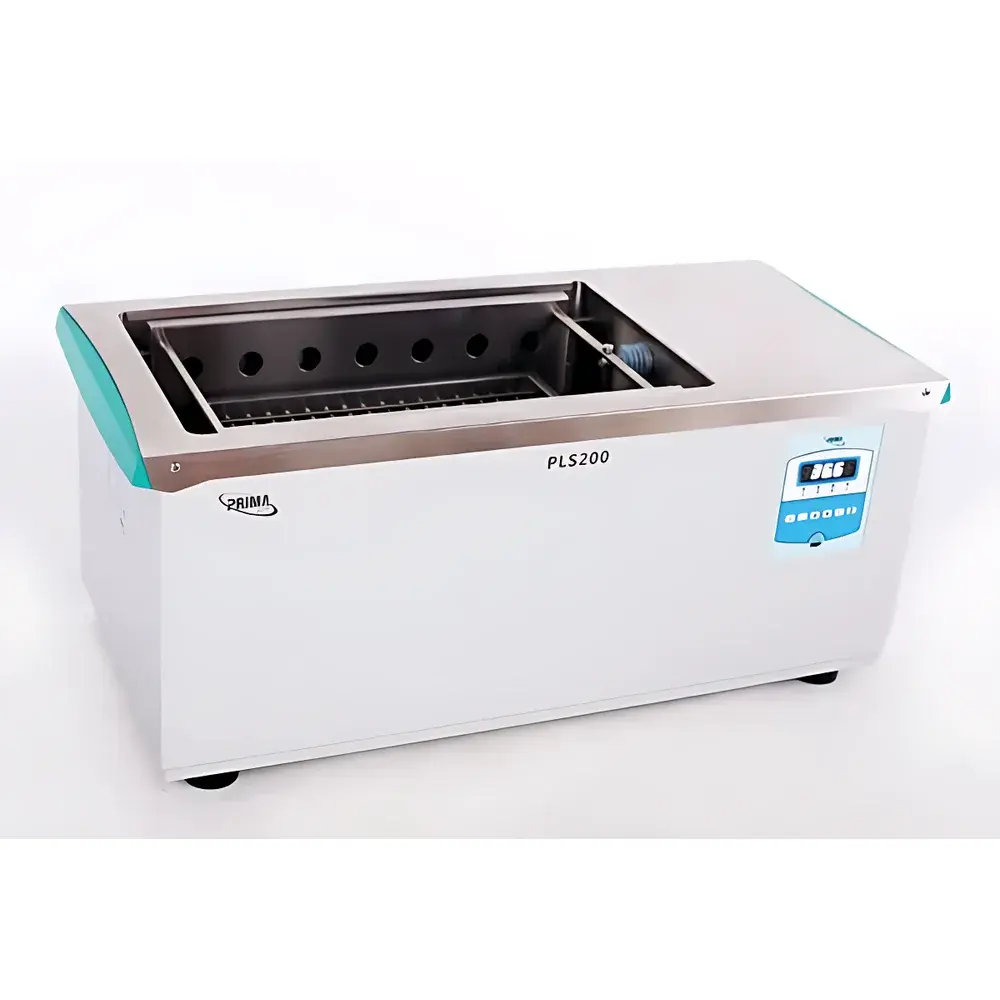
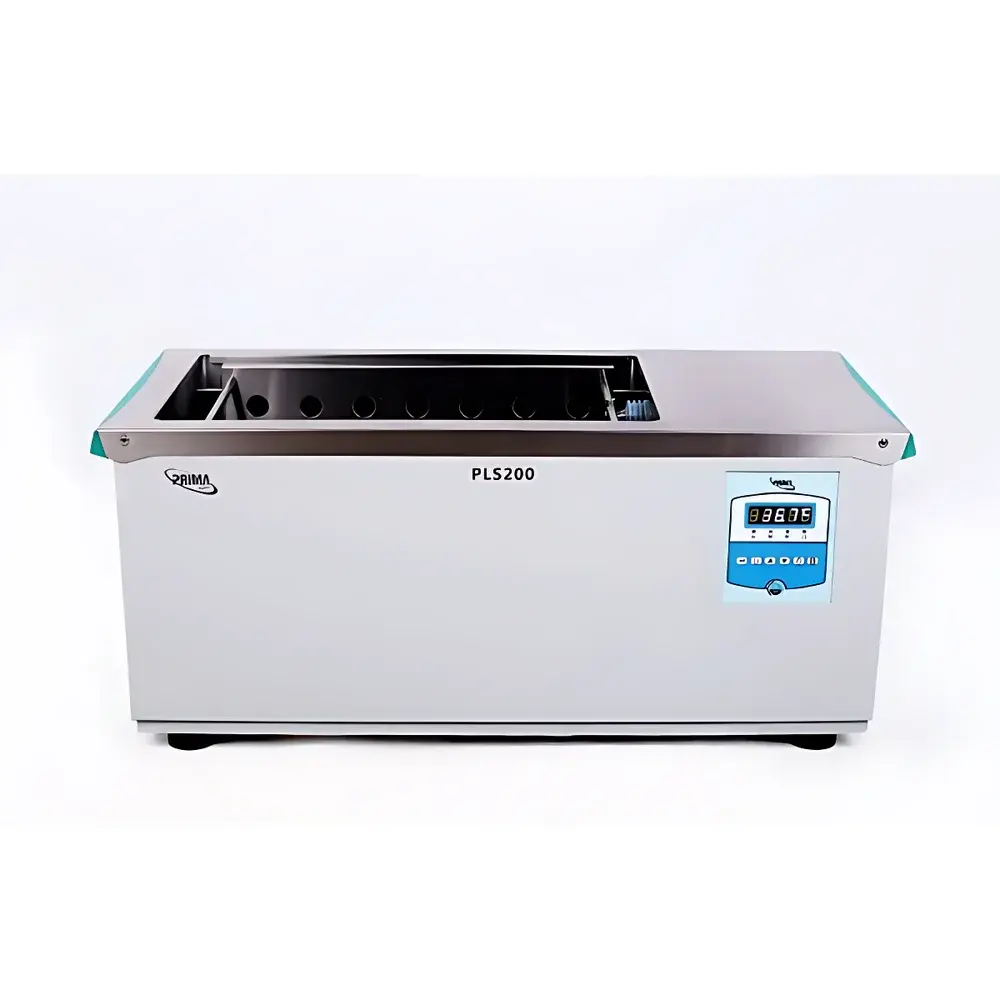
Prima PLS200 Linear Water Bath Shaker
| Brand | PRIMA (UK) |
|---|---|
| Model | PLS200 |
| Instrument Type | Constant-Temperature Linear Shaking Water Bath |
| Circulation | Internal Recirculation |
| Temperature Control | Heating-Only |
| Bath Volume | 5–28 L |
| Temperature Range | +8 °C to 99 °C |
| Temperature Stability | ±0.1 °C |
| Linear Shake Speed | 0–200 rpm |
| Shake Amplitude | 22 mm |
| Display | 4-digit LED, 0.1 °C resolution |
| Safety Features | Overtemperature Protection, Dry-run Prevention |
| Power Supply | 220 V~ ±10%, 50 Hz, 10 A |
| Max. Power Consumption | 1.5 kW |
| Dimensions (L×W×H) | 700 × 380 × 420 mm |
| Bath Working Capacity (L×W×H) | 480 × 295 × 200 mm |
| Minimum/Maximum Immersion Depth | 20–180 mm |
| Drain Port | Yes |
| Communication Interface | RS232 |
Overview
The Prima PLS200 Linear Water Bath Shaker is an engineered platform for precise temperature-controlled agitation of aqueous samples in life science, pharmaceutical, and quality control laboratories. It operates on the principle of linear reciprocating motion—driven by a brushless DC motor coupled to a robust mechanical linkage system—ensuring low-vibration, high-reproducibility oscillation across its full speed range (0–200 rpm). Unlike orbital shakers, the linear motion minimizes splashing and improves mixing homogeneity for low-volume or surface-sensitive applications such as enzyme assays, cell suspension maintenance, hybridization protocols, and solubility testing. The bath’s heating-only architecture utilizes embedded stainless-steel-sheathed heating elements and a high-response Pt100 sensor, integrated with digital PID feedback control to achieve ±0.1 °C stability at setpoints including physiologically relevant temperatures (e.g., 37 °C) and elevated conditions up to 99 °C. Its 5–28 L usable volume accommodates standard labware configurations while maintaining thermal uniformity (±0.1 °C @ 37 °C) across the entire fluid column.
Key Features
- Linear reciprocating drive system delivering smooth, low-noise oscillation from 0 to 200 rpm with fixed 22 mm amplitude—optimized for consistent sample resuspension without vortexing or foaming.
- Digital PID temperature controller with 4-digit LED display (0.1 °C resolution), enabling rapid thermal equilibration and long-term drift suppression.
- Integrated safety architecture: dual independent overtemperature cutoffs, dry-run detection via level sensor, and automatic shutdown upon abnormal thermal deviation.
- Modular tray interface supporting interchangeable accessories—including universal flat trays (UT28), tube racks (TT28), and custom H1-series microtube holders (compatible with 10–30 mm diameter tubes and 1.5 mL microcentrifuge tubes).
- RS232 serial port for remote parameter setting, real-time data logging, and integration into automated lab workflows compliant with GLP/GMP documentation requirements.
- Ergonomic design with front-access drain valve, corrosion-resistant stainless-steel bath chamber, and optional transparent polycarbonate lid (AQL28) or insulated stainless-steel cover (LT28) to reduce evaporation above 60 °C or ambient conditions.
Sample Compatibility & Compliance
The PLS200 accommodates a wide range of sample containers—from standard Erlenmeyer flasks and beakers to multi-well plates and vertically oriented tube arrays—via configurable mounting platforms. Its immersion depth adjustability (20–180 mm) ensures optimal thermal coupling for vessels of varying height and fill volume. The unit complies with IEC 61010-1:2010 for electrical safety in laboratory equipment and meets EN 61326-1:2013 electromagnetic compatibility standards. While not intrinsically refrigerated, its thermal performance aligns with ASTM D1500 and ISO 17025 method validation criteria for temperature-controlled incubation steps in analytical procedures. When operated with audit-trail-enabled software (via RS232), it supports FDA 21 CFR Part 11-compliant electronic records for regulated environments.
Software & Data Management
Though the PLS200 operates autonomously via front-panel controls, its RS232 interface enables bidirectional communication with host PCs running validated third-party data acquisition software (e.g., LabVIEW, MATLAB, or custom Python-based SCADA tools). Users can schedule multi-step temperature profiles (up to 6 segments, 99 cycles), log real-time temperature and shake status, and export timestamped CSV files for traceability. Firmware supports firmware-upgradable protocols and retains configuration settings after power loss. For GxP environments, optional software packages provide electronic signature capability, user access levels, and change-control logs—facilitating alignment with ALCOA+ data integrity principles.
Applications
- Molecular biology: DNA/RNA hybridization, restriction digests, and probe labeling under controlled thermal agitation.
- Microbiology: Bacterial culture maintenance, antibiotic susceptibility testing, and biofilm dispersion studies.
- Pharmaceutical QC: Dissolution testing support, excipient solubility profiling, and stability-indicating assay preparation.
- Clinical diagnostics: Serum/plasma sample homogenization prior to ELISA or immunoassay processing.
- Materials science: Nanoparticle dispersion in aqueous media and polymer dissolution kinetics monitoring.
FAQ
What is the minimum and maximum recommended water level for stable operation?
The bath requires a minimum immersion depth of 20 mm for sensor accuracy and heater protection; maximum fill height is 180 mm—corresponding to ~28 L capacity. Always maintain liquid coverage above the heater element and sensor tip.
Can the PLS200 be used with non-aqueous media such as silicone oil?
Yes—provided the fluid has compatible viscosity and thermal conductivity. However, oil use necessitates extended cleaning intervals and verification of seal compatibility; consult the chemical resistance chart in the operator manual before substitution.
Is the RS232 interface compatible with modern Windows/Linux systems?
Yes—using standard USB-to-serial adapters and industry-standard terminal emulation (e.g., PuTTY, Tera Term) or custom Python/Node-RED drivers. No proprietary drivers are required.
How often should calibration verification be performed?
Per ISO/IEC 17025, periodic verification using NIST-traceable thermistors or calibrated RTDs is recommended every 6 months—or after any physical impact, firmware update, or observed thermal deviation exceeding ±0.05 °C.
Does the unit support external temperature probes for sample-specific monitoring?
No—the PLS200 regulates bath temperature only. For sample-core temperature tracking, users must integrate independent fiber-optic or thermocouple probes connected to external dataloggers.



