
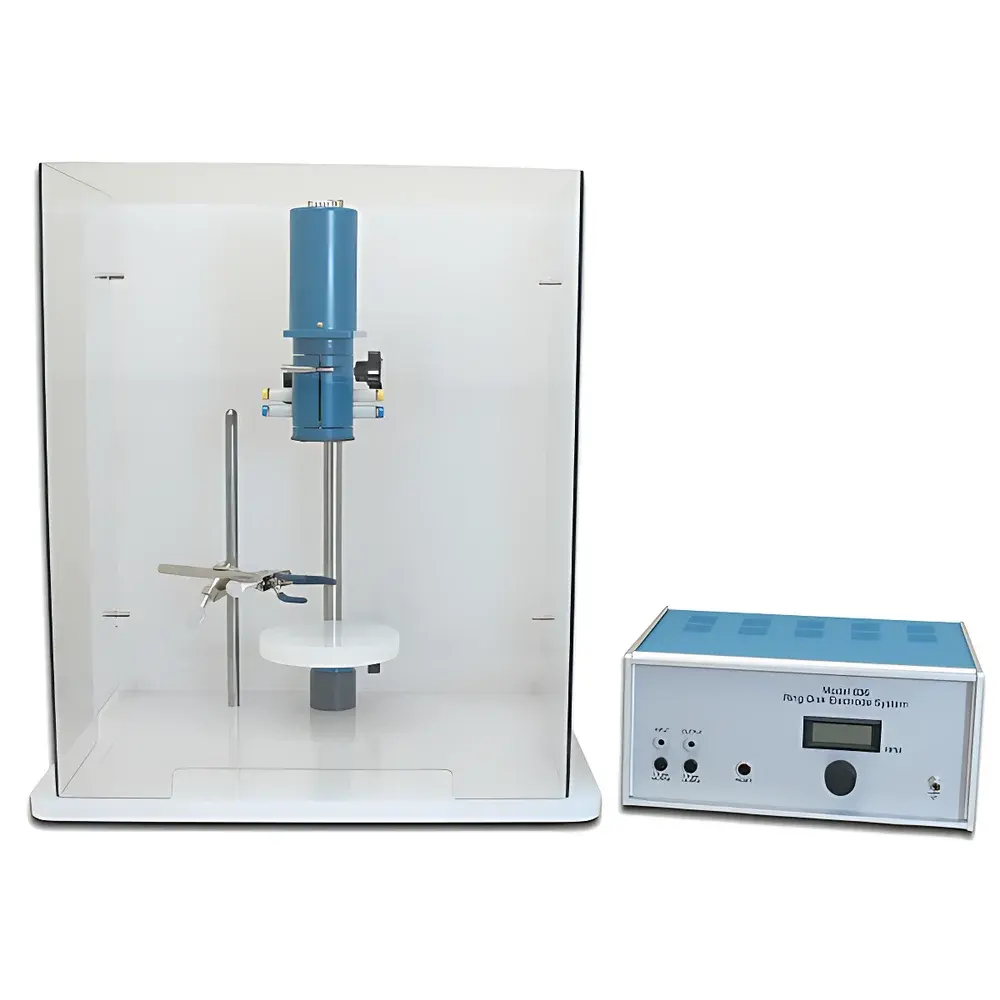
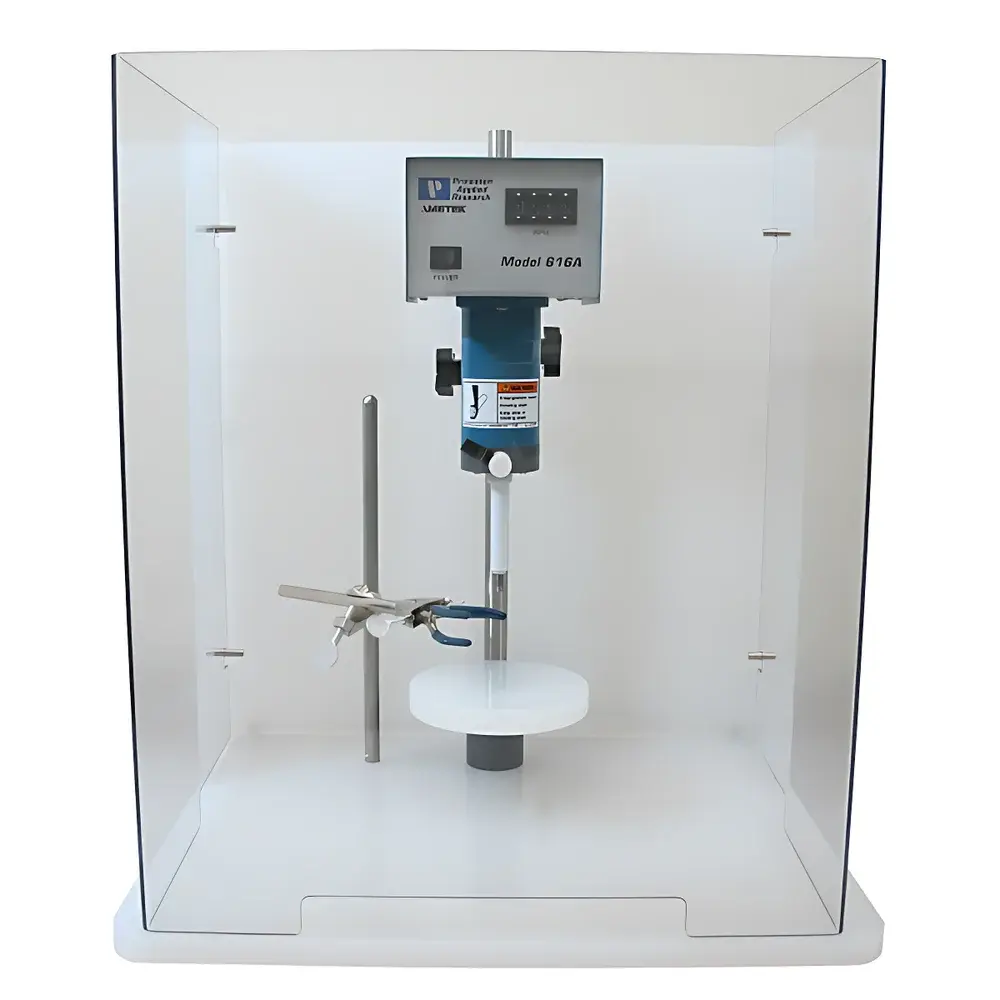
Princeton Applied Research 616A Rotating Disk Electrode (RDE) and 636A Rotating Ring-Disk Electrode (RRDE) System
| Brand | Princeton Applied Research |
|---|---|
| Origin | USA |
| Model | 616A, 636A |
| Rotation Speed Range | 50–10,000 rpm |
| Speed Accuracy | < ±1% |
| Speed Control | Analog voltage input (0–10 V DC, linear proportionality) |
| Motor Type | Solid-state servo-controlled permanent magnet DC motor |
| Power Supply | Bipolar, high-voltage DC |
| Compatibility | Integrates with standard potentiostats/galvanostats including PAR electrochemical workstations |
| Compliance | Designed for ASTM G102, ASTM G59, ISO 17475, and electrochemical kinetic studies per IUPAC recommendations |
| Application Domain | Electrocatalysis (HER, OER, HOR, ORR), mass-transport-controlled reaction analysis, reaction intermediate detection |
Overview
The Princeton Applied Research 616A Rotating Disk Electrode (RDE) and 636A Rotating Ring-Disk Electrode (RRDE) systems are precision-engineered electrochemical hydrodynamic tools designed for quantitative kinetic and mechanistic analysis of electrode processes. Both instruments operate on the principle of controlled convective mass transport—leveraging well-defined laminar flow fields generated by rotation to establish reproducible diffusion-layer thicknesses at the electrode surface. The 616A implements a single-disk configuration governed by the Levich equation, enabling determination of electron transfer kinetics, diffusion coefficients, and heterogeneous rate constants under steady-state conditions. The 636A extends this capability with a concentric ring-disk geometry, permitting real-time detection and quantification of short-lived intermediates generated at the disk and subsequently oxidized or reduced at the surrounding ring—essential for elucidating multi-step redox mechanisms in fuel cell catalysts, water-splitting electrodes, and corrosion inhibitors.
Key Features
- Solid-state servo control architecture ensures precise rotational synchronization with analog input signals—no mechanical backlash or drift over extended operation.
- Low-inertia, permanent-magnet DC motor enables rapid acceleration/deceleration and stable operation across the full 50–10,000 rpm range, with speed accuracy maintained at < ±1% across the entire span.
- Linear 0–10 V DC analog interface provides direct proportional mapping between control voltage and rotational speed—enabling seamless integration with potentiostat-triggered experiments and automated sweep protocols.
- Modular shaft design: The 636A supports interchangeable disk-only and ring-disk electrode assemblies, allowing rapid reconfiguration without recalibration or alignment recalibration.
- Electromechanical construction complies with NEMA 1 enclosure standards; all rotating components are dynamically balanced to minimize vibration-induced signal noise during sensitive current measurements.
- No internal electronics or firmware—fully passive operation eliminates electromagnetic interference (EMI) risks and ensures compatibility with Faraday cage environments and low-noise bipotentiostatic configurations.
Sample Compatibility & Compliance
The 616A and 636A systems accept standard 6-mm OD glassy carbon, platinum, gold, or modified carbon disk electrodes (and corresponding ring-disk variants) with industry-standard Teflon® sleeves and compression fittings. Electrode geometry conforms to ASTM G102-89 definitions for RDE/RRDE hydrodynamics and meets dimensional tolerances specified in ISO 17475:2004 for rotating electrode characterization. The systems support GLP-compliant workflows when paired with PAR’s VersaSTAT series potentiostats and associated software featuring audit-trail logging, user access controls, and 21 CFR Part 11–ready electronic signatures. All mechanical specifications—including disk radius, ring gap, and insulator thickness—are traceable to NIST-calibrated gauges and documented in the manufacturer’s Certificate of Conformance.
Software & Data Management
While the 616A/636A hardware operates independently of software, full automation is achieved via analog coupling to Princeton Applied Research’s VersaStudio™ or AfterMath™ platforms. These applications provide synchronized control of rotation speed, potential waveform, and current acquisition—enabling multi-step sequences such as rotating disk voltammetry (RDV), stepped potential RRDE, or chronoamperometric ring collection efficiency mapping. Data files are stored in standardized .vmp3 or .mpt formats, supporting post-acquisition analysis using Levich, Koutecký-Levich, and Shoup-Szabo models. Export options include CSV, MATLAB (.mat), and Origin-compatible XY datasets—facilitating third-party kinetic fitting and uncertainty propagation modeling.
Applications
- Oxygen reduction reaction (ORR) pathway analysis in PEMFC cathode catalysts, including peroxide yield quantification via ring collection efficiency.
- Hydrogen evolution reaction (HER) and oxygen evolution reaction (OER) kinetics on transition metal oxides, chalcogenides, and single-atom catalysts.
- Electrochemical CO2 reduction product distribution studies, where ring detection identifies adsorbed *CO intermediates or C2 dimerization precursors.
- Corrosion mechanism studies involving dissolution/repassivation cycles under controlled mass transport conditions.
- Validation of rotating electrode simulations using computational fluid dynamics (CFD) and finite-element modeling of boundary layer development.
FAQ
What is the difference between the 616A and 636A configurations?
The 616A is a dedicated rotating disk electrode system optimized for Levich and Koutecký-Levich analysis. The 636A adds coaxial ring functionality, enabling dual-electrode detection and collection efficiency calibration.
Can the 636A be used as a standalone RDE?
Yes—the 636A accepts standard disk-only electrodes and operates identically to the 616A when the ring circuit is disconnected or unused.
Is external power required beyond the potentiostat’s analog output?
No—the unit draws power exclusively from its integrated bipolar DC supply; only a 0–10 V control signal and ground reference are needed from the potentiostat.
Are replacement shafts and electrode holders available separately?
Yes—Princeton Applied Research supplies certified replacement components including PTFE-insulated disk shafts (P/N 616-SHAFT), ring-disk assemblies (P/N 636-RD), and torque-wrench calibration tools.
Does the system meet requirements for ISO/IEC 17025 accredited laboratories?
When operated with documented calibration procedures—including annual speed verification using a NIST-traceable optical tachometer—the system satisfies metrological traceability requirements for accredited electrochemical testing.





