
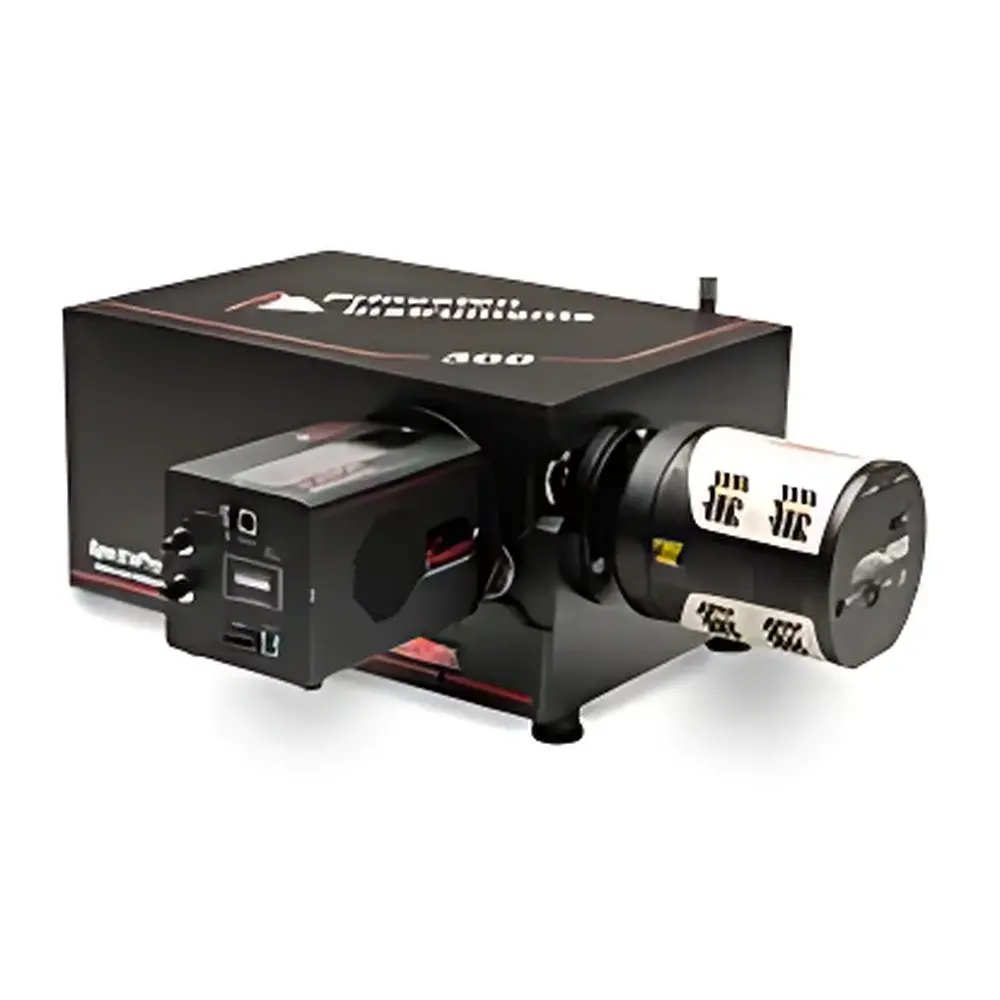
Princeton Instruments HRS-300 Czerny-Turner Spectrograph
| Brand | Princeton Instruments |
|---|---|
| Origin | USA |
| Model | HRS-300 |
| Focal Length | 300 mm |
| Spectral Resolution | ≤0.07 nm (typ., with 1200 g/mm grating @ 435.8 nm) |
| Linear Dispersion | 2.38 nm/mm |
| f-number | f/3.9 |
| Slit-Based PMT Resolution | 0.09 nm (with 10 µm slit) |
| CCD Pixel Resolution | Measured at focal plane center using PIXIS:400F (20 µm pixels) @ 546 nm |
Overview
The Princeton Instruments HRS-300 is a high-performance Czerny-Turner spectrograph engineered for precision spectral analysis across research-grade optical laboratories. Designed with a 300 mm focal length and optimized optical architecture, it delivers exceptional spectral resolution (≤0.07 nm typical), low aberration imaging, and broad wavelength coverage from deep ultraviolet (190 nm) to near-infrared (1100 nm). Its core measurement principle relies on angular dispersion of polychromatic light via interchangeable diffraction gratings, followed by spatial separation and detection at the focal plane—enabling quantitative intensity versus wavelength characterization with high photometric fidelity. The HRS-300 serves as a foundational optical engine in modular photonics systems, including fluorescence lifetime spectrometers, Raman microscopes, angle-resolved photoemission setups, dark-field scattering platforms, and micro-spectroscopy stations requiring weak-signal sensitivity and spatial-spectral correlation.
Key Features
- Dual-output port design: Simultaneous access to two independent detector channels—enabling concurrent visible and NIR acquisition or real-time reference/background subtraction without mechanical reconfiguration.
- ResXtreme resolution enhancement: A proprietary optical and software-based correction algorithm that improves both spectral line resolution and peak intensity by up to 60% relative to standard Czerny-Turner performance—standard on all HRS systems and validated per NIST-traceable line source measurements.
- IntelliCal dual-source wavelength and intensity calibration: Uses mercury and neon-argon lamp spectra to calibrate wavelength scale across UV–NIR; includes intensity normalization routines that correct for detector quantum efficiency, grating blaze function, mirror reflectance roll-off, and etaloning artifacts in back-illuminated sensors.
- AccuDrive™ intelligent initialization: Fully automated startup sequence that identifies installed grating type and rotation stage position, executes multi-point optical alignment routines (including slit-to-grating and grating-to-focal-plane registration), and establishes absolute wavelength mapping—reducing setup time and improving inter-system reproducibility (±0.005 nm RMS wavelength repeatability over 8-hour operation).
- Advanced optical coatings: Standard Acton #1900 enhanced aluminum coating provides >85% average reflectivity from 190–900 nm; optional protected silver coating achieves ≥98% reflectivity from 400 nm into NIR—maximizing throughput for low-light applications such as single-molecule spectroscopy or time-resolved PL decay analysis.
- Modular detector compatibility: Supports front-illuminated, back-illuminated, and deep-depletion CCD/CMOS sensors—including rectangular formats for extended spectral range and square formats for spectral imaging (hyperspectral line-scan or snapshot modes)—with native support for Princeton Instruments’ PIXIS, PyLoN, and ProEM platforms.
Sample Compatibility & Compliance
The HRS-300 interfaces seamlessly with fiber-coupled sources (SMA 905 or FC/PC), free-space input slits (adjustable from 10–200 µm), motorized filter wheels, and external excitation lasers (CW or pulsed). It meets essential metrological requirements for regulated environments: IntelliCal-generated calibration reports are structured to support GLP/GMP audit trails; wavelength accuracy and stability data comply with ASTM E275 (Standard Practice for Describing and Measuring Performance of Spectrophotometers) and align with ISO/IEC 17025 clause 5.10.3 on equipment calibration verification. While not FDA 21 CFR Part 11-certified out-of-the-box, its software logging architecture (via LightField® or third-party LabVIEW drivers) supports electronic signature implementation and full audit trail configuration when deployed in pharmaceutical or clinical research settings.
Software & Data Management
Native control is provided through Princeton Instruments’ LightField® software (v8.5+), which offers synchronized hardware triggering, real-time spectral preview, multi-channel acquisition scripting, and export to HDF5, CSV, and FITS formats. All IntelliCal calibration data—including wavelength polynomial coefficients, intensity correction maps, and grating-specific dispersion tables—is embedded directly into metadata headers. For integration into custom workflows, comprehensive SDKs are available for Python (PyVISA + PI-SDK), MATLAB, and C/C++. Raw spectral datasets retain full geometric and radiometric provenance: pixel-to-wavelength mapping, slit width, grating groove density, camera gain/offset, and exposure time are automatically recorded and versioned per acquisition—ensuring full traceability for publication-grade data curation and inter-laboratory comparison.
Applications
- Photoluminescence quantum yield and lifetime mapping in perovskite optoelectronics (e.g., quasi-2D LED heterostructures)
- Room-temperature exciton-polariton thermalization studies in protein-based optical cavities
- Polarized micro-photoluminescence of 2D covalent organic frameworks and layered transition metal dichalcogenides
- In situ plasma-catalysis monitoring of VOC degradation pathways (e.g., toluene oxidation intermediates via time-resolved emission bands)
- Ultrafast four-wave mixing spectroscopy of graphene plasmon resonances using gated ICCD detection
- Angle-resolved cathodoluminescence spectroscopy in semiconductor nanowire arrays
- High-throughput spectral screening of quantum dot batch uniformity in display manufacturing QA/QC protocols
FAQ
What detector formats are supported by the HRS-300?
The HRS-300 accepts both rectangular-format sensors (for extended spectral coverage) and square-format sensors (for spectral imaging applications), including front-illuminated, back-illuminated, and deep-depletion variants compatible with Princeton Instruments’ PIXIS, PyLoN, and ProEM series.
Is IntelliCal calibration traceable to national standards?
Yes—IntelliCal uses NIST-traceable Hg and Ne-Ar emission lines (e.g., Hg 435.833 nm, Ne 540.056 nm) to establish wavelength reference points; calibration reports include uncertainty budgets aligned with ISO/IEC Guide 98-3 (GUM) principles.
Can the HRS-300 be integrated into vacuum or cryogenic systems?
The spectrograph body is machined from low-thermal-expansion aluminum alloy and features vacuum-compatible flanges (CF-35 or ConFlat options); optional cold-finger mounting kits enable direct integration with liquid nitrogen or closed-cycle cryostats for low-temperature photoluminescence studies.
Does ResXtreme require proprietary detectors or firmware?
No—ResXtreme is implemented as an embedded optical correction path combined with post-acquisition deconvolution algorithms; it operates transparently across all supported detector models without hardware modification.
How does AccuDrive™ improve long-term measurement reproducibility?
By eliminating manual grating alignment drift and compensating for thermal expansion-induced focal shift through real-time feedback from internal position encoders and centroid tracking of reference lines, AccuDrive™ maintains wavelength accuracy within ±0.005 nm over multi-hour acquisitions—even during ambient temperature fluctuations of ±2°C.





