
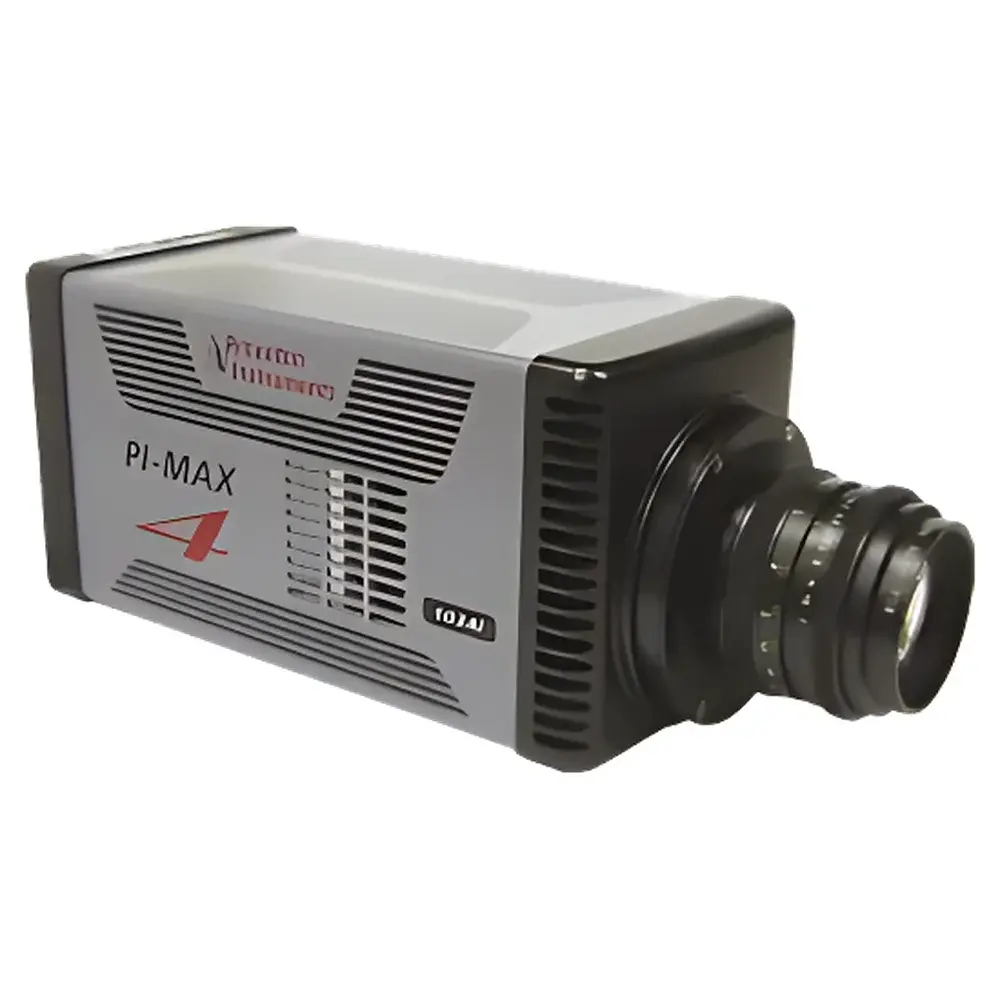
Princeton Instruments PI-MAX4 Enhanced CCD Camera
| Brand | LaVision GmbH |
|---|---|
| Origin | Germany |
| Manufacturer Type | Authorized Distributor |
| Origin Category | Imported |
| Model | PI-MAX4 |
| Price Range | USD 13,500 – 68,000 (est.) |
| Sensor Format | 1024 × 1024 interline CCD |
| Pixel Size | 13 µm × 13 µm |
| Effective Imaging Area | 13.3 mm × 13.3 mm |
| Image Intensifier Coupling | Fiber-optic taper (18 mm input window) |
| Spectral Response | 185 nm – 1100 nm |
| Minimum Gating Width | 3 ns |
| Full-Frame Frame Rate | 26 fps at 16-bit depth |
| Interface | Gigabit Ethernet (GigE Vision compliant) |
| Max Cable Length | >50 m |
| Software Control | Fully integrated with DaVis® v8.x and higher |
Overview
The Princeton Instruments PI-MAX4 Enhanced CCD Camera is a high-performance, gated intensified imaging system engineered for time-resolved scientific visualization in low-light and ultrafast optical regimes. Built upon a 1024 × 1024 interline transfer CCD sensor and optically coupled via a high-transmission fiber-optic taper to a multi-stage microchannel plate (MCP) image intensifier, the PI-MAX4 delivers photon-counting sensitivity with sub-nanosecond temporal resolution. Its design follows the fundamental principles of intensified charge-coupled device (ICCD) architecture: incident photons strike a photocathode, generate photoelectrons, undergo gain amplification within the MCP stack, and are converted back to visible light on a phosphor screen before being relayed onto the CCD. This cascade enables single-photon detection capability while preserving spatial fidelity—critical for applications such as laser-induced fluorescence (LIF), plasma diagnostics, combustion imaging, and time-of-flight spectroscopy. The absence of geometric distortion (e.g., pincushion or pillow distortion) results directly from the rigid, 1:1 fiber-optic coupling—eliminating lens-based aberrations common in lens-coupled ICCDs.
Key Features
- Gated operation with programmable exposure windows down to 3 ns—enabling precise synchronization with pulsed lasers or transient phenomena.
- Fiber-optic coupling between an 18 mm-diameter image intensifier and the 13.3 mm × 13.3 mm active area CCD ensures >75% quantum efficiency across UV–NIR (185–1100 nm), with peak response near 500 nm.
- Interline transfer architecture supports true electronic shuttering without mechanical components, eliminating motion blur and enabling rapid frame sequencing.
- GigE Vision-compliant interface provides deterministic, low-latency data streaming at up to 26 full-frame images per second at 16-bit depth, with robust noise immunity over cable runs exceeding 50 meters.
- Integrated thermoelectric cooling maintains sensor temperature at −15 °C below ambient, reducing dark current to <0.001 e⁻/pixel/s and supporting long-exposure quantitative measurements.
- Hardware-level trigger inputs (TTL/LVDS) and gate delay resolution of 10 ps allow synchronization with external timing systems, including delay generators and femtosecond laser controllers.
Sample Compatibility & Compliance
The PI-MAX4 is compatible with standard C-mount and F-mount optical interfaces, facilitating integration into custom optical benches, microscope configurations, and vacuum-compatible experimental chambers (with optional vacuum-rated housing). It meets CE marking requirements for electromagnetic compatibility (EMC Directive 2014/30/EU) and low-voltage safety (LVD Directive 2014/35/EU). While not certified for medical use under FDA 510(k) or IEC 62304, its architecture supports GLP/GMP-aligned workflows when deployed with audit-trail-enabled acquisition software (e.g., DaVis® with optional 21 CFR Part 11 compliance module). Calibration traceability to NIST standards is available through optional factory calibration services covering spectral responsivity, linearity, and gating uniformity.
Software & Data Management
The PI-MAX4 operates natively within LaVision’s DaVis® software platform (v8.4+), providing synchronized control of intensifier gain, gate timing, CCD readout mode, and hardware triggering—all accessible via intuitive GUI or scriptable Python/C++ APIs. DaVis® implements lossless TIFF and HDF5 export formats with embedded metadata (exposure time, gain setting, timestamp, trigger source), ensuring FAIR (Findable, Accessible, Interoperable, Reusable) data handling. Raw image streams are buffered in onboard DDR3 memory prior to GigE transmission, preventing frame drop during burst acquisitions. For automated experiment orchestration, the camera supports GenICam XML feature descriptions and is fully compatible with third-party frameworks including MATLAB Image Acquisition Toolbox and LabVIEW IMAQdx.
Applications
- Laser-induced breakdown spectroscopy (LIBS) and time-resolved emission spectroscopy requiring nanosecond-scale spectral gating.
- Planar laser-induced fluorescence (PLIF) for 2D species concentration mapping in turbulent flames and reacting flows.
- Ultrafast pump-probe microscopy and streak-camera alternative setups for picosecond-to-nanosecond dynamics.
- Bioluminescence and chemiluminescence imaging where signal persistence is limited to milliseconds.
- Ballistic photon imaging through scattering media using time-gated rejection of diffuse photons.
- High-speed schlieren and shadowgraphy for shockwave propagation analysis in gas dynamics.
FAQ
What is the typical system timing jitter between trigger input and gate opening?
Timing jitter is ≤25 ps RMS when using LVDS trigger inputs and internal clock distribution; jitter increases to ≤150 ps with TTL triggers due to signal edge uncertainty.
Can the PI-MAX4 be operated in photon-counting mode?
Yes—when operated at maximum gain and minimum exposure, individual photon events appear as localized clusters of ≥3 adjacent saturated pixels; post-processing via centroiding algorithms enables event localization with ~5 µm spatial precision.
Is vacuum compatibility available as a factory option?
Yes—vacuum-rated variants (up to 10⁻⁶ mbar) with conflat flange mounting and non-outgassing materials are offered under model suffix “-VAC”; standard units are rated for ambient laboratory environments only.
Does the camera support region-of-interest (ROI) readout to increase frame rate?
Yes—custom ROIs can be defined in DaVis® to reduce data volume; 512 × 512 ROI achieves >100 fps at 16-bit depth, maintaining full gating flexibility.
How is radiometric calibration performed?
Calibration is traceable to NIST SRM 2032 (photometric standard lamp) and includes pixel-wise gain/dark-field correction maps; certificates are issued with each calibration service.



