
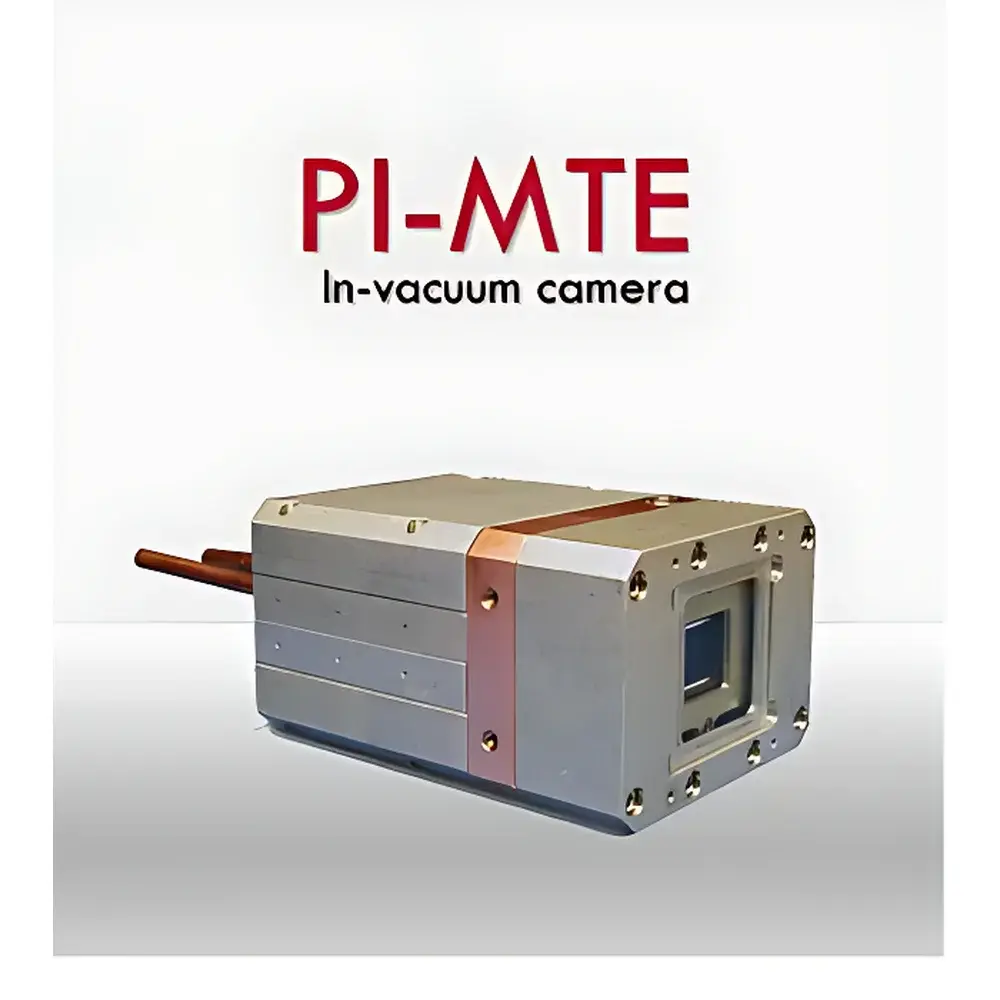
Princeton Instruments PI-MTE In-Vacuum Direct-Detection X-ray CCD Camera
| Brand | Princeton Instruments / Teledyne Princeton Instruments |
|---|---|
| Origin | USA |
| Model | 1300B, 2048B |
| Pixel Size | 13.5 × 13.5 µm, 20 × 20 µm |
| Energy Range | <30 eV to ~20 keV |
| Cooling | Thermoelectric (to –55 °C) |
| Readout Speed | 50 kHz to 2 MHz |
| ADC Resolution | 16-bit |
| Interface | High-Speed USB 2.0 (with optional fiber-optic extension up to 50 m) |
| Vacuum Compatibility | UHV-rated (<10⁻⁹ Torr), in-situ mounting |
| Imaging Array | Back-illuminated CCD, no AR coating |
| Quantum Efficiency | >95% peak absorption efficiency across soft X-ray band |
Overview
The Princeton Instruments PI-MTE is a purpose-built, ultra-compact, thermoelectrically cooled back-illuminated CCD camera engineered for direct detection of soft to hard X-rays (sub-30 eV to ~20 keV) inside ultra-high vacuum (UHV) environments. Unlike conventional X-ray detectors requiring external vacuum feedthroughs or windowed housings, the PI-MTE integrates the entire imaging sensor, low-noise electronics, and thermal management system into a single hermetically sealed, vacuum-compatible enclosure rated for continuous operation at pressures below 10⁻⁹ Torr. Its design leverages the fundamental advantages of back-illuminated CCD architecture—high quantum efficiency, negligible etaloning, and intrinsic sensitivity to photons below 100 eV—without anti-reflection coatings that degrade performance in the extreme ultraviolet (EUV) and soft X-ray regimes. The camera operates on the principle of direct photoelectron generation within the silicon depletion layer, enabling high spatial resolution (limited only by pixel pitch and charge diffusion), excellent linearity (>99.9%), and photon-counting capability under low-flux conditions. It is widely deployed in synchrotron beamlines, laser-plasma interaction chambers, X-ray interferometers, and EUV lithography development tools where minimal footprint, zero outgassing, and long-term thermal stability are non-negotiable.
Key Features
- Ultra-compact, UHV-certified mechanical design optimized for internal mounting in vacuum chambers with limited radial/axial space
- Back-illuminated, thinned CCD sensor with no anti-reflection coating—maximizing QE from 30 eV through the water window (284 eV) and into the hard X-ray regime
- Thermoelectric cooling to –55 °C, reducing dark current to <0.001 e⁻/pixel/sec and enabling integration times from milliseconds to hours
- Dual-output amplifier architecture: one optimized for ultra-low-noise readout (≤2.5 e⁻ rms), the other for high-speed acquisition (up to 2 MHz)
- 16-bit analog-to-digital conversion with linear full-well capacity ≥100,000 e⁻ per pixel
- High-Speed USB 2.0 interface with native driver support for Windows and Linux; optional fiber-optic extender for remote operation up to 50 m
- Robust clocking architecture minimizing spurious charge transfer artifacts (e.g., trailing, smearing) during fast readout
Sample Compatibility & Compliance
The PI-MTE is compatible with a broad range of X-ray sources—including laser-produced plasmas, synchrotron bending magnets/undulators, microfocus X-ray tubes, and EUV plasma sources—and supports both imaging and spectroscopic modalities. Its vacuum-integrated construction eliminates transmission losses associated with Be or Si₃N₄ windows, preserving spectral fidelity below 1 keV. The camera meets ASTM E1701-17 standards for X-ray detector calibration traceability and complies with ISO 14644-1 Class 1 cleanroom assembly protocols. All materials used in the vacuum housing conform to NASA outgassing requirements (ECSS-Q-ST-70-02C), with total mass loss (TML) <1.0% and collected volatile condensable materials (CVCM) <0.1%. For regulated environments, LightField software supports audit trails, user access control, and electronic signatures compliant with FDA 21 CFR Part 11 and GLP/GMP documentation workflows.
Software & Data Management
LightField 64-bit software provides full hardware control, real-time image preview, and advanced data processing capabilities including automatic background subtraction, flat-field correction, defect pixel masking, and photon-event centroiding. The SDK (PICAM API) enables seamless integration into custom LabVIEW, Python (PyVCAM), MATLAB, or C++ applications. All acquired frames are saved in vendor-neutral HDF5 format with embedded metadata (exposure time, temperature, gain settings, timestamp, beamline parameters), ensuring FAIR (Findable, Accessible, Interoperable, Reusable) data principles. Batch processing pipelines support spectral deconvolution, line-profile extraction, and time-resolved stacking for pump-probe experiments.
Applications
- X-ray plasma diagnostics: Time-resolved imaging of laser-driven plasma expansion, electron temperature mapping via continuum slope analysis, and emission line ratio thermometry
- Soft X-ray microscopy: Zone-plate-based full-field imaging of biological specimens, cryo-fixed cells, and magnetic domain structures at 10–50 nm resolution
- EUV lithography metrology: In-situ monitoring of mask blank defects, resist outgassing, and collector mirror degradation at 13.5 nm
- X-ray interferometry and holography: High-coherence imaging requiring sub-pixel stability and shot-noise-limited contrast
- X-ray absorption spectroscopy (XAS): Extended X-ray absorption fine structure (EXAFS) and X-ray absorption near-edge structure (XANES) measurements with energy-resolved framing
- Time-of-flight X-ray diffraction: Synchronized gating with pulsed sources for transient crystallography studies
FAQ
Is the PI-MTE suitable for use in ultra-high vacuum (UHV) systems?
Yes—the PI-MTE is fully UHV-compatible and certified for continuous operation at pressures ≤10⁻⁹ Torr without outgassing or thermal drift.
What is the minimum detectable photon energy?
The uncoated back-illuminated CCD achieves usable quantum efficiency down to <30 eV, covering the carbon K-edge (284 eV), oxygen K-edge (543 eV), and beyond.
Can the camera be synchronized with external triggers?
Yes—it supports TTL-compatible external trigger input with programmable delay (10 ns resolution) and gate width for pump-probe and time-resolved experiments.
Does the system support photon-counting mode?
At low flux and appropriate gain settings, individual X-ray photon events can be resolved using threshold-based event detection in LightField.
Are firmware updates and calibration files provided?
All units ship with NIST-traceable gain and linearity calibration files; firmware updates are delivered via Princeton Instruments’ secure customer portal with version-controlled release notes.




