
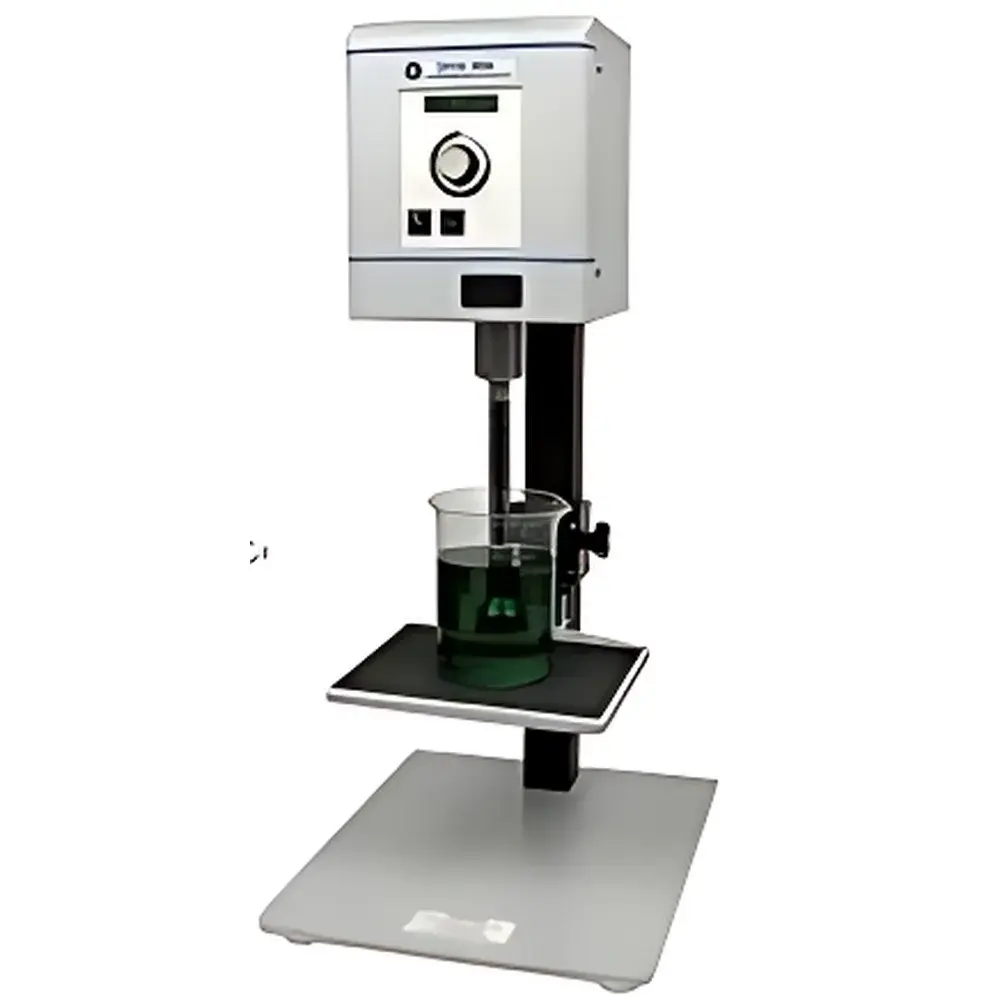
PRO MACRO-ES Programmable High-Shear Rotor-Stator Homogenizer
| Brand | PRO |
|---|---|
| Origin | USA |
| Manufacturer Type | Authorized Distributor |
| Product Category | Imported Equipment |
| Model | MACRO-ES |
| Instrument Type | Rotor-Stator Probe Homogenizer |
| Dimensions (W×D×H) | 280 × 440 × 260 mm |
| Processing Capacity Range | Up to 40 L |
| Motor Power | 1800 W |
| Speed Range | 1,000–20,000 rpm |
| Display | 32-bit Alphanumeric LED |
| Noise Level | ≤68 dB(A) at Max Speed |
| Warranty | 3-Year Motor Warranty |
| Optional Interface | RS-232 with Windows Control Software |
| Programmable Memory | 12 User-Defined Protocols (Speed, Time, Ramp Profiles) |
| Standard Accessories | Three Rotor-Stator Probes (20 mm × 195 mm serrated |
| Compliance | Designed for GLP/GMP-aligned workflows |
Overview
The PRO MACRO-ES Programmable High-Shear Rotor-Stator Homogenizer is an industrial-grade laboratory instrument engineered for reproducible, scalable mechanical homogenization of viscous, heterogeneous, or temperature-sensitive samples. Operating on the principle of rotor-stator shear—where high-speed rotation of a precision-machined rotor within a concentric stator generates intense hydrodynamic cavitation, turbulent flow, and localized shear gradients—the MACRO-ES delivers consistent particle size reduction, cell lysis, emulsification, and dispersion across volumes up to 40 L. Its 1800 W brushless motor ensures stable torque delivery even under load variations, enabling reliable operation in demanding applications such as biopharmaceutical formulation development, polymer nanocomposite preparation, and food matrix standardization. Unlike ultrasonic or bead-based systems, the rotor-stator architecture provides superior scalability from benchtop to pilot scale without re-optimization, making it particularly suited for process transfer studies compliant with ICH Q5A and FDA Process Validation Guidance.
Key Features
- Programmable digital control system supporting up to 12 user-defined protocols, each configurable with multi-stage speed ramps, dwell times, and acceleration/deceleration profiles
- Wide operational speed range (1,000–20,000 rpm) with closed-loop feedback ensuring ±1% speed stability across load conditions
- 32-bit alphanumeric LED display offering real-time monitoring of speed, elapsed time, and active protocol status
- Modular quick-connect coupling system enabling tool-free probe exchange and minimizing cross-contamination risk during multi-sample workflows
- Acoustically optimized housing design achieving ≤68 dB(A) noise emission at maximum rotational speed—critical for open-lab environments requiring low ambient disturbance
- Movable platform stand with adjustable height and lateral positioning supports ergonomic alignment with vessels ranging from 50 mL centrifuge tubes to 40 L jacketed reactors
- RS-232 serial interface compatible with Windows-based acquisition software for automated data logging, audit trail generation, and 21 CFR Part 11-compliant electronic records
Sample Compatibility & Compliance
The MACRO-ES accommodates diverse sample matrices including mammalian cell suspensions, bacterial lysates, crude oil emulsions, pharmaceutical suspensions, and high-viscosity polymer melts. Its three included rotor-stator probes—20 mm serrated (optimized for high-shear lysis), 35 mm flat-bottom (ideal for medium-viscosity dispersions), and 45 mm flat-bottom (designed for large-volume homogenization)—allow method optimization without hardware substitution. All wetted components are constructed from 316L stainless steel and PTFE-sealed to ensure chemical resistance and cleanability per ISO 14644-1 Class 7 cleanroom maintenance standards. The system supports documentation requirements for GLP audits and GMP manufacturing environments, including timestamped parameter logs, operator ID tagging, and tamper-evident protocol execution records.
Software & Data Management
The optional Windows-compatible control software enables remote configuration, real-time parameter visualization, and export of CSV-formatted datasets containing speed, time, torque estimates, and thermal drift metrics (when paired with external PT100 sensors). Audit trails comply with FDA 21 CFR Part 11 requirements, featuring electronic signatures, role-based access control, and immutable record archiving. Protocol libraries can be version-controlled and synchronized across multiple instruments, facilitating standardized operating procedures across distributed R&D sites. Data exports integrate natively with LIMS platforms via ODBC drivers and support metadata tagging aligned with ISA-88/ISA-95 batch record structures.
Applications
- Cell disruption and subcellular fractionation in proteomics and metabolomics workflows
- Preparation of stable nanoemulsions for topical drug delivery and functional food ingredients
- Dispersion of carbon nanotubes, graphene oxide, and metal-organic frameworks in polymer matrices
- Routine quality control of suspension viscosity, particle size distribution, and phase stability in QC laboratories
- Scale-down modeling of production-scale homogenization processes for regulatory filing (e.g., ANDA, BLA submissions)
- Homogenization of tissue homogenates for ELISA, PCR, and mass spectrometry sample preparation
FAQ
What is the maximum recommended processing volume for continuous operation?
The MACRO-ES is rated for intermittent use up to 40 L with the 45 mm probe; for continuous operation above 10 L, active cooling of the vessel and duty-cycle management (e.g., 3 min ON / 2 min OFF) are advised to maintain thermal stability.
Is the instrument compatible with explosion-proof environments?
Standard units are not ATEX-certified; however, custom configurations with intrinsically safe motor enclosures and non-sparking rotor materials are available upon request for Class I, Division 1 hazardous locations.
Can third-party rotor-stator probes be used?
Only PRO-branded probes with calibrated interference fits and traceable dimensional certification are supported; use of unqualified probes voids the motor warranty and compromises shear profile repeatability.
How does the MACRO-ES handle highly abrasive samples like silica suspensions?
The serrated 20 mm probe features hardened tungsten-carbide coating (HV 1800), extending service life by ≥3× compared to standard stainless-steel rotors when processing abrasive particulates >5 µm.
Does the system support IQ/OQ/PQ documentation packages?
Yes—comprehensive qualification templates (including test scripts, acceptance criteria, and raw data worksheets) are provided with purchase and align with ASTM E2500-13 and EU Annex 15 validation principles.
Related Products



