
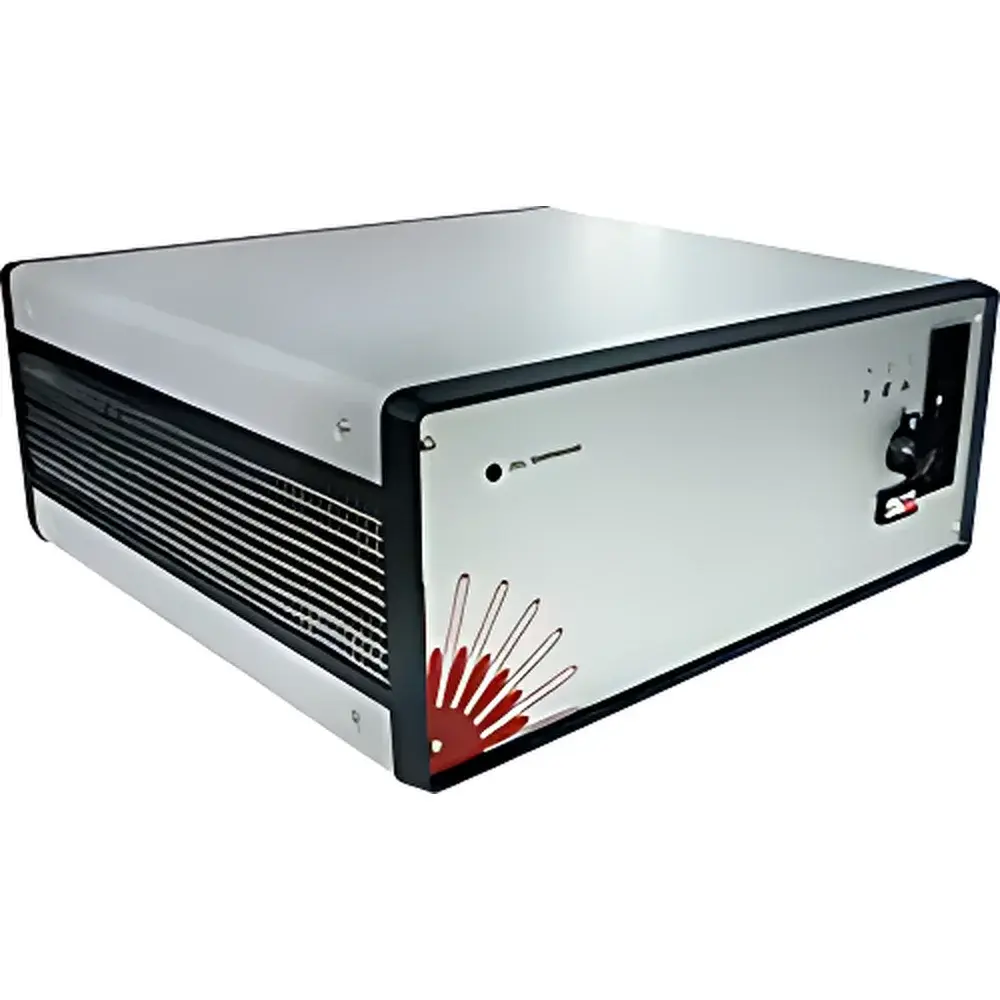
Protea Solus NH3 Ammonia Analyzer
| Brand | Protea |
|---|---|
| Origin | United Kingdom |
| Manufacturer Type | Authorized Distributor |
| Origin Category | Imported |
| Model | Solus NH3 |
| Instrument Type | Portable |
| Measurement Principle | Tunable Diode Laser Absorption Spectroscopy (TDLAS) |
| Target Gases | NH₃ and H₂O (simultaneous) |
| Detection Limit | Sub-ppm NH₃ |
| Response Time | ≤1 s |
| Tuning Range | 2–2.5 nm |
| Spectral Resolution | 0.1 nm |
| Optical Material | Zinc Selenide (ZnSe) |
| Detector | Photodiode |
| Optical Path Length | 0.4 m (standard) |
| Sample Volume | 15 mL |
| Measurement Chamber Temperature | 190 °C |
| Sample Flow Rate | 3 L·min⁻¹ |
| Integrated Sampling System | Heated inlet filter, mass flow controller, automated N₂ purge valve, programmable dilution module |
| Enclosure | Carbon-fiber reinforced composite |
| Weight | 10 kg |
| Dimensions | 46 cm × 35 cm × 17.8 cm (4U, 19″ rack-mountable) |
| Compliance | Designed for GLP/GMP-aligned operation |
Overview
The Protea Solus NH₃ Ammonia Analyzer is a portable, laser-based gas analyzer engineered for high-selectivity, real-time quantification of ammonia (NH₃) in demanding industrial and environmental applications—particularly selective catalytic reduction (SCR) systems used in power generation, waste incineration, and cement production. At its core, the instrument employs Tunable Diode Laser Absorption Spectroscopy (TDLAS), a well-established optical absorption technique that leverages narrow-linewidth, temperature- and current-tuned near-infrared (NIR) laser diodes. Unlike broadband methods such as NDIR or electrochemical sensors, TDLAS targets specific ro-vibrational absorption lines of NH₃ within the 1.5–2.0 µm range, enabling exceptional selectivity against spectral interferences from CO₂, NOₓ, SO₂, and hydrocarbons. The Solus platform integrates micro-machined optical components and thermally stabilized ZnSe optics to maintain wavelength accuracy and signal stability across ambient temperature fluctuations. Its heated measurement cell (190 °C) prevents NH₃ adsorption and condensation, ensuring quantitative recovery even in high-humidity or low-concentration exhaust streams.
Key Features
- Sub-ppm NH₃ detection limit with ≤1-second response time, validated per ISO 14687 Annex B protocols for SCR slip monitoring
- Simultaneous dual-gas measurement capability: NH₃ and H₂O vapor via single-laser TDLAS—eliminating cross-sensitivity through line-locking and harmonic detection
- Modular architecture supporting optional integration of a zirconia-based O₂ sensor for stoichiometric combustion control correlation
- Integrated heated sampling system featuring a ceramic inlet filter (operating up to 200 °C), precision mass flow controller, automated N₂ purge sequence, and software-controlled dilution for high-concentration sample handling
- Carbon-fiber composite enclosure—lightweight (10 kg), shock-resistant, and EMI-shielded—designed for field deployment and mobile lab use
- Zero-calibration operational mode: factory-characterized laser absorption cross-sections and pressure/temperature compensation algorithms eliminate routine span gas calibration
Sample Compatibility & Compliance
The Solus NH₃ is optimized for hot, wet, and particulate-laden sample streams typical of flue gas ducts downstream of SCR reactors. Its 190 °C heated optical cell and heated sampling train prevent NH₃ loss due to surface adsorption or ammonium salt formation. The 15 mL sample volume and 0.4 m optical path length balance sensitivity and dynamic response—enabling compliance with EN 15267-3 and EPA Method 320 for continuous emission monitoring system (CEMS) auxiliary verification. While not certified as a standalone CEMS, the analyzer meets key functional requirements of ISO 14687:2019 for hydrogen purity analysis (applicable to NH₃ slip limits in fuel cell feedstocks) and supports audit-ready data logging aligned with 21 CFR Part 11 principles when paired with Protea’s optional secure firmware package.
Software & Data Management
The Solus operates via embedded Linux-based firmware with a web-accessible interface (HTTPS-enabled) and native Modbus TCP/RTU support for PLC integration. Real-time concentration data, diagnostic flags (e.g., laser health, flow deviation, cell temperature drift), and spectral baseline logs are timestamped and stored onboard (8 GB internal memory). Data export is supported in CSV and XML formats compliant with ASTM E2500-18 for analytical instrument qualification. Optional Protea DataHub software provides trend visualization, alarm threshold configuration, and automated report generation—including customizable PDF summaries meeting GLP documentation standards. All firmware updates undergo cryptographic signature verification to ensure integrity during remote maintenance.
Applications
- Ammonia slip monitoring in coal-, gas-, and biomass-fired power plants with SCR denitrification systems
- In-process NH₃/H₂O ratio control in fertilizer production off-gas streams
- Verification of catalyst performance during SCR commissioning and periodic audits
- Mobile stack testing and fugitive emission surveys in petrochemical refineries
- Research-grade NH₃ kinetics studies requiring fast transient resolution (e.g., cold-start SCR behavior)
- Complementary measurement in biogas upgrading facilities where NH₃ corrosion potential must be quantified prior to membrane separation
FAQ
Does the Solus NH₃ require daily calibration gas?
No. It operates in zero-calibration mode using factory-determined absorption line strengths and real-time thermobaric compensation. Periodic verification with traceable NH₃ standard (e.g., NIST-certified 10 ppm in N₂) is recommended every 90 days for QA/QC.
Can the same unit measure HCl instead of NH₃?
Yes—the Solus platform is reconfigurable. By selecting an alternate laser diode tuned to the 1.7 µm HCl absorption band and updating firmware parameters, the instrument can be repurposed for HCl + H₂O measurement without hardware modification.
Is the carbon-fiber housing suitable for outdoor installation?
The enclosure meets IP54 ingress protection and MIL-STD-810G vibration specifications. For permanent outdoor mounting, Protea recommends optional weatherproof enclosure (Part No. SOLUS-WE-IP65) and active thermal management in ambient temperatures below −10 °C or above +50 °C.
How does TDLAS compare to extractive FTIR for NH₃?
TDLAS offers superior sensitivity (<0.1 ppm vs. ~1 ppm for typical FTIR), faster response (sub-second vs. 30+ seconds), lower power consumption, and reduced susceptibility to optical fouling—making it preferred for continuous slip monitoring where reliability and minimal downtime are critical.
What maintenance intervals are required?
Routine maintenance includes quarterly inspection of the heated inlet filter and annual verification of laser alignment and detector linearity using Protea’s certified service kit (P/N MAINT-SOLUS-KIT). No consumables or replacement cells are required within the first five years of operation.







