
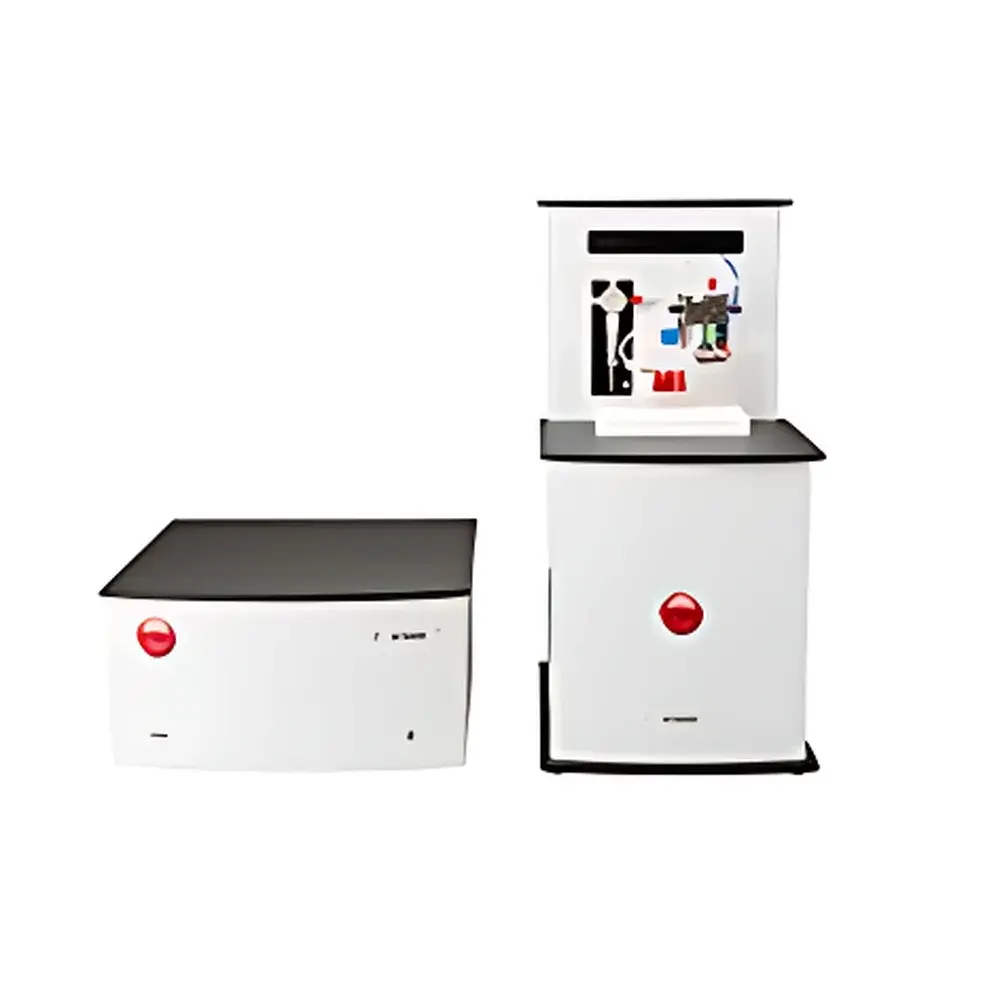
PSS AccuSizer 780 A7000 APS Automated Particle Counter with SPOS Technology
| Brand | Particle Sizing Systems (PSS), USA |
|---|---|
| Origin | USA |
| Model | AccuSizer 780 A7000 APS |
| Detection Principle | Single Particle Optical Sensing (SPOS) combining Light Extinction (LE) and Light Scattering (LS) |
| Size Range | 0.5 µm – 400 µm |
| Concentration Limit | up to 10¹¹ particles/mL |
| Channel Resolution | 512 logarithmically spaced channels |
| Compliance | USP <729>, CP <0903>, 21 CFR Part 11, GLP/GMP-ready |
| Automation | Integrated auto-sampling, two-step dynamic dilution, auto-cleaning, and data processing |
Overview
The PSS AccuSizer 780 A7000 APS is an automated, high-resolution particle counter engineered for quantitative analysis of large and subvisible particles in low-to-high concentration suspensions. It employs Single Particle Optical Sensing (SPOS) — a validated, regulatory-accepted methodology that combines light extinction (LE) and light scattering (LS) detection within a single flow cell. Unlike ensemble-averaging techniques such as laser diffraction, SPOS individually resolves and sizes each particle passing through the sensing zone, delivering true number-weighted distributions with exceptional sensitivity to tail-end outliers. This principle underpins its designation as the reference method for PFAT5 (Percent Fat Above 5 µm) testing in lipid emulsions per Chinese Pharmacopoeia (CP) Chapter 0903 and United States Pharmacopeia (USP) . The instrument’s operational range spans 0.5 µm to 400 µm with ≤10 ppt particle detection sensitivity, making it uniquely suited for applications where trace-level large particles dictate product safety, stability, or functional performance — including parenteral drug formulations, CMP slurries, pigment dispersions, and inkjet inks.
Key Features
- 512-channel logarithmic resolution enables precise binning across the full 0.5–400 µm range, with sub-micron granularity below 2 µm — critical for resolving multimodal distributions and identifying subtle population shifts.
- Two-step automated dilution system (static + dynamic) accommodates undiluted sample concentrations up to 10¹¹ particles/mL while maintaining single-particle transit conditions; final dilution factors span 20× to 144,060× with programmable precision.
- Dual-mode optical detection (LE + LS): LE provides broad dynamic range and composition-independent sizing; LS extends lower detection limit to 0.5 µm without sacrificing counting fidelity.
- Modular architecture supports field-upgradable sensors (e.g., LE400-05, LE1000-2), syringe/loop configurations, and fluidic options (aqueous/organic solvents), ensuring long-term adaptability to evolving application needs.
- On-site calibration capability eliminates downtime associated with factory recalibration; NIST-traceable PSL standards (0.5–100 µm) enable routine performance qualification per PQ protocols.
- Compliance-ready hardware and firmware: optically isolated signal paths, non-volatile audit trail storage, electronic signatures, role-based user permissions, and LIMS connectivity via standard OPC UA or CSV export.
Sample Compatibility & Compliance
The AccuSizer 780 A7000 APS accepts aqueous and organic-phase samples across diverse viscosities and conductivities. Its 30 mL quartz chamber with PFA-coated magnetic stirrer ensures homogeneous dispersion during static dilution, while PFA fluidic pathways and 0.2 µm Millipore-certified diluent filtration minimize background contamination — essential for pharmacopeial compliance. The system meets ISO 21501-4 for light extinction particle counters and aligns with regulatory expectations for analytical instrument qualification (AIQ) under ICH Q2(R2). It satisfies data integrity requirements per FDA 21 CFR Part 11, EU Annex 11, and NMPA GLP/GMP guidance, supporting full audit trails, immutable data archiving, and electronic record retention for ≥30 years. Validation packages include IQ/OQ/PQ documentation templates compliant with USP and ASTM E2500.
Software & Data Management
The instrument operates via dual software platforms: AccuSizer Research Edition (L2W) for exploratory analysis and method development, and AccuSizer Regulatory Edition — a 21 CFR Part 11-compliant application featuring password-protected access levels, time-stamped audit logs, electronic signatures, and automatic encrypted backup to network drives or cloud repositories. All raw pulse data are retained alongside processed histograms, enabling retrospective re-analysis without data loss. Customizable reporting modules support USP PFAT5 calculations, CP large-particle thresholds, and client-defined pass/fail criteria. Export formats include PDF, Excel, XML, and ASCII for integration into enterprise quality management systems (QMS) and statistical process control (SPC) workflows.
Applications
This platform is routinely deployed in regulated and industrial settings where large-particle presence correlates directly with clinical risk or manufacturing yield. In biopharmaceutical development, it quantifies subvisible particles in monoclonal antibody formulations, liposomal drugs, and nanoemulsions — detecting aggregation events invisible to light obscuration or dynamic light scattering. Semiconductor manufacturers rely on its superior sensitivity (>1,500× vs. laser diffraction) to monitor abrasive agglomeration in CMP slurries, preventing wafer scratching. Inkjet ink producers use it to verify研磨 efficacy and prevent printhead clogging by tracking >1 µm contaminants. Additionally, it serves as a primary tool for quality control of vaccines, blood substitutes, and contrast agents — all subject to strict particle burden limits defined in global pharmacopoeias.
FAQ
How does SPOS differ from laser diffraction in detecting large particles?
SPOS detects and sizes each particle individually, producing number-weighted distributions that accurately reflect tail-end populations. Laser diffraction infers size from ensemble scattering patterns and often overestimates large-particle counts due to Mie theory assumptions — particularly problematic for polydisperse or sparse large-particle samples.
Can the A7000 APS analyze viscous or opaque samples?
Yes — optional high-torque mechanical stirring, heated flow cells, and solvent-compatible sensors (e.g., LE2500-5) extend usability to glycerol-based emulsions, polymer dispersions, and pigmented suspensions.
Is method transfer between labs supported?
Absolutely — standardized sensor calibration protocols, identical pulse-processing algorithms, and cross-platform software ensure reproducible results across global R&D and QC sites.
What validation documentation is provided?
Factory-installed IQ/OQ protocols, PQ kits with certified reference materials (Duke NIST-traceable PSLs), and GxP-aligned SOP templates are included with every system shipment.
Does the system support remote monitoring and troubleshooting?
Yes — secure VNC-enabled remote desktop access, real-time sensor diagnostics, and predictive maintenance alerts are embedded in the Regulatory Edition software suite.



