
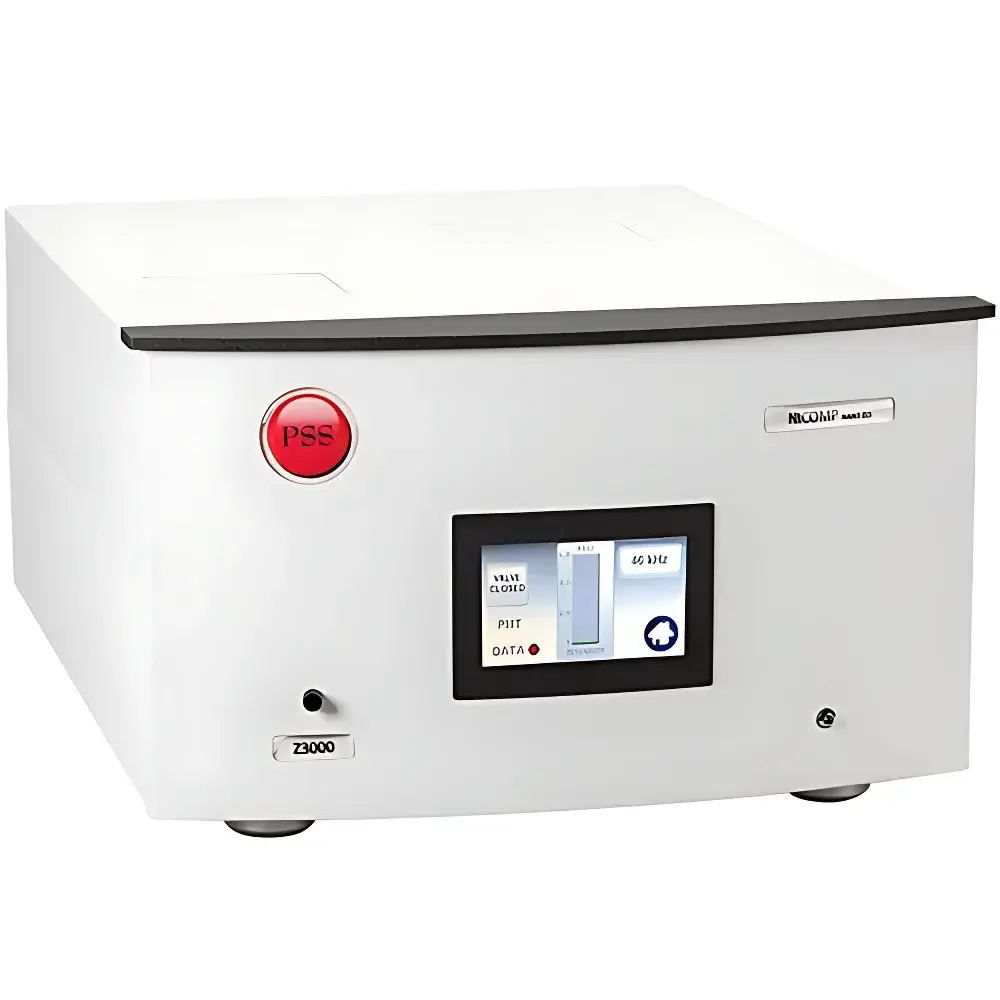
PSS Nicomp Z3000 Nanoparticle Size and Zeta Potential Analyzer
| Brand | Particle Sizing Systems (PSS), USA |
|---|---|
| Origin | USA |
| Model | Nicomp Z3000 |
| Zeta Potential Range | ±500 mV |
| pH Range | 1–14 |
| Temperature Range | 0–90 °C |
| pH Resolution | 0.1 |
| Temperature Resolution | 0.1 °C |
| Accuracy | 99% |
| Repeatability | 99% |
| Particle Size Range | 0.3 nm – 10.0 µm |
| Detection Principle | Dynamic Light Scattering (DLS) & Electrophoretic Light Scattering (ELS) with Phase Analysis Light Scattering (PALS) |
| Measurement Angles | Fixed 90° or Multi-Angle DLS (14.4°–180°, 0.9° step) |
| Detector Options | PMT and/or APD |
| Sample Volume | As low as 10 µL |
| Max. Concentration | 40% w/v |
Overview
The PSS Nicomp Z3000 Nanoparticle Size and Zeta Potential Analyzer is a dual-function benchtop instrument engineered for high-precision characterization of colloidal and nanoscale dispersions. It integrates two orthogonal physical measurement principles: Dynamic Light Scattering (DLS) for hydrodynamic size distribution analysis and Electrophoretic Light Scattering (ELS), enhanced by Phase Analysis Light Scattering (PALS), for zeta potential determination. Unlike conventional single-angle DLS systems, the Nicomp Z3000 supports true multi-angle detection (14.4°–180°, 0.9° increments), enabling optimized scattering geometry selection for sub-10 nm species—critical for resolving polydisperse systems where Rayleigh approximation limitations degrade resolution. The instrument operates on first-principles physics: DLS quantifies Brownian motion-induced intensity fluctuations to compute diffusion coefficients via autocorrelation analysis, then applies the Stokes-Einstein equation to derive hydrodynamic radius; ELS measures electrophoretic mobility under applied electric field, while PALS detects phase shifts—not frequency shifts—in scattered light, delivering superior sensitivity and accuracy in both aqueous and organic media without calibration dependency.
Key Features
- Multi-Angle DLS (MADLS) module with 0.9° angular resolution across 14.4°–180°, enabling angle-optimized sizing for ultra-small particles (<5 nm) and complex mixtures.
- Nicomp multimodal distribution algorithm—validated to resolve components differing by as little as 2:1 in diameter—outperforming Gaussian fitting in heterogeneous samples such as protein oligomers, liposomal formulations, and CMP slurries.
- Dual-detector architecture: Configurable with high-gain photomultiplier tube (PMT) or military-grade avalanche photodiode (APD), offering up to 10× signal amplification for low-scattering samples (e.g., proteins, polymers in dilute buffer).
- Reusable dual-pin insertion electrode for zeta potential measurements—designed for rigorous cleaning and long-term reuse, eliminating disposable electrode waste and reducing consumable cost per analysis.
- Integrated automated dilution and autosampling modules—minimizing manual handling error, enabling unattended batch analysis, and supporting GLP-compliant workflow scalability.
- Temperature-controlled cuvette chamber (0–90 °C, ±0.1 °C stability) with condensation-suppression design for extended thermal ramping studies.
Sample Compatibility & Compliance
The Nicomp Z3000 accommodates a broad range of sample types and matrices: biologics (proteins, viruses, exosomes, liposomes, mRNA-LNPs), synthetic nanoparticles (polymeric micelles, quantum dots, metal oxides), industrial dispersions (ink pigments, CMP slurries, photoresists), and food/cosmetic emulsions. Its pH tolerance (1–14) and compatibility with organic solvents (via PALS-enabled zeta measurement) extend applicability beyond aqueous systems. The system supports regulatory compliance requirements including ISO 22412 (DLS), ASTM E2490 (zeta potential), USP (liposome size), and FDA 21 CFR Part 11 when configured with ProPlus or Ultimate software packages—featuring role-based access control, electronic signatures, audit trail logging, and immutable data archiving.
Software & Data Management
The Nicomp Software Suite provides a validated, secure computing environment compliant with computerized system validation (CSV) standards. Core capabilities include: user-defined permission levels (16 granular rights, from method editing to firmware updates); configurable password policies (complexity, expiration, auto-lockout); full audit trail with searchable metadata (user, timestamp, action, parameter change); automated database backup (local/network path) including raw correlation data, processing methods, and audit logs; real-time switching between Gaussian, Nicomp multimodal, and CONTIN models; and customizable reporting templates exportable to PDF, CSV, or XML. All data files are cryptographically timestamped and version-controlled; deleted entries remain recoverable from the underlying relational database to satisfy ALCOA+ data integrity principles.
Applications
The Nicomp Z3000 serves critical quality control and R&D functions across regulated and industrial sectors. In pharmaceutical development, it characterizes batch-to-batch consistency of lipid nanoparticles (LNPs), monitors aggregation kinetics of monoclonal antibodies, and validates sterilization-induced size shifts in viral vectors. In semiconductor manufacturing, it tracks abrasive particle growth in CMP slurries and verifies photoresist dispersion stability. In materials science, it quantifies grafting efficiency in core-shell polymers and assesses surfactant adsorption via zeta potential titration. For academic research, its sub-nanometer resolution enables direct observation of protein monomer–dimer–tetramer equilibria—demonstrated by reproducible resolution of 1.7 nm (monomer), ~2.9 nm (dimer), and ~5.7 nm (tetramer) peaks in native BSA solutions—validating theoretical hydrodynamic scaling.
FAQ
What is the minimum detectable particle size using the Nicomp Z3000?
The instrument achieves reliable sizing down to 0.3 nm hydrodynamic diameter under optimal conditions (e.g., low-viscosity solvent, high-scattering contrast, sufficient signal-to-noise ratio), as confirmed by protein monomer standards.
Can the system measure zeta potential in non-aqueous solvents?
Yes—Phase Analysis Light Scattering (PALS) eliminates reliance on Doppler frequency shift, enabling accurate zeta potential determination in ethanol, isopropanol, THF, and other low-conductivity organic media.
Is the multi-angle DLS module required for routine sizing?
Not mandatory for monodisperse samples near 90° scattering maximum; however, it is essential for resolving multimodal distributions, detecting trace aggregates, or analyzing particles <5 nm where angular dependence dominates scattering intensity.
How does the Nicomp multimodal algorithm differ from standard cumulant or CONTIN analysis?
Unlike model-dependent Gaussian fitting or regularization-based CONTIN, Nicomp uses constrained iterative deconvolution with physical boundary conditions (e.g., non-negativity, log-normal width limits), yielding statistically robust, physically interpretable peaks without user bias.
Does the system support 21 CFR Part 11 compliance out of the box?
Part 11 functionality requires ProPlus or Ultimate software configuration—including electronic signatures, audit trail export, and permission-locked method editing—and must be implemented within a validated network infrastructure per organizational SOPs.



