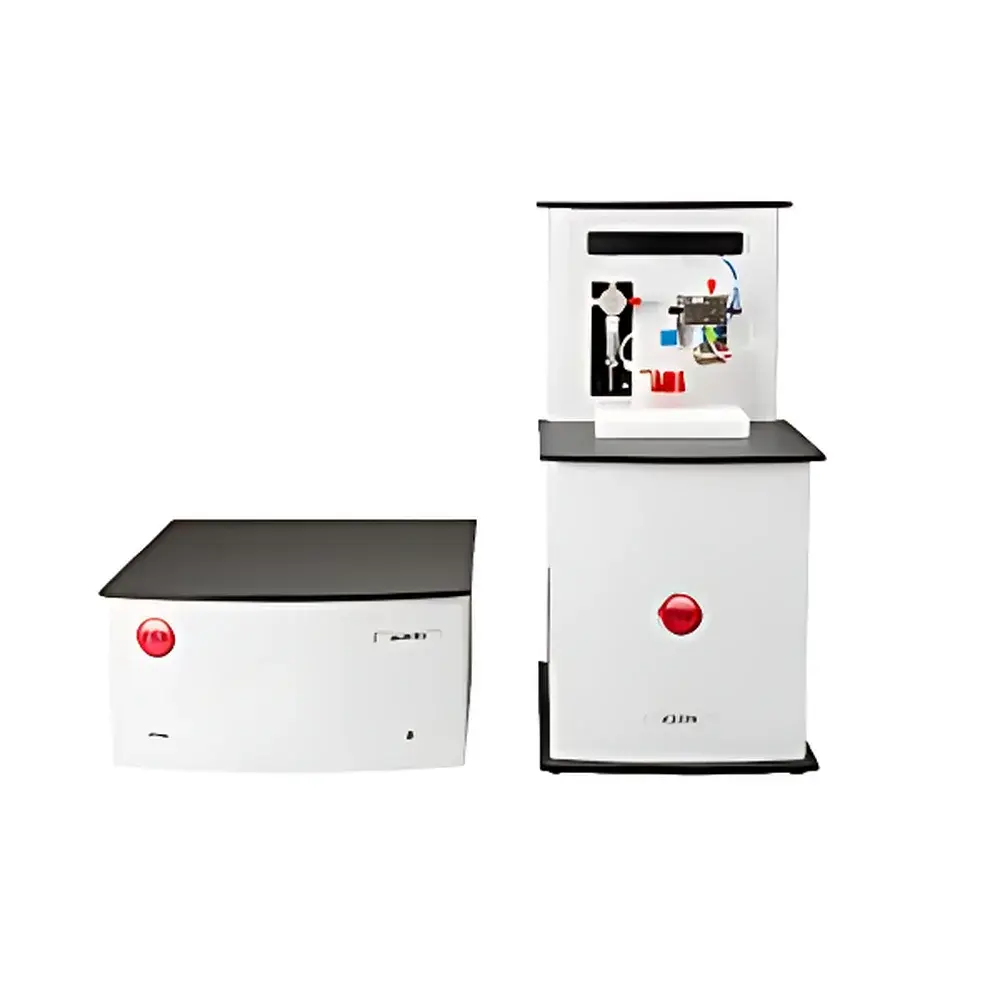
PSS AccuSizer 780 A7000 APS Automated Particle Counter
| Brand | Particle Sizing Systems (PSS) |
|---|---|
| Origin | USA |
| Model | AccuSizer 780 A7000 APS |
| Detection Principle | Single Particle Optical Sensing (SPOS) |
| Size Range | 0.5 µm – 400 µm |
| Resolution | 512-channel |
| Max Sample Concentration | 10¹¹ particles/mL |
| Compliance | USP <729>, ChP 2015, 21 CFR Part 11, cGMP |
| Automation | Integrated auto-sampling, two-step auto-dilution, auto-detection, data processing, and auto-cleaning |
Overview
The PSS AccuSizer 780 A7000 APS is an automated particle counter engineered for high-fidelity, quantitative analysis of insoluble particulates in pharmaceutical parenterals, lipid emulsions, injectable suspensions, and other critical liquid formulations. It employs Single Particle Optical Sensing (SPOS), a direct-counting methodology based on light extinction (LE) combined with light scattering detection within a precisely dimensioned flow cell. Unlike ensemble-averaging techniques such as dynamic light scattering (DLS) or laser diffraction, SPOS resolves individual particles as they pass one-by-one through the sensing zone—enabling statistically robust enumeration and sizing of low-abundance, large-diameter outliers (e.g., PFAT5 particles in lipid emulsions). This principle delivers exceptional sensitivity in the tail-end distribution (>1 µm), where regulatory thresholds are most stringent and product stability, safety, and efficacy are directly impacted.
Key Features
- Two-stage automated dilution system enabling accurate quantification of highly concentrated samples up to 10¹¹ particles/mL without manual intervention or operator-induced variability
- 512-channel high-resolution optical sensor with dual-mode detection (light extinction + light scattering) for enhanced discrimination between transparent, opaque, and semi-transparent particles
- Fully integrated workflow automation: auto-sampling, auto-dilution, auto-detection, real-time data acquisition, statistical reporting, and post-run cleaning—all under software control
- Optimized flow cell design ensuring laminar, single-file particle transit to eliminate coincidence error and preserve counting integrity across the full 0.5–400 µm range
- Compliant architecture supporting audit trails, electronic signatures, and secure user access levels per FDA 21 CFR Part 11 requirements
Sample Compatibility & Compliance
The AccuSizer 780 A7000 APS is validated for use with aqueous and non-aqueous liquid formulations including intravenous lipid emulsions, monoclonal antibody suspensions, nanosuspensions, pigment dispersions, inkjet inks, and complex generic injectables. Its measurement protocol satisfies pharmacopeial mandates for subvisible particle characterization: USP for large particle count in fat emulsions (PFAT5), Chinese Pharmacopoeia ChP 2015 General Chapter 0903, and EP 2.9.19. Instrument qualification follows IQ/OQ/PQ protocols aligned with ISO/IEC 17025 and ICH Q5A(R2). Data integrity is maintained through time-stamped, immutable records with full traceability—including raw pulse data, calibration logs, and user action history—supporting GLP and cGMP laboratory audits.
Software & Data Management
The proprietary AccuSizer Software v8.x provides a validated, 21 CFR Part 11–compliant environment with role-based permissions, electronic signature capture, and configurable report templates. All measurements generate native .acx files containing raw sensor pulses, histogram metadata, cumulative distribution curves, and statistical summaries (e.g., % >5 µm, PFAT5 value, Dv10/Dv50/Dv90). Batch-level trending, outlier flagging, and comparative overlay analysis are supported. Data export options include CSV, PDF, and XML formats compatible with LIMS integration. Audit trail functionality records every user login, parameter change, calibration event, and report generation with tamper-proof timestamps.
Applications
- Quantification of PFAT5 (particles ≥5 µm) in IV lipid emulsions per USP and ChP 2015
- Detection and enumeration of subvisible particulates in biologics, biosimilars, and mRNA-LNP formulations
- Stability assessment of colloidal drug delivery systems during accelerated and real-time storage studies
- Process development support for sterile filtration validation and formulation robustness testing
- Quality control of pigments, dyes, and functional nanomaterials where aggregate presence compromises performance
FAQ
What distinguishes SPOS from laser diffraction or DLS for pharmaceutical particle analysis?
SPOS provides absolute particle count and size distribution at the single-particle level, making it uniquely suited for detecting rare, large outliers critical to safety—whereas DLS reports intensity-weighted averages and laser diffraction lacks resolution below ~1 µm.
Can the AccuSizer 780 A7000 APS analyze undiluted clinical-grade injectables?
Yes—the two-step auto-dilution module dynamically adjusts dilution factor based on initial concentration estimate, allowing direct analysis of vial- or syringe-contained samples without pre-dilution errors.
Is the system qualified for regulated GMP manufacturing environments?
Yes—hardware, firmware, and software are designed and documented to meet cGMP, 21 CFR Part 11, and Annex 11 requirements, with full IQ/OQ/PQ documentation packages available.
How does the instrument handle sample carryover between runs?
An automated cleaning cycle—using programmable solvent flushes and ultrasonic agitation—is executed after each analysis, with verification via blank run monitoring and residual particle threshold alerts.
Does the system support method transfer between laboratories?
Yes—standardized SOPs, calibration kits traceable to NIST SRM 1963, and cross-platform software licensing enable reproducible operation across global QC sites.