
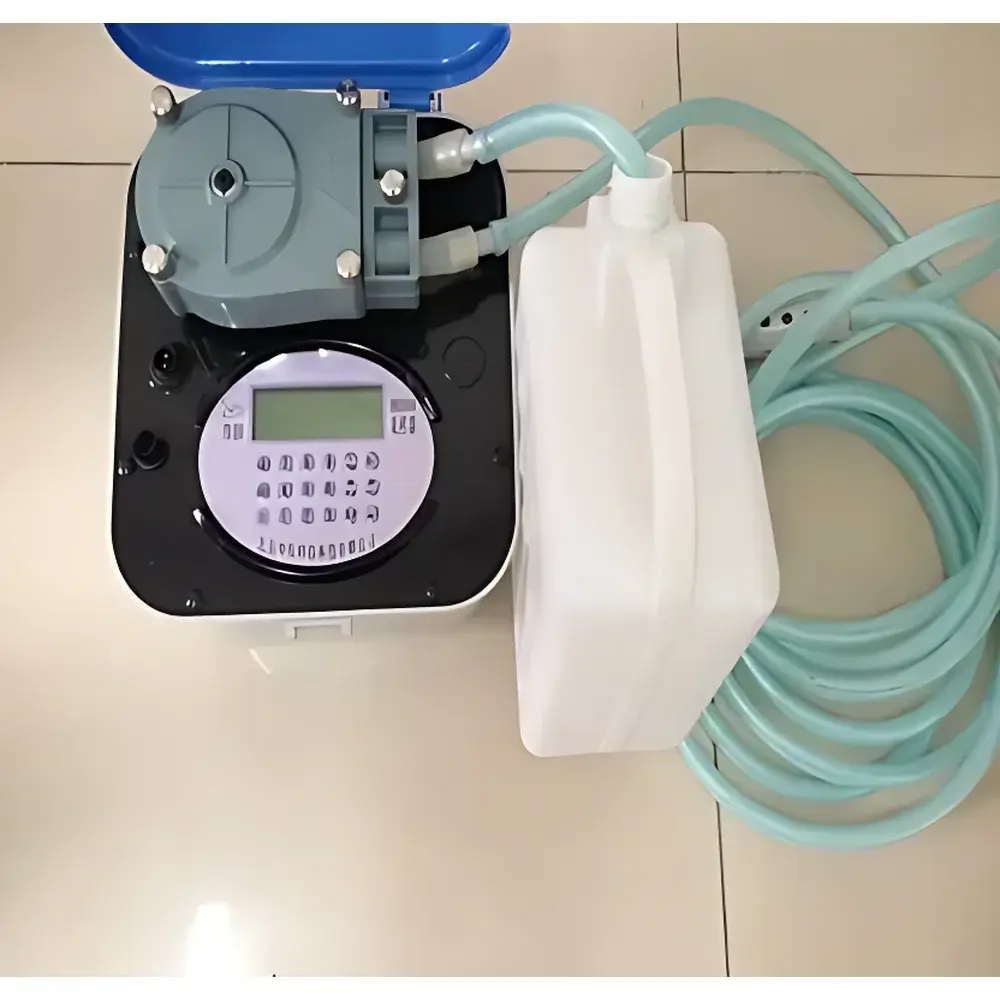
PTB-2010 Portable Automatic Water Sampler
| Origin | Beijing |
|---|---|
| Manufacturer Type | Distributor |
| Origin Category | Domestic |
| Model | PTB-2010 |
| Instrument Type | Portable Water Sampler |
| Pump Tube Diameter | 10 mm |
| Max. Suction Head | 7.2 m |
| Flow Rate | 2.4 L/min (at 3 m suction head) / 1.5 L/min (at 6 m suction head) |
| Sampling Volume Range | 50–1000 mL (1 mL increment) |
| Sampling Precision | ±8 mL |
| Sampling Interval | 3–9999 min |
| Operating Temperature | −5°C to +50°C |
| Power Supply | DC 12 V (rechargeable battery or external adapter) |
| Enclosure Rating | IP67 |
| Dimensions | 300 × 260 × 230 mm (L×W×H) |
| Weight | 2 kg |
| Sample Container | External (user-supplied or optional) |
Overview
The PTB-2010 Portable Automatic Water Sampler is an engineered field instrument designed for unattended, programmable collection of surface water and wastewater samples in compliance with national environmental monitoring standards—including China’s HJ/T 92–2002 “Technical Specifications for Monitoring of Surface Water and Wastewater Pollution.” It employs a precision-controlled peristaltic pump system to draw representative aqueous samples from open channels, discharge pipes, or influent/effluent points without cross-contamination. Its core architecture prioritizes operational reliability under variable ambient conditions, featuring a sealed, corrosion-resistant housing rated IP67 for dust-tight and immersion-resistant performance. Unlike fixed-station samplers, the PTB-2010 is optimized for mobility: weighing only 2 kg and powered by a rechargeable 12 V DC battery, it enables rapid deployment across multiple sampling sites—ideal for mobile environmental inspection teams, municipal drainage surveillance, and industrial effluent auditing.
Key Features
- Peristaltic pumping mechanism with 10 mm internal-diameter tubing—meets international standard requirements for large-bore fluid handling and minimizes clogging risk in suspended-solids-rich wastewater.
- Programmable sampling logic supporting both time-proportional (isochronous) and flow-proportional modes; configurable via intuitive Chinese-language menu interface with password-protected parameter locking.
- Auto-rinse function (0–2 cycles per sample) ensures consistent tube conditioning between collections, reducing carryover and improving inter-sample reproducibility (±8 mL volume repeatability).
- Flexible sample partitioning: supports composite sampling (1–50 sub-samples per bottle) or discrete sequential collection (up to 200 aliquots per session), accommodating regulatory batch testing and trend analysis protocols.
- Integrated real-time clock with ≤0.1% drift over 24 hours, enabling traceable temporal alignment of sample metadata—critical for audit-ready data logging in GLP-aligned workflows.
- External printer interface for hard-copy documentation of sampling events, including timestamps, volumes, and, when paired with a level sensor, instantaneous and cumulative flow metrics.
- Robust mechanical design: acid-alkali resistant enclosure, 30 W nominal power draw, and operating temperature range of −5°C to +50°C—validated in long-term field use across diverse climatic zones.
Sample Compatibility & Compliance
The PTB-2010 is validated for direct sampling of raw sewage, treated effluent, stormwater runoff, and natural surface waters containing particulates up to 20 mm in diameter. Its peristaltic pump eliminates fluid contact with internal electronics or moving parts other than the disposable tubing—ensuring chemical compatibility with pH 2–12 solutions and organic solvents commonly encountered in industrial discharge streams. The instrument conforms to HJ/T 92–2002 sampling integrity requirements, including minimum sample volume accuracy, temporal resolution, and container material neutrality. While not certified to ISO/IEC 17025 or EPA Method 1664, its operational parameters align with foundational principles of representative sampling defined in ISO 5667-1 and ASTM D3370. For regulated reporting contexts, users are advised to validate tubing compatibility and rinse protocols against site-specific matrix interference studies.
Software & Data Management
The embedded microcontroller firmware provides non-volatile storage for up to 10 preconfigured sampling programs—each defining interval, volume, rinse count, and composite logic. All user interactions occur through a high-contrast monochrome LCD with full Chinese character support and context-sensitive prompts. Parameter modification requires entry of a software-defined access code, preventing unauthorized configuration changes during field operation—a functional prerequisite for QA/QC accountability in third-party monitoring engagements. Time-stamped event logs (sampling start/end, pump activation, error flags) are retained onboard and exportable via serial interface. When integrated with external level or ultrasonic flow sensors, the system can generate time-synchronized flow-weighted composite records suitable for mass loading calculations required under discharge permit compliance frameworks.
Applications
- Regulatory compliance monitoring at municipal wastewater treatment plant outfalls and combined sewer overflows (CSOs).
- Industrial pretreatment verification at facility discharge points—supporting NPDES-style self-monitoring programs.
- Mobile source tracking during environmental incident response (e.g., spill delineation, plume mapping).
- Calibration and performance verification of permanent-installed flow meters and automatic samplers.
- Time-series nutrient or contaminant profiling in rivers, reservoirs, and irrigation canals where manual grab sampling is logistically impractical.
- Field validation of online analyzers (e.g., COD, NH₃-N, turbidity sensors) through concurrent physical sample collection.
FAQ
Does the PTB-2010 include onboard sample storage containers?
No. The unit is intentionally designed as a lightweight sampling engine without integrated bottles. Users supply compatible containers—typically HDPE or borosilicate glass—based on analyte-specific preservation requirements (e.g., acid-washed for metals, amber for photolabile compounds).
Can the sampler operate submerged or in heavy rain?
Yes. Its IP67-rated enclosure permits temporary immersion up to 1 m for 30 minutes and full protection against low-pressure water jets—making it suitable for deployment in wet wells, culverts, or exposed outdoor manholes.
What maintenance is required for long-term field deployment?
Primary maintenance involves periodic replacement of the silicone peristaltic tubing (recommended every 500–1000 operating hours depending on abrasive content) and verification of pump calibration using gravimetric volume checks per HJ/T 92–2002 Annex B.
Is the device compatible with external flow measurement systems?
Yes. It accepts analog 4–20 mA or pulse-output signals from ultrasonic, magnetic, or area-velocity flow sensors to trigger flow-proportional sampling. Integration requires user-configured scaling factors and is documented in the technical manual.
How is data integrity ensured during extended unattended operation?
All sampling events are timestamped using an onboard RTC with temperature-compensated crystal oscillator. Power-loss recovery preserves program state and resumes scheduled operations upon battery recharge—no manual reinitialization needed.
Related Products







