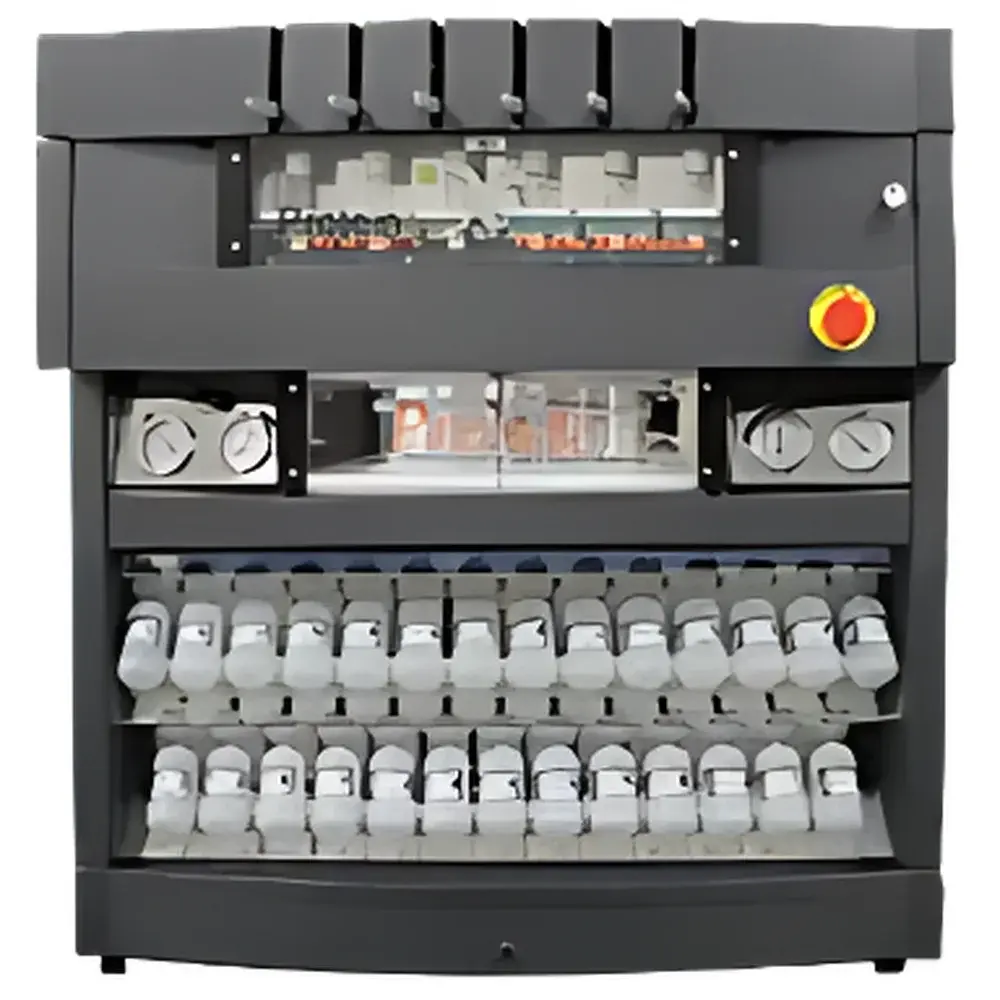
PTI PurePep Chorus / Symphony X / Sonata Automated Peptide Synthesizer
| Brand | PTI |
|---|---|
| Origin | USA |
| Model(s) | PurePep Chorus, Symphony X, Sonata |
| Channel Capacity | 2/4/6 (field-upgradable) |
| Synthesis Scale per Channel | 0.005–1.0 mmol (max. 6.0 mmol total) |
| Reaction Vessel Options | Disposable polypropylene (10/45 mL) or borosilicate glass (10/25/40 mL) |
| Reagent Bottles | 8 positions (standard 1–4 L |
| Amino Acid Positions | 33 (supporting 10/50/120/400 mL bottles) |
| Chemistry Support | Fmoc, t-Boc, organic, peptoid, combinatorial, branched, PNA |
| Pre-activation | On-resin in situ activation |
| Fluid Delivery | Pressure-driven nitrogen gas delivery |
| Mixing Method | Nitrogen sparging + mechanical agitation |
| Heating | Induction-based temperature control |
| Cleavage | Fully automated on-instrument in situ cleavage |
| Waste Container | 20 L with overflow sensor |
| Reporting | Timestamped log files, email alerts, print-ready status/error reports |
| Power | 100–230 VAC, 50/60 Hz |
| Dimensions (W×D×H) | 87.1 × 72.1 × 72.4 cm (34.3 × 28.4 × 28.5 in) |
| Weight | 90.7 kg (200 lbs) |
Overview
The PTI PurePep Chorus, Symphony X, and Sonata series represent a family of benchtop automated peptide synthesizers engineered for reproducible, scalable solid-phase peptide synthesis (SPPS) under controlled laboratory conditions. These instruments implement standard Fmoc- and t-Boc-based coupling chemistries using iterative deprotection–coupling–washing cycles, with precise reagent metering, inert atmosphere maintenance (via nitrogen purging), and real-time process monitoring. Designed for academic core facilities, biopharma process development labs, and contract research organizations (CROs), the platform supports both routine synthesis of research-grade peptides and method development for GMP-aligned workflows. The modular architecture allows channel expansion from 2 to 6 independent synthesis lines—enabling parallel synthesis of multiple sequences or replicates without cross-contamination—while maintaining consistent coupling efficiency and minimal deletion sequence formation.
Key Features
- Modular channel scalability: Field-upgradable from 2 to 6 fully isolated synthesis channels, each with dedicated fluidic pathways and pressure-regulated nitrogen delivery.
- Patented matrix-style liquid handling system: Eliminates shared manifolds; ensures zero carryover between amino acids, reagents, or solvents across all 33 amino acid positions.
- In situ cleavage capability: Integrated cleavage station enables automated TFA-mediated resin cleavage and side-chain deprotection directly within the reaction vessel—reducing manual handling and exposure to hazardous reagents.
- On-resin pre-activation: Coupling reagents (e.g., HBTU, DIC) are mixed with amino acids immediately prior to delivery, minimizing racemization and improving coupling kinetics.
- Induction heating with closed-loop temperature feedback: Maintains precise thermal control (±0.5 °C) across the full operating range (room temperature to 90 °C), critical for difficult couplings and sterically hindered residues.
- Comprehensive chemistry compatibility: Native support for Fmoc/t-Boc strategies, peptoids, pseudopeptides, branched architectures, peptide nucleic acids (PNA), and combinatorial libraries.
Sample Compatibility & Compliance
The synthesizer accommodates a broad range of solid supports—including Wang, Rink amide, 2-chlorotrityl, and Sieber resins—in standard disposable polypropylene or reusable borosilicate glass vessels (10–40 mL). All wetted materials comply with USP Class VI and ISO 10993-5 biocompatibility standards. Instrument operation adheres to GLP principles: full audit trail logging (user ID, timestamp, parameter changes, error events), electronic signature readiness, and exportable CSV/JSON logs compatible with LIMS integration. While not certified as 21 CFR Part 11 compliant out-of-the-box, the software architecture supports validation packages for regulated environments upon customer-requested IQ/OQ/PQ documentation.
Software & Data Management
The embedded control interface provides intuitive sequence entry, step-by-step protocol editing, and real-time monitoring of pressure, temperature, and cycle progress. Each synthesis run generates a timestamped log file containing reagent consumption, coupling times, wash volumes, and detected anomalies. Email notifications can be configured for completion, interruption, or critical fault conditions. Data export supports PDF report generation and structured formats (CSV, XML) for downstream analysis in statistical or QC software. Remote diagnostics via secure HTTPS connection enable vendor-assisted troubleshooting without local network exposure.
Applications
- Synthesis of antigens, epitope mapping peptides, and immunogenic fragments for vaccine development.
- Production of labeled peptides (e.g., isotopically enriched, fluorescently tagged) for structural biology (NMR, cryo-EM) and binding assays.
- High-throughput generation of SAR libraries for early-stage drug discovery targeting GPCRs, kinases, and protein–protein interfaces.
- Manufacturing of reference standards and impurity controls aligned with ICH Q5 and Q7 guidelines.
- Method optimization studies for challenging sequences containing multiple prolines, N-methylated residues, or hydrophobic stretches.
FAQ
What is the maximum length of peptide that can be reliably synthesized on this platform?
Synthesis success depends on sequence composition and scale; however, routine production of 30–50 residue peptides at >75% crude purity is achievable using optimized protocols. Longer sequences (>60 residues) require iterative coupling validation and may benefit from segment condensation strategies.
Can the instrument be validated for use in a GMP environment?
Yes—PTI provides validation documentation templates (IQ/OQ/PQ), traceable calibration records, and software configuration control procedures to support regulatory submissions. Full 21 CFR Part 11 compliance requires site-specific implementation of electronic signature policies and audit trail review workflows.
Is third-party amino acid bottle integration supported?
All 33 amino acid positions accept standard threading caps (e.g., GL45, GL32); custom adapters are available for non-standard containers. Bottle volume detection is manual—no weight-based or level-sensing automation is included.
How is solvent waste managed during extended synthesis runs?
The 20 L waste reservoir includes an optical overflow sensor that halts synthesis and triggers an alert before capacity is reached. Waste lines are chemically resistant (PTFE-lined) and rated for prolonged exposure to DMF, DCM, piperidine, and TFA.
Does the system support real-time monitoring of coupling efficiency?
No in-line analytics (e.g., UV monitoring, conductivity sensing) are integrated. Coupling completeness is inferred from ninhydrin/Kaiser test integration (optional external module) or post-synthesis HPLC/MS analysis.
Related Products