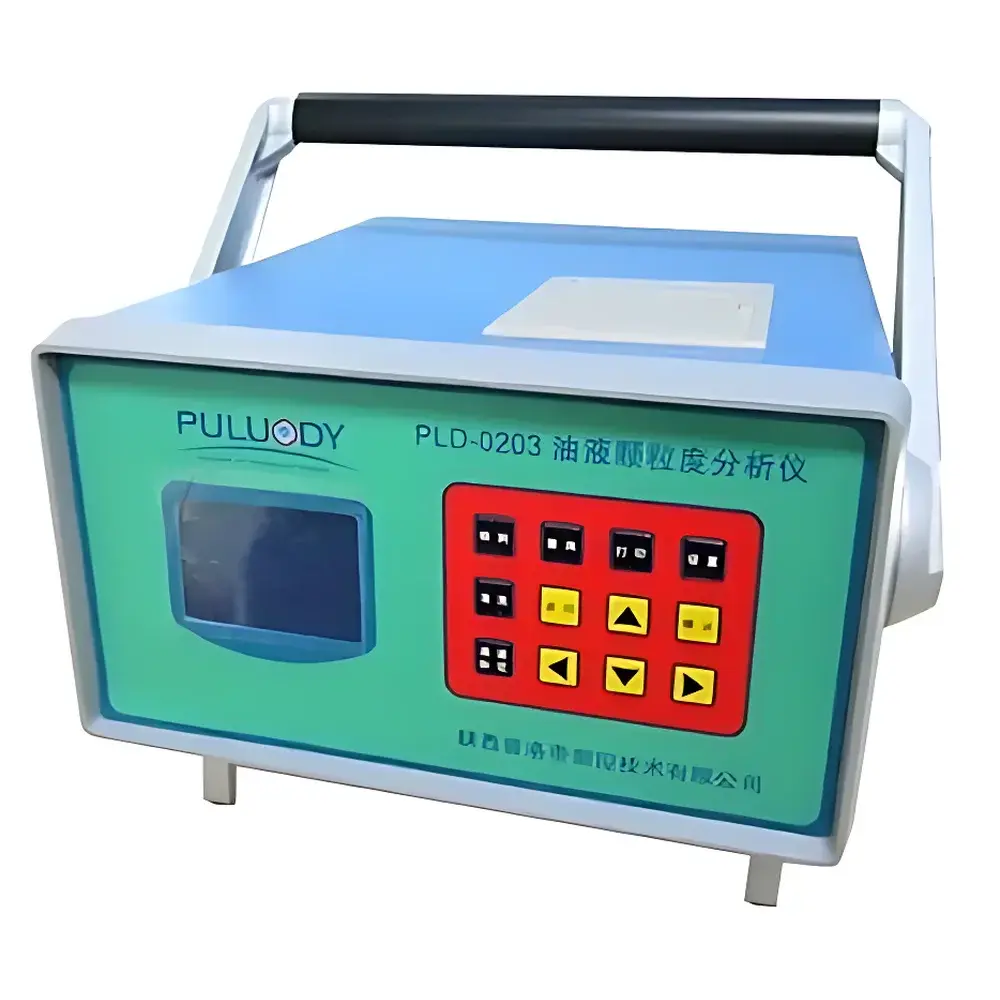
PULUODY PLD-0203-3 Portable Liquid Particle Counter
| Brand | PULUODY |
|---|---|
| Origin | Shaanxi, China |
| Model | PLD-0203-3 |
| Price | USD 27,800 (approx.) |
| Compliance | ISO 4406, NAS 1638, SAE AS4059F, GJB 420B, DL/T 432, GJB 380, ISO 11500 |
| Calibration Standards | JJG 1061, ISO 11171, ASTM F658-87 (PSL), GB/T 18854 |
| Detection Principle | Light Obscuration (LO) |
| Laser Source | 7th-generation dual-laser narrow-beam sensor |
| Measurement Range | 0.03 µm – 3000 µm (configurable sensor modules) |
| Channel Count | Up to 1000 resolution channels |
| Sensitivity | 1 µm (ISO 4402) / 4 µm(c) (ISO 11171, GB/T 18854) |
| Accuracy | < ±3% |
| Sample Volume Precision | ±1% |
| Max. Online Pressure | 31.5 MPa (with pressure regulator) |
| Viscosity Range | Offline ≤99 mm²/s |
| Flow Rate | Sampling 5–60 mL/min |
| Operating Temp. | Sample 20–65°C |
| Power | 220 VAC, 50 Hz, <80 W |
| Data Storage | Up to 6000 test records |
| Output Interfaces | RS232, RS485, USB, 4–20 mA, 0–5 V, MODBUS |
| Regulatory Certification | CALIBRATED by NW National Metrology Center (civil) or CMC Level-1 Particle Metrology Station (defense) |
Overview
The PULUODY PLD-0203-3 Portable Liquid Particle Counter is an engineered solution for in-field and laboratory-based particulate contamination analysis of hydraulic fluids, aviation lubricants, phosphate ester hydraulic oils, jet fuels, and ultra-pure solvents. It operates on the internationally recognized light obscuration (LO) principle—where particles suspended in a liquid stream pass through a focused laser beam, causing transient reductions in detected light intensity proportional to their cross-sectional area. This method enables quantitative, real-time sizing and counting of insoluble particulates across a broad dynamic range—from sub-micron colloidal contaminants to coarse wear debris exceeding 1 mm. Designed for operational readiness in defense logistics, aerospace maintenance depots, power generation facilities, and high-reliability industrial OEMs, the PLD-0203-3 delivers metrologically traceable data compliant with ISO 11500, ISO 4406, and military specifications including GJB 420B and SAE AS4059F. Its modular optical sensor architecture supports mission-specific configuration—enabling precise detection down to 0.03 µm using PSL-traceable calibration spheres per ASTM F658-87.
Key Features
- Seventh-generation dual-laser narrow-beam optical sensor system with temperature-stabilized diode lasers and optimized flow-cell geometry for enhanced signal-to-noise ratio and reduced coincidence error.
- Modular multi-sensor design: Select from 13 interchangeable sensor modules (A–N) covering discrete size ranges—from 0.03–0.10 µm (4-channel ultrafine mode) to 100–2000 µm (10-channel macro-debris mode)—each independently calibrated per ISO 11171 and GB/T 18854.
- 1000-channel high-resolution particle distribution profiling with user-definable binning (up to 16 custom size thresholds per test).
- Integrated industrial PC or ruggedized embedded controller with 10.1-inch capacitive color touchscreen interface supporting multilingual UI (English default), password-protected access levels, and GLP/GMP-compliant audit trail logging.
- Automatic self-cleaning cycle post-analysis using programmable reverse-flow and solvent flush protocols; compatible with common cleaning agents (e.g., isopropyl alcohol, filtered petroleum ether).
- Real-time compliance grading: Direct output of ISO 4406 code (e.g., 18/16/13), NAS 1638 class, or GJB 420B level without manual interpolation.
- Robust mechanical architecture rated for field deployment: IP54 ingress protection, shock-mounted optics, and wide ambient operating range (0–50°C).
Sample Compatibility & Compliance
The PLD-0203-3 accommodates a wide spectrum of challenging fluid matrices without pre-filtration or dilution. Validated applications include aviation turbine oils (MIL-PRF-23699, MIL-PRF-6083), phosphate ester fire-resistant hydraulic fluids (e.g., Skydrol LD-4), JP-5/JP-8 fuels, synthetic gear oils, transformer insulating oil (IEC 60296), deionized water (≥18.2 MΩ·cm), and pharmaceutical-grade water for injection (WFI). All measurements adhere to international standard methodologies: particle counting per ISO 11500 (replacing ISO 4402), calibration traceability to NIST-traceable PSL standards (ASTM F658-87), and volumetric accuracy verified per JJG 1061. For regulated environments—including FDA-regulated pharmaceutical manufacturing and DoD-certified maintenance facilities—the instrument supports 21 CFR Part 11-compliant electronic signatures and full audit trail export when paired with optional P6.4 software license.
Software & Data Management
The bundled P6.4 Analysis & Testing Software (PC Edition) provides comprehensive data acquisition, statistical trending, and regulatory reporting. It supports automated batch testing, multi-instrument fleet synchronization, and customizable report templates aligned with ISO 55000 asset management frameworks. Raw channel data, cumulative/differential histograms, time-series contamination profiles, and pass/fail compliance flags are exportable in CSV, PDF, XML, and SQL-compatible formats. The software includes built-in tools for repeatability assessment (per ISO 4406 Annex B), inter-laboratory comparison studies, and long-term wear debris trend analysis using ISO 4022-based degradation models. All data operations maintain full ALCOA+ principles: attributable, legible, contemporaneous, original, accurate, complete, consistent, enduring, and available.
Applications
- Military and aerospace: On-site verification of hydraulic fluid cleanliness prior to aircraft launch; post-maintenance verification of gearbox oil integrity; corrosion inhibitor efficacy monitoring in fuel systems.
- Power generation: Turbine oil condition monitoring per DL/T 432; detection of catalytic degradation by-products in transformer oil; early warning of bearing wear in hydroelectric governors.
- Heavy equipment OEMs: Validation of filtration efficiency in off-highway machinery; qualification of new lubricant formulations under ASTM D7619.
- Research & development: Nanoparticle dispersion stability studies in functional fluids; quantification of catalyst leaching in synthetic process streams.
- Quality control laboratories: Release testing of purified solvents per USP <788>, EP 2.9.19, and JP 6.06; validation of cleanroom rinse water purity.
FAQ
Does the PLD-0203-3 require sample dilution or filtration prior to analysis?
No—samples are introduced directly into the flow cell without pretreatment, provided viscosity remains within specified limits (≤500 mm²/s online, ≤99 mm²/s offline). High-viscosity samples may be pre-warmed to reduce shear-induced aggregation.
How is calibration traceability maintained for regulatory audits?
Each sensor module is individually calibrated using NIST-traceable PSL reference materials per ASTM F658-87 and ISO 11171. Calibration certificates include uncertainty budgets and are archived in the onboard database with timestamped operator verification logs.
Can the instrument operate continuously in online bypass mode?
Yes—when equipped with the optional high-pressure sampling kit (rated to 31.5 MPa), it supports unattended 24/7 monitoring with programmable sampling intervals, alarm-triggered data capture, and MODBUS RTU integration into SCADA systems.
What documentation is provided for GxP compliance?
Factory-issued IQ/OQ documentation, software validation protocol (SVVP), electronic audit trail configuration guide, and 21 CFR Part 11 implementation checklist are supplied with validated software licenses.
Is remote diagnostics and firmware updates supported?
Yes—via secure HTTPS-enabled web interface or encrypted USB transfer; all updates undergo SHA-256 signature verification and rollback capability.
Related Products