
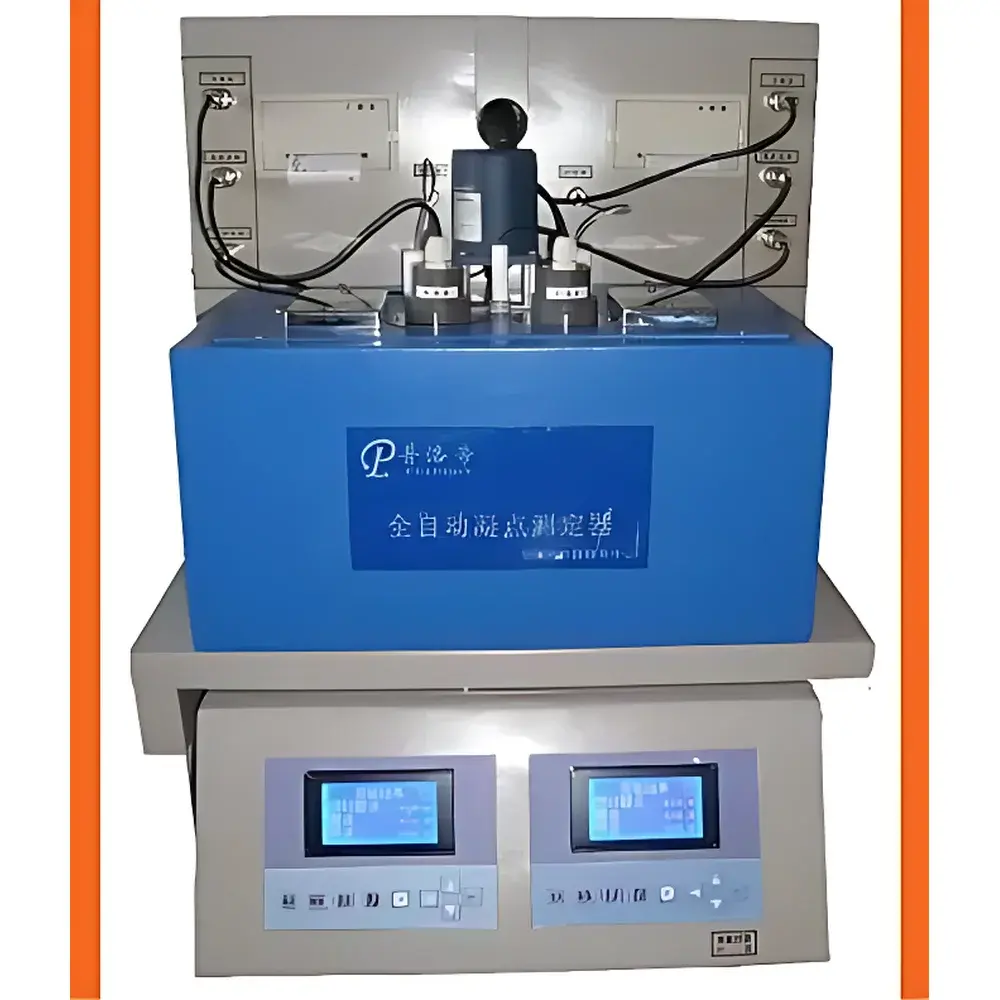
PULUODY PLD-3535D Automatic Pour Point and Cloud Point Tester
| Brand | PULUODY |
|---|---|
| Origin | Shaanxi, China |
| Manufacturer Type | Direct Manufacturer |
| Country of Origin | China |
| Model | PLD-3535D |
| Temperature Range | 60 °C to −38 °C |
| Temperature Resolution | 0.1 °C |
| Sample Channels | 2 |
| Cooling Method | Air-Cooled Compressor System |
| Detection Method | Top-Mounted Photoelectric Liquid-Level Sensor with Micro-Tilt Mechanism |
| Temperature Interval Setting | 1–10 °C (user-defined) |
| Power Supply | AC 220 V ±10%, 50 Hz ±2 Hz |
| Display | 128×64 Dot-Matrix LCD (Chinese Characters) |
| Printer | 20-Column Dot-Matrix Thermal Printer (Chinese Characters) |
| Compliance Standard | GB/T 510 |
Overview
The PULUODY PLD-3535D Automatic Pour Point and Cloud Point Tester is an engineered solution for standardized low-temperature performance evaluation of petroleum products in accordance with GB/T 510—China’s national standard equivalent to ASTM D97 (pour point) and aligned with principles referenced in ISO 3016 and IP 15. It employs a dual-channel, micro-tilt-based detection architecture grounded in optical liquid-level displacement sensing. Unlike conventional manual or semi-automated testers relying on visual observation or fixed-angle tilt protocols, the PLD-3535D implements real-time photoelectric monitoring of meniscus movement during controlled thermal descent. A precision air-cooled compressor system delivers stable, reproducible cooling across the full operational range (60 °C to −38 °C), while integrated PID-regulated heating enables rapid sample recovery between tests without compromising thermal history integrity.
Key Features
- Two independent test channels enable parallel analysis of duplicate samples or comparative testing of dissimilar petroleum products—enhancing throughput and statistical robustness per ASTM D6300 guidelines.
- Top-mounted photoelectric liquid-level sensor detects sub-millimeter meniscus displacement during programmable micro-tilt cycles (0.1°–2° increments), eliminating operator subjectivity and vibration-induced disturbance inherent in benchtop mechanical designs.
- Dynamic tilt control logic halts inclination immediately upon detection of liquid movement, then reverts to vertical orientation—avoiding unnecessary thermal cycling and preserving sample morphology critical for waxy crude or distillate fuel characterization.
- Intelligent cooling management maintains consistent ΔT between coolant bath and sample, ensuring linear, repeatable cooling rates compliant with GB/T 510’s specified 1–1.5 °C/min descent protocol.
- Onboard micro-heater accelerates post-test warm-up (≤3 min from −35 °C to 25 °C), reducing turnaround time without requiring elevated bath temperatures that risk thermal degradation of paraffinic structures.
- Ruggedized industrial enclosure with EMI-shielded electronics and fan-forced heat dissipation ensures stable operation in ambient environments up to 35 °C and 80% RH.
Sample Compatibility & Compliance
The PLD-3535D is validated for use with dark petroleum products—including residual fuels, lubricating oils, crude oils, and middle distillates—as defined in GB/T 510 and ASTM D97 Annex A1. Its dual-path design accommodates standard 34-mL ASTM D97 test tubes (Type A or B) and supports viscosity ranges typical of Group I–III base stocks and blended diesel fractions. All firmware and hardware configurations adhere to GB/T 26575–2011 (General Technical Requirements for Petroleum Testing Instruments) and incorporate fail-safe thermal cutoffs at −40 °C. Data logging meets GLP documentation requirements via timestamped print output and internal memory storage (100 test records), with traceability aligned to ISO/IEC 17025 clause 7.7 on result reporting.
Software & Data Management
Although the PLD-3535D operates via embedded real-time OS (no PC dependency), its 128×64 Chinese-character LCD provides full parameter configuration—including target temperature setpoint, tilt interval, detection sensitivity threshold, and cooling rate offset. All test results—including pour point, cloud point (when adapted per GB/T 255), final tilt angle, and elapsed cooling duration—are stored with date/time stamps and printed via built-in 20-column thermal printer using standardized report formatting. For laboratory integration, optional RS-232 serial interface supports ASCII-formatted data export to LIMS or Excel-compatible spreadsheets, enabling audit-ready record retention per FDA 21 CFR Part 11 principles when paired with institutional electronic signature policies.
Applications
This instrument serves quality control laboratories in refineries, independent testing facilities, and R&D centers focused on cold-flow properties of hydrocarbon streams. Typical use cases include specification verification of winter-grade diesel (EN 590, ASTM D975), pour point optimization of lubricant formulations, wax appearance temperature (WAT) screening in crude assay workflows, and compliance testing for marine fuel (ISO 8217 F-RME/F-DMA). Its reproducibility (±0.5 °C per ASTM D6300 repeatability criteria) makes it suitable for method validation studies and inter-laboratory comparison programs under CNAS accreditation frameworks.
FAQ
Does the PLD-3535D comply with international standards beyond GB/T 510?
Yes—it is functionally aligned with ASTM D97 (pour point), ISO 3016 (petroleum products—determination of pour point), and IP 15, with hardware design satisfying mechanical and thermal stability requirements outlined in ISO/IEC 17025:2017 clause 6.4.
Can the instrument determine cloud point as well as pour point?
While primarily configured for GB/T 510 pour point testing, the micro-tilt + photoelectric detection architecture allows adaptation for cloud point assessment per GB/T 255 or ASTM D2500 when used with appropriate light-scattering accessories and modified tilt logic—subject to user calibration and validation.
Is external PC software required for operation or data retrieval?
No—the device is fully autonomous. All setup, execution, and reporting occur via front-panel interface and built-in printer. RS-232 output is optional and intended only for archival integration.
What maintenance is required for the compressor cooling system?
The air-cooled hermetic compressor requires no routine refrigerant servicing. Annual inspection of condenser coil cleanliness and fan operation is recommended per manufacturer’s maintenance schedule.
How is measurement uncertainty managed during multi-sample runs?
Channel-to-channel thermal uniformity is maintained within ±0.3 °C across the bath volume; each test path includes independent temperature feedback and tilt actuation, minimizing cross-talk and supporting ISO 5725-2 repeatability claims.





